
NEWS / CLIMATE & PUBLIC HEALTH
Europe’s Summer Heat Linked to More Than 50,000 Deaths in Cities
A new analysis estimates a substantial urban heat-mortality toll in summer 2026. Its scope, uncertainty and practical implications matter as much as the headline number.
Summer heat is estimated to have caused 50,391 deaths across 854 European urban areas between June and August 2026, according to research led by Imperial College London and the London School of Hygiene & Tropical Medicine. The analysis attributes about 32,619 of those deaths—roughly 65%—to human-caused warming.
The distinction matters. These are estimates of heat-related mortality, not a list of death certificates recording heatstroke. Nor is the figure a complete count for Europe. The places studied contain almost 173 million people, approximately 40% of the population of the 30 countries covered. The research manuscript puts a 95% empirical confidence interval of 46,026–53,878 around the overall estimate.
For readers, the news is not simply that a very hot summer was dangerous. It is that heat protection needs to work inside ordinary homes and everyday routines, not only during dramatic outdoor emergencies. A warning message is useful only if someone can act on it: reach a cooler place, receive help, or change an exposed activity.
WATCH / ORIGINAL R&R EXPLAINER
The numbers, without losing the context
A 60-second explainer combining our research graphics, Michael narration and original music with four real archival cutaways from California in July 2023. The archive clips provide context, not footage of the European 2026 events.
Archival footage: Voice of America, California, July 2023 · Camera: Vazgen Varzhabetian. Shortened and reframed within an R&R layout; original watermark retained. VOA-produced footage is public domain under its copyright statement. These clips provide heat-adaptation context and do not depict the European 2026 deaths or imply endorsement.
Read the video transcript
Summer heat caused an estimated fifty thousand deaths across the European urban areas studied. This is not a complete count for Europe.
About two thirds of those estimated deaths were attributed to human caused warming. That is part of the total, not additional deaths.
Dates, places and methods matter. Compare like with like, rather than scaling the urban estimate into a new continent wide total.
Before the next hot spell, confirm a cooler place, its opening hours, and how the person will get there.
For someone living alone, agree who checks in, when, and what happens if contact fails. Make the arrangement specific.
Read the full story at Ready and Resourceful. Explore the research, our comparison chart, and practical questions for your household.
What the European heat-death estimate actually covers
The study examines summer conditions in urban areas across the European Union, the United Kingdom, Norway and Switzerland. Its headline period is June 1 to August 31. That boundary matters when comparing the result with numbers for an individual heatwave, a different season or an entire country.
The LSHTM announcement, published October 23, identifies 2026 as the highest estimated summer heat-mortality burden since 2000 within this research framework. It also reports approximately 4,500 deaths across the 135 UK urban areas included, and about 6,000 deaths among people younger than 65 across the full study area. Those figures describe the analysed populations, not every resident of the countries concerned.
Two comparisons should be avoided. First, do not divide the estimate by the population coverage and announce a new continent-wide total. Second, do not compare a city-only summer estimate directly with a nationwide figure for one week and call the difference a contradiction. The geography, dates and method have to match before the numbers answer the same question.
View chart data as a table
| Selected summer | Estimated heat-related deaths |
|---|---|
| 2003 | 28,462 |
| 2022 | 29,480 |
| 2025 | 24,572 |
| 2026 | 50,391 |
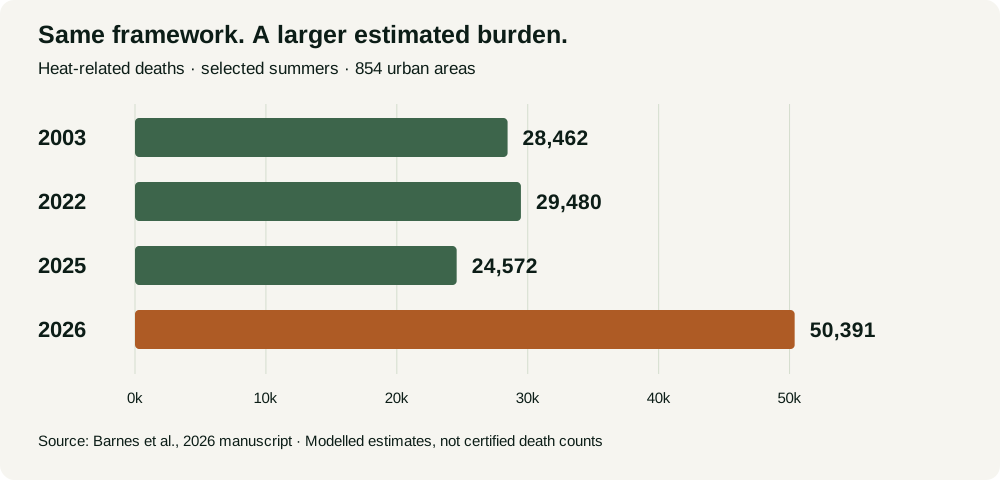
The comparison above uses selected benchmark summers calculated within the same analytical framework. It is not a complete annual time series. Showing every year would require the full yearly dataset; joining these selected values with a continuous line would imply information the graphic does not contain.
How researchers separate heat deaths from the contribution of climate change
The analysis combines temperature information with relationships between temperature and mortality. It compares estimated deaths under the observed climate with a modelled alternative without human-caused warming. The difference is the estimated contribution from climate change. That is different from claiming every heat-related death was caused by climate change, or that heat would be harmless without it.
There are two questions here. How much mortality is associated with the heat experienced? How much of that burden is associated with the warming added by human activity? Keep those questions separate when reading the headline or sharing the numbers. The climate-attributable figure is part of the total, not an additional death toll to add on top.
The related 2000–2025 research in Nature Health provides the longer historical analysis. The contemporary study and the historical paper are related work, not two independent surveys discovering the same deaths. At the time of the initial coverage, the 2026 work was described as accepted for publication; the institutional announcement and public manuscript provide the evidence for the figures discussed here.
Observed climate
Estimate heat-related mortality using the temperatures experienced.
Without human warming
Estimate mortality under a modelled cooler counterfactual.
Compare the estimates
The difference is the estimated climate-attributable contribution.
What the number cannot tell you about your home
A population estimate is not a personal forecast. It cannot tell a reader the temperature in their bedroom, whether a particular medicine needs different storage, or whether an older relative can travel to a cooling location. Those are local and individual questions. Treating a large number as a substitute for those checks would miss the practical point of the news.
Equally, uncertainty does not make the finding meaningless. The central estimate is reported alongside a range rather than as a perfectly counted total. The useful response is to preserve that distinction, not to replace the finding with either an exact-sounding certainty or a claim that nothing is known.
We have deliberately kept the original study's scope beside the main figures. When a statistic travels without its dates and population, it becomes easier to misread. A useful summary retains all three: the estimate, the places studied and the time period. That is a better message to share than a screenshot saying only “Europe deaths.”
Why a heat emergency is not only a heatstroke emergency
Heat can worsen existing illness as well as cause heat exhaustion and heatstroke. The World Health Organization's heat and health guidance explains how difficulty regulating body temperature and shedding heat can increase health risks. This helps explain why a mortality study is broader than a count of obvious collapses outdoors.
For a household, the implication is to plan around the person, not a stereotype of who looks vulnerable. Someone with an existing condition may need a heat action plan with their healthcare team. A family member who lives alone may need an agreed check-in. Neither task requires diagnosing them from a news article.
The CDC advises readers to stay cool, stay hydrated, know overheating symptoms and check on family, friends and neighbours, particularly people with chronic conditions or those living alone. Air conditioning, or access to a place with it, is a practical protective option. In the United States, local health departments and emergency-management agencies can help identify cooling locations.
The useful question is not “Have we bought enough summer equipment?” It is “Can the person actually get the protection we are counting on?” A cooling destination that is closed, inaccessible or unreachable is not a completed arrangement. Confirming it turns a vague intention into something a household can use.
The housing details that deserve attention before the next hot spell
England's official home-overheating checklist identifies features including top-floor flats, limited cross-ventilation, unshaded windows and densely built-up surroundings with little greenery. Its practical measures include shading windows, reducing unnecessary indoor heat and opening windows when outside air is cooler and it is safe to do so.
This is not an instruction to open every window all day. The condition attached to ventilation is important. Nor should a household remove safety restrictions, block exits or assume that a fan makes any indoor temperature acceptable. Follow current local health guidance and the actual conditions, rather than applying a cooling tip without its limits.
Our heatwave home-preparedness guide develops those household decisions in more detail. Despite its El Niño context, this European mortality study does not establish that El Niño caused these deaths. We keep that distinction clear: a link to a relevant preparation resource is not a new attribution finding.
A household response that is specific enough to use
The table below is R&R's planning interpretation of the public-health guidance, not a clinical assessment or a claim that a particular measure eliminates risk. It is designed to expose unfinished arrangements. Write the answer down, assign a person and check the missing detail before the next heat alert.
| Question | A usable answer | What remains unresolved |
|---|---|---|
| Where could we cool down if this room becomes unsuitable? | A named place with confirmed opening hours and access | “Somewhere with air conditioning” |
| How would the person get there? | A transport arrangement agreed with the person providing it | Assuming a relative will be available |
| Who checks on someone living alone? | A named contact, agreed time and follow-up if contact fails | A general family message that nobody owns |
| What depends on electricity? | A list of actual cooling and essential-device dependencies | Treating a charged phone as the whole outage plan |
| Who can answer medicine questions? | The pharmacist or healthcare team, with storage instructions available | Changing doses or storage from an online tip |
Consider a fictional example. A daughter proposes that her mother use the local library during a hot afternoon. Before calling that a plan, they check opening hours, seating and accessibility. They agree who provides transport and when to review the arrangement. If the library is closed on the relevant day, they find out before the mother needs it—not at the door.
Nothing in that example predicts the indoor temperature or certifies safety. Its usefulness is organizational. It replaces an assumption with a confirmed option. Households can use the same approach for a friend, neighbour or relative without needing to turn a research finding into an individual risk calculation.
Power loss changes the cooling question
An outage is not established by this study, and the findings do not predict that the reader's grid will fail. But if your cooling arrangement depends on electricity, power is a dependency worth identifying. The next question is what happens if that arrangement is unavailable, not which device looks reassuring in a shopping list.
Renters can use our apartment power-outage guide to think through building access, communication and essential services. Keep any actual medical-device or refrigerated-medicine questions with the healthcare professional or supplier responsible for them. A generic backup-power suggestion is not a substitute for equipment-specific advice.
For this news article we have not inserted product rankings or buying claims. The immediate value is understanding the finding and resolving a protection gap. Relevant equipment can support an appropriate plan, but an affiliate purchase is not the required first step to responding to this news.
When symptoms make it an emergency rather than a planning task
Confusion, altered mental state, seizures or loss of consciousness during heat exposure can indicate a medical emergency. CDC heat-illness guidance calls for emergency medical care for suspected heatstroke, moving the person to a cool or shaded area and beginning rapid cooling while help is coming. Do not wait for an article or thermometer reading to give permission to seek help.
Call the local emergency number—911 in the United States, 112 across the EU, and 999 or 112 in the UK—and follow the dispatcher's instructions. Stay with the person. The same CDC guidance notes that heatstroke can involve either dry skin or profuse sweating; sweating does not rule it out.
This is the boundary between a household organization exercise and urgent care. A check-in schedule is useful before a crisis. Once someone is seriously unwell, the priority is emergency assistance and cooling, not finishing a checklist or researching the continent-wide death count.
What to watch next
The next important developments are not limited to a revised headline number. Watch for comparable mortality updates, clear explanations of geographic coverage, and evidence of protection reaching the people who need it. A change in an estimate should be read with its method and population, not treated automatically as proof that an earlier figure was dishonest.
At policy level, the WHO's June 2026 heat–health action-plan guidance connects warnings with responsibilities, healthcare resilience, reduced exposure and evaluation. That is a more useful standard than counting how many warnings were issued. The question for public services is whether communication leads to practical protection, and whether the response is checked and improved.
For readers, the immediate next step can be small and concrete. Confirm one cooler destination. Agree one check-in. Ask one unanswered medicine or care question. The European estimate is large; the household decisions it highlights are specific. Keeping both scales visible makes the news more useful than either a frightening total without context or a list of tips without the evidence behind them.
Reporting notes and primary references
Reporting method, visual provenance and source links
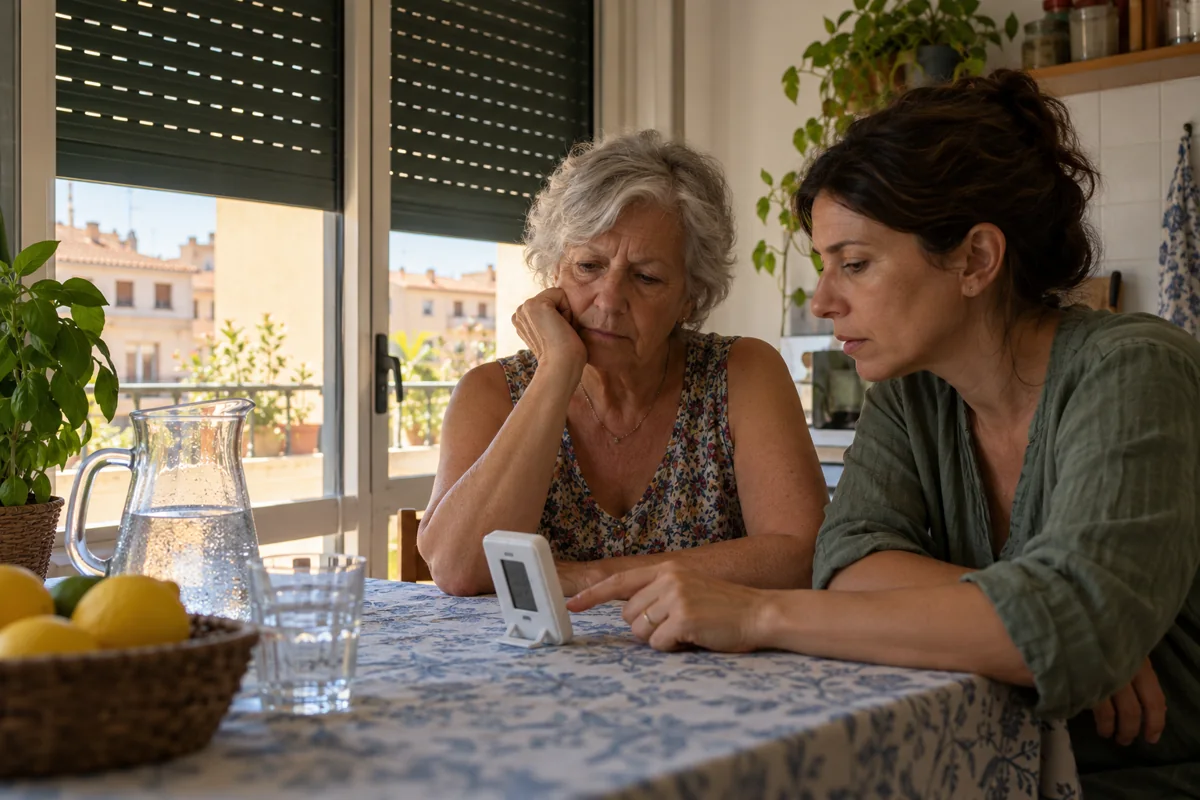
Ready & Resourceful reviewed the public manuscript, institutional announcement and linked health guidance on October 26, 2026. This is a source-based news explainer, not eyewitness reporting, an original mortality study or a clinical review. Figures are modelled estimates. Our charts, decision table and video are original explanatory presentations, not independent measurements. The household scene is illustrative, not a photograph from the reported heatwaves.
The CNN story supplied the starting topic; the findings above were checked against the research and primary guidance. The comparison graphic uses the same-study benchmark estimates rather than mixing country-wide and city-only counts. No search-volume, ranking, traffic or treatment-outcome claims are made.