
A sewage backup in the basement can turn an ordinary bathroom decision into a household emergency. The first question is not which cleaner to buy. It is whether people can stay out of the affected area, whether electricity creates a danger and whether using another fixture will add more wastewater to the problem.
This guide gives you a practical order of operations for a suspected sewer backup, including one discovered during heavy rain, flooding or a power outage. Start with the immediate actions, then use the call sheet to separate observations from a professional diagnosis. You do not need to identify the exact pipe failure before protecting your household.
Sewage backup in basement: what to do first
Stop flushing and pause water-using appliances while the wastewater problem is assessed. Keep people and pets away from the affected area. Do not enter standing water to reach electrical equipment. Contact the responsible plumber, building manager or wastewater utility, and arrange a usable bathroom elsewhere if drainage is unavailable.
If someone is injured, there is an immediate electrical danger or you suspect a gas leak, leave the hazardous area and contact emergency services. CDC's flooded-home guidance explains that electrical isolation must be approached from a dry location; if that is impossible, an electrician should handle it. Cleanup can wait until entry is safe.

A first-response checklist you can actually follow
- Keep children, other household members and pets out of the affected basement.
- Stop test flushes, laundry, showers and dishwasher use pending instructions.
- Check whether you can leave and make calls without entering contaminated water.
- Report what you can see from a safe location, including active inflow and affected fixtures.
- Notify building management if you rent or share the wastewater system.
- Arrange a confirmed working toilet and clean handwashing supplies.
- Record the time, contacts, instructions and photographs obtainable without exposure.
- Ask who will confirm safe entry, cleanup completion and normal wastewater use.
Treat this as a coordination checklist, not permission to enter the basement. A phone, a dry observation point and the right contact are more useful at this stage than an improvised cleanup kit. The aim is to prevent further exposure while the people responsible assess the cause and the next steps.
Separate a sewage backup from other basement water
Rainwater entering around a wall, water from a broken supply pipe and wastewater emerging through a drain need different investigations. A puddle's color alone cannot establish its source or cleanliness. Tell the responder where water appeared and what was happening beforehand instead of deciding that it is harmless because it looks clear.
CDC's floodwater guidance warns that floodwater can contain sewage, chemicals and physical hazards. Staying out of it is the simplest way to avoid exposure. Do not wade in to smell the drain, collect a sample or move stored boxes for a better view.
Use three labels in your notes: observed, reported and unconfirmed. “Water appeared around the floor drain at 7:10” is an observation. “The neighbor reports a street backup” is a report. “Our sewer pipe is broken” remains unconfirmed until someone qualified establishes it. This distinction makes the first call clearer and prevents a rumor from becoming the household's repair plan.
Why the upstairs toilet is not automatically a workaround
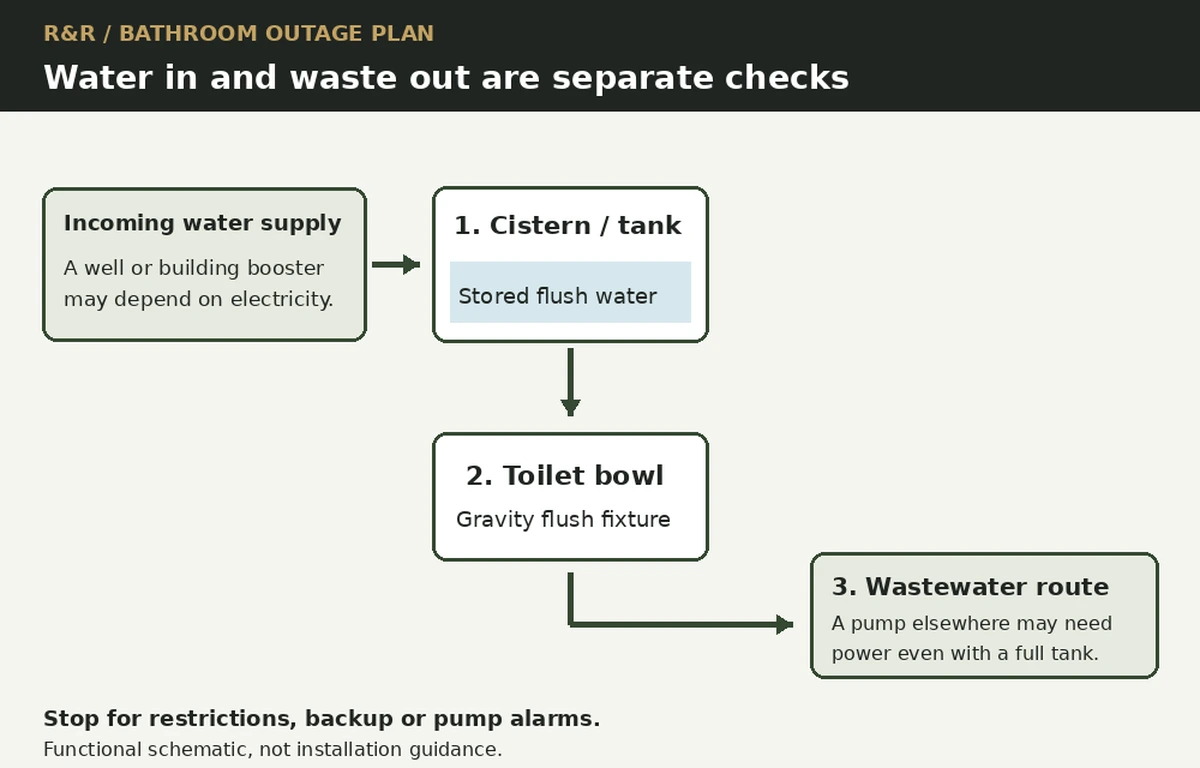
A toilet can have a full cistern while the wastewater route is unavailable. Using an upstairs fixture may still send waste toward the same affected system. The important issue is where the discharge goes, not simply which bathroom looks dry. Pause use until the responsible person confirms what remains usable.
Our primary guide to flushing a toilet during a power outage separates the fixture, incoming water and wastewater removal. It is the right companion when a blackout complicates the backup. A gravity toilet does not require household electricity for its basic flush, but an ejector or other pump elsewhere can introduce an electrical dependency.
Do not pour a bucket into the bowl to investigate a suspected backup. Manual flushing addresses missing incoming water in a suitable toilet with usable drainage; it does not fix unavailable drainage. Keep the manual-flushing instructions for the appropriate supply-only situation, after the wastewater question has been resolved.
Make the first call specific
Tell the plumber or utility where the backup is, whether inflow continues, which fixtures appear affected and whether there has been heavy rain, a power loss or an official notice. Mention that you have stopped water use. If you rent, give management the same concise account rather than starting several conflicting conversations.
Ask which service should respond first and what you should do while waiting. A household plumber, public wastewater utility and building maintenance team have different responsibilities. Do not assume a national guide can assign liability for your particular connection. If one contact refers you elsewhere, record the new contact and the instruction given.
An effective call sounds like this: “Water is coming up around the basement floor drain. We are staying out and have stopped flushing. The power is off, and we do not know whether this bathroom uses a pump. Who should assess this, and which fixtures must remain unused?” That is a proposed script, not a diagnosis.
Keep one incident record instead of scattered messages
| Record | Useful detail | Avoid substituting |
|---|---|---|
| First observation | Time, location and visible change | A guessed pipe diagnosis |
| Current water use | Fixtures and appliances paused | A promise that every pipe is isolated |
| Official instruction | Contact, time and exact direction | A neighborhood rumor |
| Access condition | Dry observation point or unavailable access | A risky inspection for better photographs |
| Bathroom fallback | Confirmed location and assistance needs | A facility that might be open |
| Next decision | Person responsible and question outstanding | An assumed restoration deadline |
Keep this record somewhere dry and accessible. If another household member takes over, they should be able to continue the conversation without reconstructing it from a group chat. A single sheet also helps you separate the household's immediate arrangement from a contractor's later repair findings.
Heavy rain, flooding and septic systems
Heavy rain can coincide with a backup, but timing alone does not prove its cause. Report the weather and any public advisory without assuming that every home has the same sewer arrangement. For septic properties, the condition of the tank, drainage field and any pumping equipment requires a system-specific assessment.
EPA's guidance for septic systems after flooding warns against pumping a tank while surrounding conditions remain flooded or saturated. It also directs homeowners toward professional inspection where damage is suspected. Do not use a general basement guide to open a tank, enter a chamber or improvise servicing instructions.
The useful preparation task is identifying the system and keeping its maintenance contact. Record whether the home connects to a public sewer or an onsite system, where the existing records are and which professional normally maintains it. If those details are unknown during the incident, say so. A truthful gap is easier to resolve than an incorrect assumption.
During a power outage, check wastewater equipment separately
If the incident begins during a blackout, make the power loss part of the first call. King County's septic outage guidance explains that electrically dependent septic components can stop working and continued normal water use can cause backups. Its equipment procedures are not universal instructions for other properties.
Do not repeatedly flush to determine how much reserve capacity remains. Do not assume that a lit room means every wastewater component has restarted. Ask the system maintainer or building manager what needs confirming before use resumes. Keep the answer with the current incident record.
The bathroom outage household plan gives you a place for these details. It separates supply and wastewater arrangements, includes contacts and leaves room for an alternative toilet. The document is free and contains no product links; filling it out cannot replace assessment of an active backup.
Arrange sanitation outside the affected area
First look for a confirmed working toilet that household members can reach and use. A friend, building facility or temporary service can be an option only if access and availability are confirmed. Include transport, stairs, operating hours and assistance needs in that decision. “We will find somewhere later” is not yet a workable arrangement.
If a temporary collection option is necessary, plan privacy, hand hygiene, suitable supplies and locally permitted waste handling together. PublicAlerts' emergency toilet resources explain that the appropriate method depends on local conditions and access, and that public agencies provide disposal instructions. Do not assume a shared garbage chute accepts toilet waste.
Our apartment emergency toilet guide helps organize those choices. Keep the fallback away from the affected basement and make its location clear to everyone. Buying a portable toilet is only one possible component; the arrangement must also work for the intended user and the actual duration of the interruption.
What sewage cleanup involves after access is safe
There are two separate jobs: correcting the wastewater problem and addressing contamination and water damage. A cleared drain does not automatically establish that affected materials are clean and dry. Ask the professionals to explain both scopes so that the household knows which task has been completed and which remains outstanding.
EPA's flooded-home guidance covers safe reentry, removing damaged materials, cleaning and drying. It notes that basement cleanup may be too dangerous or difficult for a household to undertake alone. Use the assessment to decide who should perform the work rather than treating ordinary cleaning supplies as a complete response.
Ask practical questions before work starts: which rooms are included, which belongings need assessment, where waste goes and how unaffected areas will be protected. Ask who handles electrical assessment and who documents completion. These are coordination questions you can ask without entering the affected space or claiming technical cleanup expertise.
Protect the unaffected part of the home
Do not carry wet boxes, shoes or cleanup equipment into the household's dry living area simply to make the basement look organized. Identify an unaffected place for drinking water, food, medicines and your incident notes. Keep access to it separate from the affected area while you obtain the responder's instructions.
If anyone has contacted contaminated water, follow CDC's exposure guidance: wash exposed skin with soap and clean water and obtain medical attention where needed, especially for contaminated wounds. Give the clinician an accurate account of the exposure; do not try to diagnose illness from an online checklist.
Arrange assistance for anyone who cannot safely remain at the property. That may mean a temporary destination rather than a more elaborate indoor workaround. Keep the destination and the person coordinating it in the same record as the bathroom plan, so household members are not making separate assumptions about where everyone will stay.
Photographs, insurance and repair documents
Document what is visible from a safe position and contact your insurer promptly. EPA's flooded-home guidance recommends photographs and insurer contact before cleanup activities. Do not delay necessary emergency action or enter contaminated water for a better picture. Explain any limits on access and ask what documentation can be provided later by the responding professionals.
Keep the date, descriptions, receipts, service findings and communications together. Ask your insurer how it treats the particular cause and which documents it requires. Avoid assuming coverage because a policy uses the word “water.” NFIP explains that sewer-backup coverage depends on whether the damage directly results from flooding.
A useful request is: “Please identify the relevant coverage and the evidence needed for this event.” That is more precise than asking whether every basement incident is covered. This guide does not interpret your contract or assign repair responsibility. Preserve the written answers so that a later conversation can refer to the same facts.
A fictional example: two calls and one bathroom plan
Imagine a household finding water around a basement drain after overnight rain. They remain at the dry stair landing, stop water-using appliances and keep everyone upstairs while making calls. One person contacts the property manager; another records observations and checks whether a nearby relative can provide a working bathroom.
They do not know whether the basement fixture uses an ejector. They mark that question unconfirmed rather than flushing upstairs to test it. Management arranges an assessment and supplies a current restriction. The household writes it down, confirms the temporary bathroom's availability and waits for the relevant professional's instructions about entry and restoration.
This is a planning example, not a reported event or a repair sequence. Its value is the division of tasks: someone manages contacts, someone keeps the record and someone confirms the household fallback. That approach prevents uncertainty about a pipe from becoming uncertainty about what everyone should do next.
After the incident, make the next response easier
Keep the professional findings with your property records. Ask whether any maintenance or prevention measure is recommended for the actual cause, and who should perform it. Do not buy a backwater valve or alter drainage because it appears on a generic equipment list; suitability, installation and maintenance need property-specific advice.
Review the small gaps that slowed the household down. Perhaps the after-hours number was missing, the flashlight was stored downstairs or nobody knew the wastewater arrangement. Correct those gaps first. If drinking water was also affected, use the water-shutoff checklist to organize the separate supply question.
Questions about a sewer backup in the basement
Can I keep flushing a toilet on another floor?
Do not assume so. It may discharge into the same affected system. Pause use and obtain the responsible professional or building manager's instruction. The toilet power-outage decision guide explains why a full cistern and usable wastewater route are separate checks.
Can I use a household wet vacuum to clean it up?
Do not enter a potentially contaminated or electrically hazardous area to try household equipment. Ask the cleanup professional what assessment, removal and contamination controls the incident needs. A machine that removes visible liquid does not establish safe access or complete remediation.
Does a sewer backup always mean a public sewer failed?
No conclusion should be drawn from location alone. Report observations and ask the plumber, utility or building team to determine the source and responsibility. Record their findings separately from your initial description.
What is the most useful thing to prepare now?
Keep the wastewater contact, system information, battery light and a realistic alternative toilet plan together. Start with the free bathroom outage household plan, then resolve unknown answers before an emergency interrupts the conversation.