
NEWS / U.S. ENERGY & INFRASTRUCTURE
Electricity Bills and Data Centers Become a Post-Election Battleground
The election changes political leverage. Utility filings and regulatory decisions will determine whether—and how—households see an effect.
The fight over America’s electricity bills is moving into a new political phase after Democrats’ congressional victories, with data-center expansion and the cost of powering it emerging as issues to watch. But the election result does not automatically lower a utility rate—or establish that a nearby server facility caused a particular household’s higher bill.
Reuters reported on November 4 that Democrats won both chambers of Congress and that the outcome could bring greater scrutiny of data-center energy use and protections for utility customers. The new Congress takes office in January. Legislative outcomes remain uncertain, and President Donald Trump retains the presidency. Reuters’ energy-policy assessment describes possible changes, not a package of measures already in force.
What households need to know
- The political development: A change in congressional control could reshape energy oversight and negotiations.
- The household question: Who pays for new infrastructure serving very large electricity customers?
- The existing process: Federal grid proceedings were underway before the election.
- The limit: A national headline cannot establish why your individual bill changed.
- The next evidence: Utility filings, regulator decisions, cost-allocation rules and effective dates.
The dispute is about costs as well as electricity demand
For the broader context beyond rates, our AI environmental-impact explainer separates electricity demand, water use, emissions and neighborhood noise.
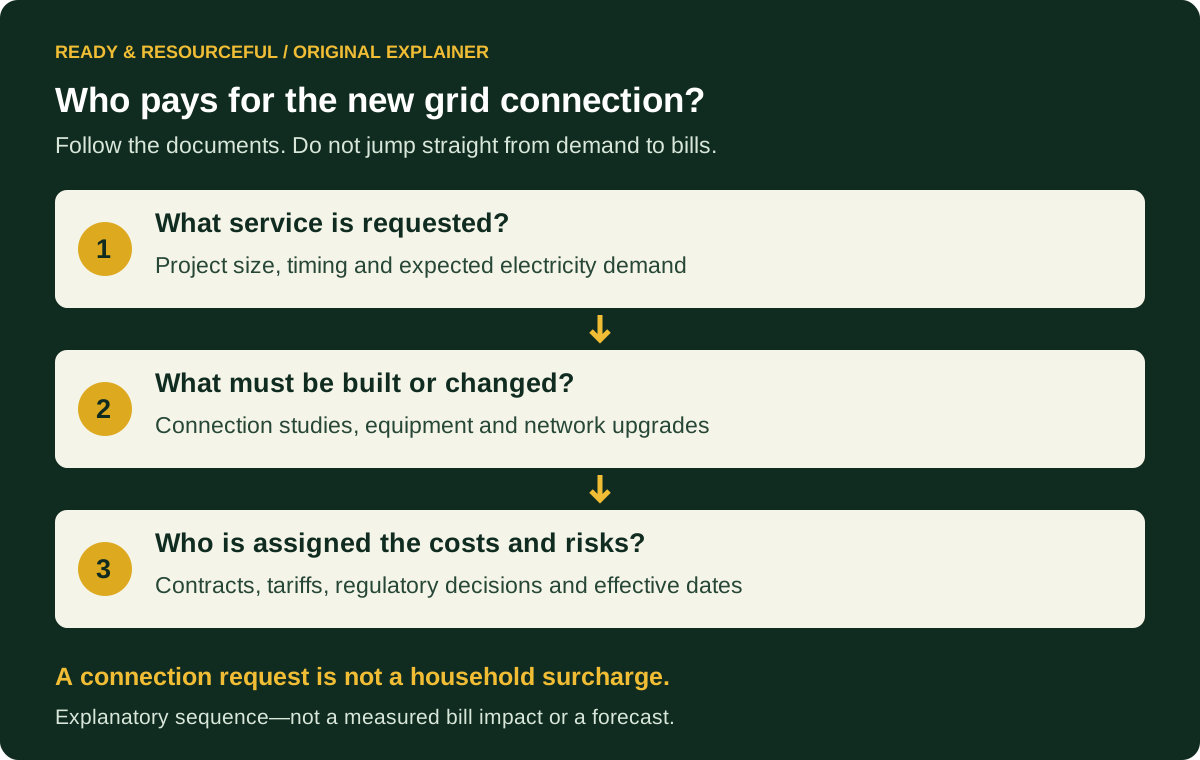
A large customer can require more than the electricity it buys each day. Connecting it may involve construction, equipment and system planning. The central consumer question is how those costs and risks are divided between the project and other users.
The Department of Energy’s technical brief on large-load electricity rates, published in January 2025, identifies both opportunities and challenges from data-center growth. Its concerns include unfair cost shifting, investments left underused, adequacy risks when demand exceeds supply and the different service requirements of large customers.
That framing allows for more than one outcome. A project could contribute toward needed infrastructure under a carefully designed agreement. A poorly structured arrangement could leave others exposed if a customer’s expected demand fails to materialize. Simply counting proposed data centers does not tell a household which outcome its utility has arranged.
The useful distinction is between electricity consumption, the infrastructure needed to serve it and the rules assigning the resulting bill. Treating all three as one number makes political claims harder to check.
Congress is one actor, not the household rate setter everywhere
The election creates a possible route to changed legislation and oversight. It does not collapse the separate roles of utilities, grid operators and regulators into a single congressional decision.
| Decision or document | Where to look | What it can establish |
|---|---|---|
| A proposed federal law or congressional investigation | Congress and the relevant committee | The proposal, scope and legislative stage—not an automatic change to your account. |
| Regional transmission service rules | FERC and the relevant regional grid proceeding | Terms governing grid service and associated federal regulatory decisions. |
| Retail cost allocation and regulated utility rates | The applicable state utility commission | How approved costs are assigned to customer classes and when a rate takes effect. |
| Your actual account charge | Your tariff, bill and utility explanation | Which rate schedule, usage and line items were applied to you. |
FERC regulates interstate electricity transmission and aspects of wholesale markets. Its June 18 large-load announcement directed six regional grid operators to justify or revise relevant tariffs. Among the issues were cost transparency, protection against cost shifting and service arrangements for large customers with flexible demand.
The operators named were PJM, MISO, SPP, CAISO, ISO New England and NYISO. This particular process should not be described as a uniform retail-rate order covering every American household.
The next concrete dates are in a process that predates the vote
FERC’s Office of Public Participation says responses in the large-load proceedings are now due November 16, 2026, for five operators and November 20 for SPP. Its educational explanation says the show-cause orders are preliminary: they do not themselves impose new transmission rates or make final findings.
The same explanation distinguishes federal transmission decisions from state decisions assigning transmission costs to retail customers. It also describes possible safeguards, including clearer upgrade-cost information and cost-recovery agreements. The office identifies this as educational guidance, not legal advice or an official statement of the Commission’s views.
| Date | Development | How to read it |
|---|---|---|
| June 18, 2026 | FERC launched the regional tariff proceedings. | The regulatory work began before the midterm outcome. |
| November 3–4 | Voting and reporting established a change in congressional control. | A political result is separate from a completed rate decision. |
| November 16 and 20 | Current regional response deadlines identified by FERC’s participation office. | Filings are the next evidence to examine, not guaranteed approval dates. |
| January 2027 | The new Congress takes office. | Future proposals still require the applicable decision-making process. |
A higher bill does not identify its own cause
The U.S. Energy Information Administration identifies fuel, power-plant expenses, transmission and distribution, weather and regulation among the factors affecting electricity prices. The mix differs by location. Higher household consumption can also raise the amount due without a higher per-unit rate.
Start with three comparisons: kilowatt-hours used, the number of billing days and the applicable charges. Check whether the reading was actual or estimated and whether the statement includes an adjustment or a past balance. Then examine a local rate notice for a documented change. A social-media claim about nationwide bills cannot substitute for those account details.
An example that separates usage from price
These are invented round numbers for explanation, not observed utility prices or a forecast. Assume a flat energy charge and an unchanged $15 fixed charge, with no taxes or other fees.
- Starting bill: 800 kWh × $0.15 + $15 = $135.
- Usage increases: 1,000 kWh × $0.15 + $15 = $165.
- Rate increases instead: 800 kWh × $0.18 + $15 = $159.
Both alternatives produce a larger bill. Only the second involves a changed energy rate. Neither calculation identifies a data center as the cause.
Real tariffs can include tiers, time-of-use periods, riders and other charges. The example is deliberately simple: its purpose is to show why a bill total alone is insufficient evidence.
Five questions that make a data-center cost claim testable
When a utility, candidate, campaign group or project developer discusses residential impacts, ask for the document behind the statement:
- Which utility and which proceeding? Record the docket number and the customer classes involved.
- What is proposed, and what is already approved? Keep a requested increase separate from a regulator’s decision.
- What costs are assigned to the large customer? Look for an explanation of construction payments and ongoing obligations.
- What happens if the project shrinks or never opens? Ask who carries the remaining financial exposure.
- When would households actually pay? Find the effective date and the residential bill-impact calculation, including its assumed usage.
These questions provide a more useful basis for local coverage than a blanket claim that every data center either raises or lowers bills. They also make room to compare a company’s promise with the terms ultimately approved.
Household resilience is a separate decision from the political forecast
A rate debate is not an outage warning. Buying backup equipment solely because an election changed congressional control confuses two different risks: the cost of routine service and the ability to keep essential devices running when service is interrupted.
For readers already planning backup power, our refrigerator power-station sizing guide and calculator separates starting watts from stored energy. Our apartment power-outage plan covers practical preparations, while the power-outage food-safety guide addresses a different household question: what remains safe when cooling stops.
The immediate news is a change in political leverage. The evidence that will reveal a household impact comes next—in legislation, regional filings, state decisions and the terms on an actual utility bill.
Watch the short explanation
Read the video transcript
The election changes political power, but it does not automatically change your electricity rate. The household question is who pays for the grid infrastructure needed by very large customers.
Data centers need electricity and connections. The important details are in the agreements: which costs the project pays, and what happens if its expected demand never arrives.
Federal grid proceedings were underway before the vote. Regional filings, state rate decisions and effective dates will provide more useful evidence than a campaign promise alone.
Compare your kilowatt hours, billing days and charges. A higher total can come from using more electricity, even if the rate stays the same. Read the source linked report at Ready Resourceful dot com.
Sources and reporting notes
This is a source-based news explainer, not on-site reporting or a forecast of utility rates. Election context comes from Reuters; grid-process details were checked against FERC materials, with broader rate-design and price context from DOE and EIA. We have not calculated a national data-center surcharge or verified an individual utility’s household impact in this report. Information checked November 5, 2026.
- Reuters, November 4: how the election could affect energy policy
- FERC, June 18: six regional large-load proceedings
- FERC Office of Public Participation: cost transparency, current deadlines and consumer protection
- Department of Energy: electricity rate design for large loads
- EIA: factors affecting electricity prices
- Pexels: transmission-tower footage
- Pexels: server footage
- Pexels reuse license