
PREPAREDNESS / REFRIGERATOR BACKUP
What Size Portable Power Station Do You Need to Run a Refrigerator?
Find the startup watts, measure daily energy and calculate the battery capacity you need—without confusing a big output rating with all-day backup.
THE SHORT ANSWER
Check watts to start it. Check watt-hours to keep it cold.
Choose a portable power station that meets your refrigerator’s continuous and startup power requirements, then size its battery for the hours you need. There is no universal “fridge size” battery. In our worked example, a refrigerator using 1.5 kWh per day needs about 2,250Wh of nominal battery capacity for 24 hours, including 90% usable battery, 85% conversion efficiency and 8W inverter overhead. Those are adjustable planning assumptions, not a product test.
Calculate your refrigerator backup size · Check startup compatibility first
WATCH / R&R EXPLAINER
Why a 1,000W station is not a 1,000Wh promise
A narrated explanation with moving household footage and original animated sizing graphics. The example numbers illustrate the calculation; they are not measured performance.
Read the transcript and media credits
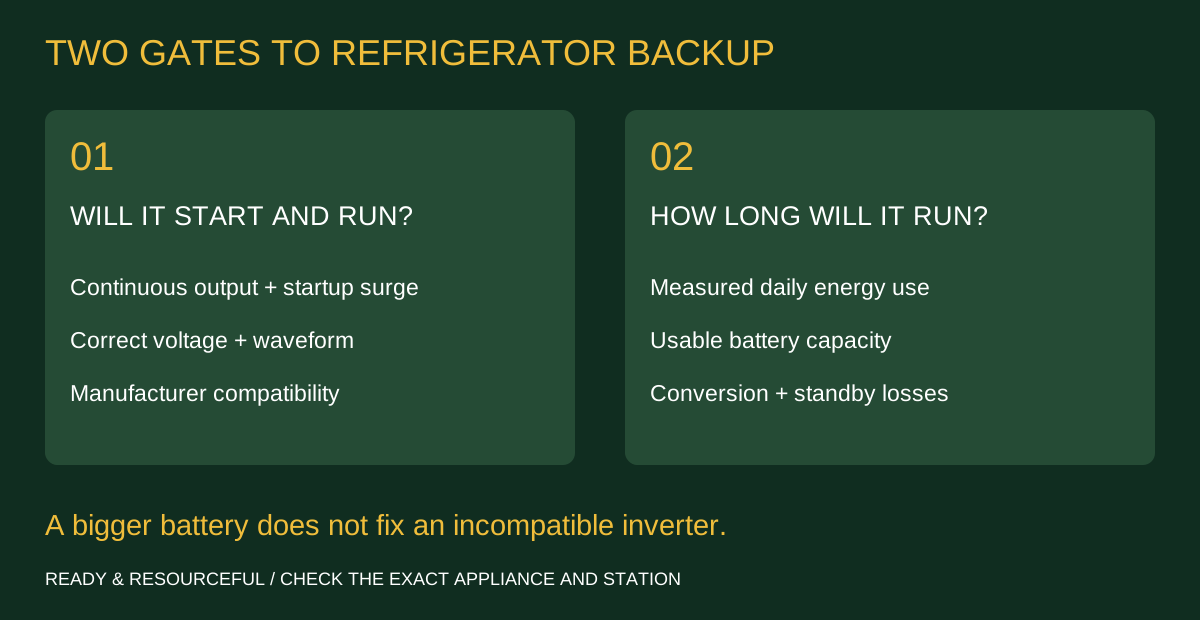
A refrigerator backup needs two separate checks. Watts tell you whether the power station can start and run the appliance. Watt hours help estimate how long it can keep running.
Measure your refrigerator over representative days, including compressor cycles and defrost. A single reading while the compressor is off cannot tell you the daily energy demand.
Suppose your fridge uses one point five kilowatt hours per day. That is sixty two point five watts on average. With conversion losses and inverter overhead, our example draws about eighty two watts from the battery.
A two thousand watt hour battery, at ninety percent usable capacity, gives about twenty two hours in this example. For twenty four hours, the calculated size is roughly twenty two hundred watt hours, before an extra uncertainty margin.
Battery size does not verify compressor startup. Check the exact refrigerator and power station manuals, including surge duration, voltage, low load shutdown and restart behavior.
Keep the setup dry and ventilated. Never feed a wall outlet. Monitor refrigerator temperature, not only battery percentage. Use the calculator and food safety links at Ready Resourceful dot com.
Original R&R edit, animated graphics and synthetic narration. Household footage: Pexels refrigerator scene and Pexels kitchen scene, used under the Pexels license. Illustrative scenes, not equipment testing.
A refrigerator can look like an easy backup load. Plug it into a battery, see a modest number on the display and assume the groceries are covered until tomorrow. Then the compressor restarts, the inverter shuts off, or the remaining-hours estimate drops sharply.
The useful approach is to answer two separate questions: Will this power station operate my refrigerator reliably? And how long can it supply the energy my refrigerator actually uses? This guide answers both, with calculations you can check and inputs you can replace.
It covers plug-in household refrigerators, refrigerator-freezers and small compressor fridges. It does not size clinical cold-storage equipment, provide a medication-storage protocol or certify a home electrical installation.
How many watts does a refrigerator need to start?
A compressor can briefly demand more power when starting than while running. That short demand is why a station can have ample stored energy and still fail to start the refrigerator. Jackery’s support guidance explicitly separates rated power from startup demand and warns that motor loads can trip protection.
Do not apply a fixed surge multiplier to every refrigerator. Compressor design, controls and operating conditions differ. Ask the appliance manufacturer for startup requirements and the power-station manufacturer to confirm compatibility with that load. A peak claim without a supported duration is incomplete information.
| Number to check | What it answers | Common mistake |
|---|---|---|
| Continuous AC output, W | Can the inverter sustain the simultaneous load? | Ignoring defrost or other connected appliances |
| Surge output and duration | Can it handle compressor startup? | Treating a momentary marketing peak as guaranteed motor compatibility |
| Battery capacity, Wh | How much energy is stored? | Assuming 2,000W means 2,000Wh |
| Voltage, frequency and waveform | Does the output match the appliance? | Buying a different regional version |
A hypothetical fridge might draw 150W while its compressor runs and require a brief 900W startup. A 600W inverter with a compatible, sufficiently long surge rating might start it; a 600W inverter without that capability might not. Neither result can be established from battery capacity alone. These numbers illustrate the check, rather than describe your appliance.
Choose the correct regional AC output—typically 120V/60Hz for U.S. appliances and the appliance-specified supply elsewhere. Seek manufacturer-approved waveform compatibility, commonly pure sine wave for this use. Voltage-reduction “boost” modes should not substitute for explicit compressor-load approval.
Find your refrigerator’s daily energy use before buying a battery
The best starting input is measured kilowatt-hours over representative days. A compatible plug-in electricity monitor can record energy while the compressor cycles, the door opens and defrost occurs. Read the meter and appliance instructions and use a monitor rated for the appliance. Do not dismantle an outlet or probe live wiring to obtain a number.
Record the duration as well as the energy. If the refrigerator uses 2.4kWh over 48 hours, the average is 1.2kWh per day. One reading taken while the compressor is idle is not useful for battery sizing. Include normal household use, and recognize that a warmer room or repeated door opening during an outage can increase demand.
If you cannot measure yet, use the annual kWh figure from the EnergyGuide label or an official model listing as a preliminary estimate. Divide annual kWh by 365. For example, 547.5kWh/year ÷ 365 = 1.5kWh/day. Standardized energy-label conditions will not reproduce every home or season. The PNNL emergency refrigeration guide explains both label-based estimates and plug-in measurement.
Why the amperage label is not a daily-energy measurement
Multiplying volts by amps gives volt-amperes. It does not automatically establish true watts for an AC motor, and it cannot tell you how many hours the compressor operates. The label remains important for electrical compatibility, but do not turn a maximum electrical rating into a 24-hour energy budget.
What if all you know is compressor running watts?
Use the calculator’s cycling mode as a rough scenario. Multiply compressor running watts by the fraction of time it runs, then add any average auxiliary load. A 150W compressor at a hypothetical 40% duty cycle averages 60W before other loads. Do not assume that every refrigerator runs one-third or one-half of the time. Defrost heaters, fans and controls can make that simple model incomplete.
INTERACTIVE / ORIGINAL R&R TOOL
Refrigerator power-station runtime calculator
Estimate hours from a battery you own, or nominal battery capacity for your target outage. The tool runs in your browser and does not send your entries anywhere.
Defaults are adjustable assumptions, not industry guarantees. Usable fraction includes charge level/reserve and battery availability; conversion efficiency covers the variable AC energy conversion; overhead is a separate battery-side drain. If your measured usable AC-capacity figure already includes inverter losses, do not subtract them a second time. Startup compatibility must be checked separately.
The formula, with a 24-hour refrigerator backup example
Use these equations when daily energy already includes cycling, controls and defrost:
Average fridge watts = daily kWh × 1,000 ÷ 24
Battery-side average watts = (fridge average W + other AC average W) ÷ efficiency + inverter overhead W
Runtime hours = nominal Wh × usable fraction ÷ battery-side average W
Required nominal Wh = target hours × battery-side average W ÷ usable fraction
For the default example, 1.5kWh/day becomes 62.5 average watts. Divide by 0.85 efficiency and add 8W overhead: the battery supplies about 81.5W on average. A 2,000Wh battery at 90% usable capacity has 1,800Wh available on the battery side. Divide 1,800 by 81.5 and the estimate is 22.1 hours.
To cover 24 hours under those assumptions, the calculation gives about 2,174Wh. Rounding upward to the next 250Wh planning increment gives 2,250Wh. This rounding is a shopping aid, not an available product size or a guaranteed runtime. Adding a 20% uncertainty margin raises the rounded planning target to 2,750Wh.
The starting charge matters. If you reserve 10% at the bottom and begin at 70%, you have roughly 60 percentage points available before accounting for other capacity limitations. Do not leave the calculator on 90% merely because the battery’s nameplate capacity sounds large enough.
A phone and router change the answer
Add an average 20W AC load to the example and battery demand becomes approximately 105.1W. The same battery now lasts about 17.1 hours. A kettle or space heater can dominate the budget much faster. Keep refrigerator backup separate from high-power convenience appliances unless you have explicitly sized for both.
How long will a 500Wh, 1,000Wh or 2,000Wh station run a refrigerator?
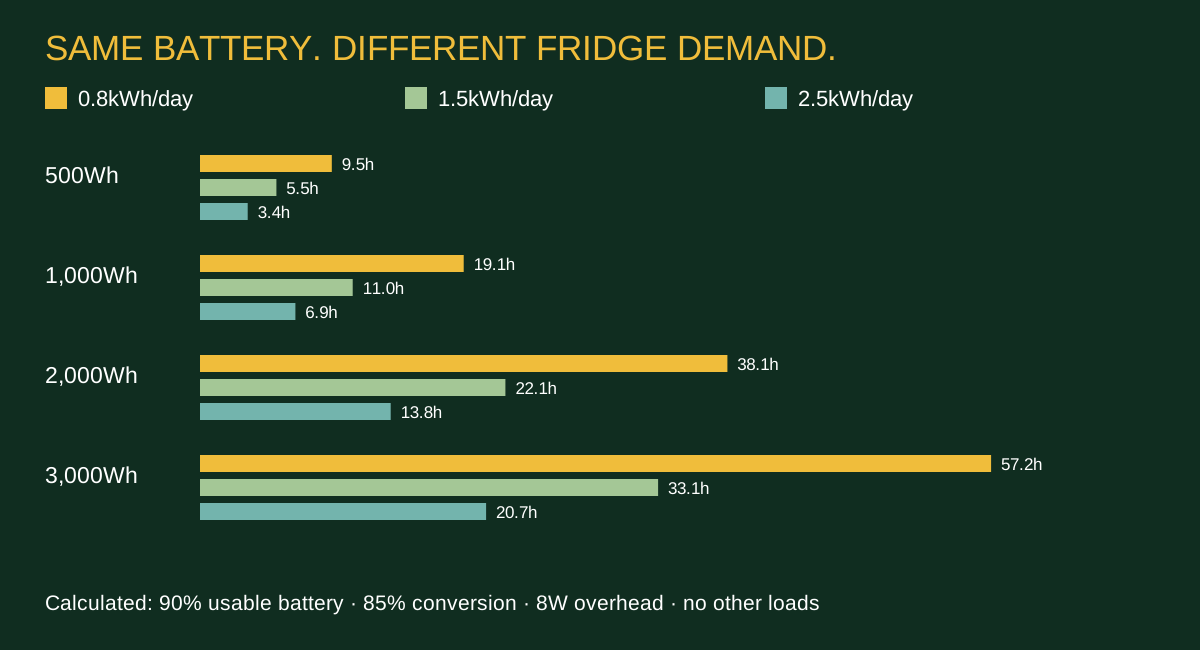
The following are calculated scenarios, not measured runtimes. Each uses 90% usable battery, 85% conversion efficiency, 8W battery-side overhead and no extra appliances. All assume the station passes the startup and continuous-output checks.
| Nominal battery | 0.8kWh/day fridge | 1.5kWh/day fridge | 2.5kWh/day fridge |
|---|---|---|---|
| 500Wh | 9.5 hours | 5.5 hours | 3.4 hours |
| 1,000Wh | 19.1 hours | 11.0 hours | 6.9 hours |
| 2,000Wh | 38.1 hours | 22.1 hours | 13.8 hours |
| 3,000Wh | 57.2 hours | 33.1 hours | 20.7 hours |
The table shows why “a 1,000Wh station runs a fridge for a day” is too broad. In these scenarios, the 1,000Wh battery lasts between about 6.9 and 19.1 hours. Your refrigerator’s measured demand determines which scenario is relevant.
Battery size for an 8-, 12- or 24-hour outage
| Daily fridge use | 8 hours | 12 hours | 24 hours |
|---|---|---|---|
| 0.8kWh/day | 500Wh | 750Wh | 1,500Wh |
| 1.5kWh/day | 750Wh | 1,250Wh | 2,250Wh |
| 2.5kWh/day | 1,250Wh | 1,750Wh | 3,500Wh |
These values are rounded upward to 250Wh increments with no additional uncertainty margin. A warm kitchen, aging battery, incomplete charge, unusually heavy defrost period or extra loads can shorten coverage. Use a separate margin where the consequences of running short matter.
What to check when choosing refrigerator backup power
Separate the inverter decision from the battery decision
First confirm the exact refrigerator can start and run from the station. Then buy the energy capacity required. An expansion battery can extend runtime on compatible systems, but it normally does not raise the inverter’s continuous output. Verify the manufacturer’s configuration rather than assuming that more batteries mean more watts.
Check low-load shutdown and restart behavior
The compressor turns off between cycles. Some power-saving settings can switch AC output off when the measured load stays low. Read the exact model’s instructions, configure it for the intended refrigerator use and verify that the next compressor cycle starts. Also check what happens after a fully depleted battery: does AC output resume after charging, or does someone need to press a button?
Read the bypass and EPS instructions
Pass-through charging, emergency power supply and UPS are not interchangeable promises. Check permitted continuous-use arrangements, transfer behavior, output limits while charging and whether the manufacturer approves your intended unattended use. Test a supported configuration before relying on it. Do not infer medical-grade continuity from a short advertised transfer time.
Consider indoor placement, weight and charging temperature
A battery station has no running combustion engine, but still needs the dry location, clearance and operating temperatures specified in its manual. Keep vents unobstructed. Do not put it inside the refrigerator cabinet or seal it in a soundproof box. Check whether its lifting weight suits the person who will actually move it during an outage.
Build a realistic recharge plan
A solar panel’s rated watts are not all-day guaranteed input. Shade, season, orientation, weather and charging limits affect the energy collected. Suppose the whole system supplies an assumed net 600Wh into the battery over a day, while your refrigerator setup requires about 1,957Wh at the battery in 24 hours. The daily deficit is still roughly 1,357Wh. Solar helps, but that scenario is not energy-independent.
Follow the station’s input-voltage, current, connector and panel-configuration limits. If using a fuel generator to recharge, its placement and electrical precautions still apply. A rechargeable battery does not make a generator safe indoors.
Mini fridge, full-size refrigerator or fridge and freezer together?
A small cabinet does not guarantee small daily consumption. Compare actual energy use rather than liters or cubic feet alone. A small compressor fridge, an older mini fridge and a full-size efficient refrigerator can behave quite differently.
For a refrigerator and a separate freezer, add their measured daily kWh for the energy calculation. For compatibility, consider the possible simultaneous running load and overlapping startup demands. Staggering initial connection does not guarantee that thermostats will never restart together later.
A 12V compressor cooler connected to a supported DC output uses a different conversion path. Do not automatically apply the AC calculator’s efficiency assumptions. Confirm DC voltage, connector current and low-voltage cutoff behavior, and measure its daily energy under the intended conditions.
Set up refrigerator backup safely before the next outage
- Record the exact appliance and station models. Save their manuals and compatibility information where the household can find them offline.
- Prepare a dry, ventilated location. Follow both manuals for clearance, cabling and temperature. Do not use flood-wet electrical equipment.
- Use the approved direct appliance connection. If an extension is permitted, select the grounded cord rating and length specified for the load. Never improvise a male-to-male cord or feed power into a wall socket.
- Test a normal operating period. Observe startup, cycling and applicable defrost behavior. Follow the refrigerator’s restart-delay instructions; repeated immediate restarts are not a useful stress test.
- Monitor temperature as well as battery percentage. Electrical operation does not by itself prove food stayed cold.
- Write down the fallback. Know where to obtain ice or safe cold storage and when to make a food-discard decision.
Powering household circuits requires an appropriate professionally installed transfer arrangement, not an improvised plug connection. For combustion generators, CPSC guidance calls for outdoor operation at least 20 feet from homes and buildings, with exhaust directed away from openings.
For apartment planning, use our apartment power-outage guide. A balcony is not automatically a safe or permitted generator location. For charging phones separately, see our emergency power-bank comparison; pocket power banks are not substitutes for a refrigerator’s AC supply.
Backup runtime is not a food-safety countdown
Keep a refrigerator thermometer and aim for 40°F (4°C) or below. FDA says an unopened refrigerator generally keeps food cold for about four hours without power. That is not a promise that every food remains safe after every outage, nor permission to repeatedly warm and recool perishables. Check temperatures and food-specific discard guidance.
If backup fails, follow our power-outage food-safety guide and the official refrigerated-food chart. Do not taste food to decide whether it is safe. Refrigerated medicines require their own manufacturer and pharmacist advice.
Questions about power stations for refrigerators
Can a portable power station run a refrigerator?
Yes, if the exact station’s output matches the appliance’s electrical requirements and handles startup, running and other relevant loads. Battery capacity then determines estimated duration. A successful momentary start is not proof of full-night coverage.
Will a 1,000W power station run a refrigerator?
Possibly, but 1,000W alone is insufficient information. Check surge capability, its duration, voltage and appliance compatibility. Also read the battery’s Wh capacity: output watts do not establish runtime.
Can a 2,000Wh battery keep a fridge running for 24 hours?
It depends on measured demand and losses. Our 1.5kWh/day example gives about 22.1 hours with the default assumptions. The lower-demand 0.8kWh/day scenario gives about 38.1 hours. Both are calculations, not guarantees.
Should I multiply refrigerator watts by 24?
Only if that watts figure is the true average over the whole day. Multiplying compressor-only running watts by 24 assumes it runs continuously. Measured daily kWh already includes the cycling that occurred during measurement.
Can a solar generator run a refrigerator indefinitely?
Only if the system consistently replenishes enough usable energy and has sufficient storage for periods without input. Check the daily energy balance and poor-weather reserve. A panel’s peak rating alone does not answer that question.
Does LiFePO4 guarantee longer refrigerator runtime?
No. Battery chemistry can matter for durability, weight and operating characteristics, but runtime still depends on available energy, conversion behavior and the load. Compare verified usable energy and relevant operating limits rather than chemistry alone.
Sources, assumptions and how we prepared this guide
Prepared November 5, 2026. The equations, calculator, tables and diagrams are original R&R planning tools. Examples are hypothetical; no hands-on refrigerator or power-station performance testing is claimed. Defaults of 90% usable battery, 85% conversion efficiency and 8W overhead are editable assumptions. No universal efficiency, startup multiplier or duty cycle is asserted.
- PNNL / Building America — emergency cooling, refrigeration and energy measurement
- U.S. Department of Energy — refrigerator and freezer energy database
- ENERGY STAR — model-specific annual energy listings
- Jackery support — motor startup and output compatibility
- FDA — refrigeration and outage food safety
- FoodSafety.gov — food-specific discard guidance
- CPSC — generator placement and electrical precautions
Photography and visual methods
The cover is a generated conceptual household scene, not a photograph of a reviewed product or tested installation. The kitchen photograph and video footage are licensed illustrative Pexels material. Diagrams and animation are original, with calculated scenario values. No pictured person endorses this guide.