
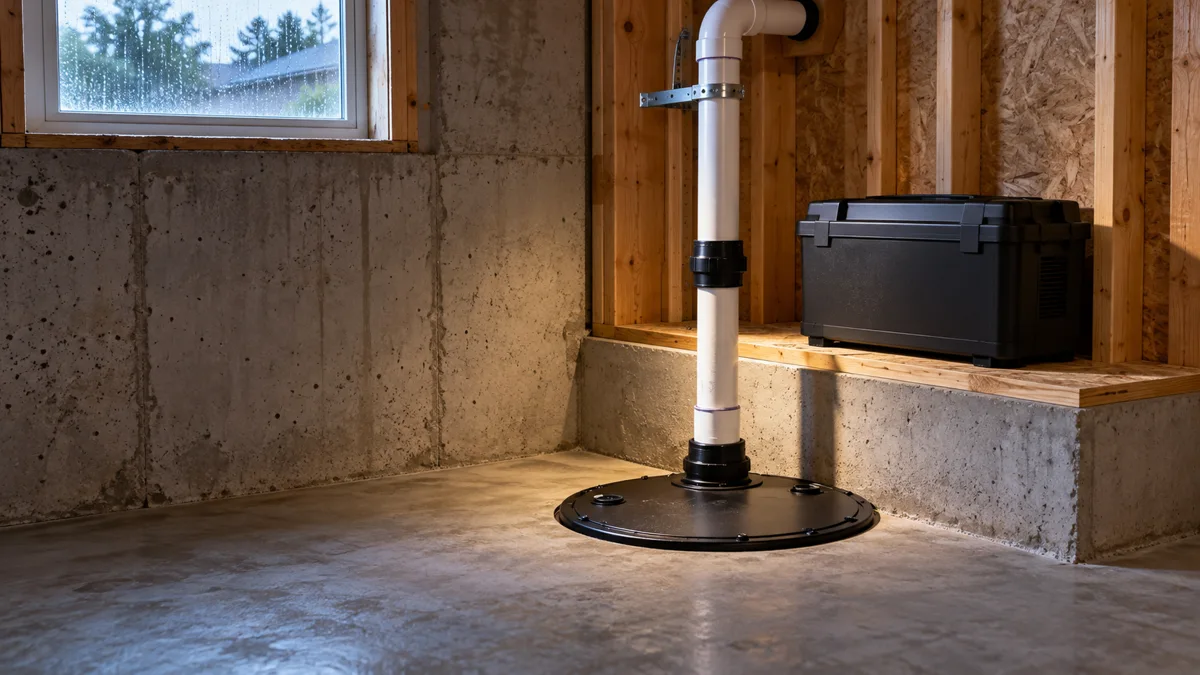
What to do when your sump pump stops during an outage
If your sump pump is not working during a power outage, an ordinary plug-in pump has lost its energy source. It cannot restart until usable power returns or a compatible backup takes over. First establish that you can stay on dry ground away from electrical equipment. Then check the backup system you actually have, rather than repeatedly resetting the silent primary pump.
The distinction matters when rain is still falling. A separate battery backup sump pump can move water even if the main pump fails. A generator or battery inverter can supply electricity to the main pump, but it cannot repair that pump or clear a blocked discharge. A water-powered backup needs a suitable pressurized water supply. Each solves a different problem.
I would start with three questions: Is access safe? Is there a working backup? Is that backup lowering the water? Those answers are more useful than a shopping list while the pit is rising. Use the decision tree below, then jump to the relevant troubleshooting branch.
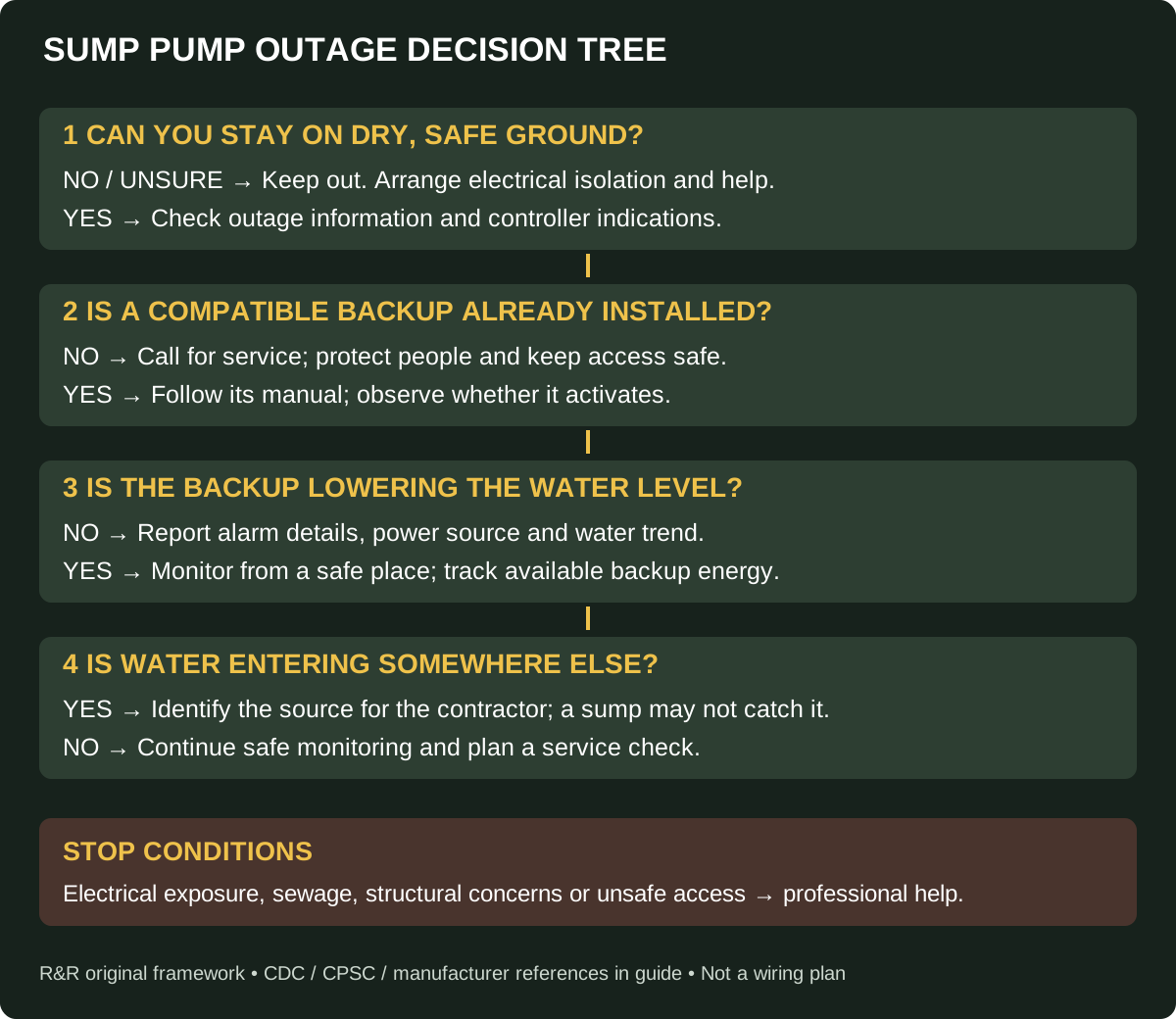
Keep electrical danger ahead of the pump diagnosis
Do not enter standing water to reach a plug, battery controller, breaker or pump. A utility outage does not prove the installation is electrically safe: power can return, and other power sources may be present. If water has reached electrical equipment, keep out and arrange safe isolation and assessment through the utility or a qualified electrician. Follow evacuation instructions; call emergency services for an immediate threat to people.
The CDC's electrical-hazard guidance specifically warns against operating electrical equipment or switching power while standing in water. Rubber boots do not turn that into a safe troubleshooting job. Your first useful action may be keeping other people away and making the call from upstairs.
If the basement is already deeply flooded, rapid emptying can create a separate structural problem when outside groundwater remains high. Nebraska Extension explains the pressure imbalance that can damage basement walls and floors. Get the pump-out sequence assessed instead of using the biggest pump available. This is different from keeping a normal sump operating before the basement floods.
From a safe position, note whether water is confined to the pit, spreading over the floor, coming through a wall or rising from a drain. Photograph what you can without entering danger. A concise description helps a contractor decide which equipment and expertise to bring.
Confirm an outage rather than assuming the pump is broken
Check the utility's outage information on your phone and whether other household circuits have power. A widespread outage and one dead pump outlet are different diagnostic paths. If the rest of the home works, the pump may have a circuit, protective-device, switch or equipment fault that needs investigation.
Do not bypass a GFCI, replace a breaker with a larger one, defeat a float switch or repeatedly reset a device that trips again. Do not improvise a connection to a battery. A protective device that will not remain set is a reason to stop and seek help, not proof that the device is the problem.
Read the pump model and controller labels only where safely accessible. Look for separate equipment: a DC backup pump, a battery enclosure and charger, a water-powered unit, or a professionally installed standby power connection. A box marked “battery” does not necessarily power the primary pump. It could serve only an alarm or an entirely separate pump.
An alarm tells you something needs attention; it does not establish the cause. Record the exact light or message, the sound pattern and whether water is rising. Keep the manual available offline. In a noisy storm, “power failure light on; backup running; water level falling” is much more useful than “the sump is beeping.”
Follow the symptom before choosing the fix
| What you observe | Question to resolve | Useful next step |
|---|---|---|
| Silent primary pump; home has no power | Is an independent backup available? | Read backup indications from dry ground; arrange help if none |
| Backup alarm; no water removal | Which fault is the controller indicating? | Record the exact message; use the model manual and installer |
| Motor runs; pit still rises | Can water leave fast enough through a usable discharge? | Report flow and level trend; have pump and discharge assessed |
| Pit falls; floor still floods | Is water entering outside the sump collection path? | Identify the location and possible source without entering water |
| Power returns; pump still will not operate | Has a circuit or equipment fault remained? | Do not repeatedly reset protection; arrange electrical/pump service |
The primary pump is silent and the house has no power
Check whether an installed backup is operating through its controller indications and observable water-level response, staying on dry ground. A backup may not activate immediately: its float can be set above the primary pump's normal operating level. Use the actual manual to understand its activation point; do not reach into the pit to force operation.
If no backup exists, call a sump-pump service or qualified restoration contractor promptly while planning for safe household access. Say that utility power is unavailable, give the approximate water level and rate of change, and identify any suspected sewage or electrical exposure. A pump that arrives without a safe power source or discharge plan will not solve the whole problem.
The battery backup is beeping but not removing water
Read the controller's specific indication. Battery condition, a connection problem, a float issue and a pump fault require different responses. A charger that lost AC input during the outage is not itself evidence that the battery or pump has failed. Conversely, a lit display is not proof that sufficient energy remains to run the motor.
Follow the model's troubleshooting sequence and call its support line or installer. Keep sparks, flames and improvised charging arrangements away from batteries. Do not substitute a battery chemistry because the voltage matches; controller and charger compatibility matter. Once conditions are safe, ask for a loaded functional test rather than relying only on a resting voltage reading.
A pump runs, but the pit keeps rising
Power alone is no longer the main question. The pump may be unable to match incoming water, or water may not be leaving through a usable discharge route. Possible causes include a blocked or frozen outlet, an obstructed intake, a valve problem or equipment damage. These are possibilities to investigate, not diagnoses from the sound of the motor.
Tell the contractor whether the discharge is observable from a safe location and whether water appears to return immediately. Do not open piping, handle a powered pump or venture into stormwater to check an outlet. A larger power station will not correct a blocked pipe; a second pump sharing that pipe may inherit the same failure.
The sump level falls, but water still enters the basement
Identify where water is entering. A sump collects water delivered to its drainage system; it does not automatically intercept a backed-up sewer, a broken supply pipe or every window-well leak. Our sewage backup in a basement guide addresses contaminated drain water. Avoid treating unknown floodwater as clean groundwater.
If the inflow is a supply leak, a safe, accessible shutoff may be relevant; see our water shutoff planning guide. Keep storm drainage, drinking water and wastewater as separate systems in your description to the contractor. The right fix follows the source.
Compare the four ways to keep a sump working without utility power
| Backup approach | What moves the water | Dependencies to check | Primary pump failure covered? |
|---|---|---|---|
| Separate battery backup pump | A second DC pump | Battery/charger match, pit fit, float, pump curve, discharge | Potentially, if separate pump and route remain usable |
| Battery inverter or power station | Your existing AC pump | Supported motor surge, continuous load, usable energy, safe connection | No — the original pump must still work |
| Portable generator | Your existing AC pump | Starting load, fuel, safe outdoor setup and electrical connection | No — the original pump must still work |
| Water-powered backup | A separate water-powered unit | Reliable municipal pressure/flow, backflow protection, approved discharge | Potentially, if supply and backup remain usable |
For an unattended home, automatic operation is a major selection criterion. A portable generator stored in the garage does nothing until someone can safely set it up. A properly installed automatic backup can respond while you are away, but still needs maintenance and enough capacity for the actual inflow.
I would compare failure coverage before advertised runtime. Ask whether the option protects against lost electricity, a failed primary pump, or both. Then ask which components it shares with the original system. An independent pump adds redundancy; a shared discharge can remain a common point of failure. Have the installer explain the complete arrangement, including alarms and what happens if communications fail.
Three backup products to compare after checking compatibility
These are three distinct approaches, not a ranked list of interchangeable kits. Choose the system type first. Then verify the exact model, included components and installation requirements. We researched manufacturer documentation; we have not conducted hands-on tests of these products.
The battery option suits a planned, separate automatic pumping path. The water-powered option is worth discussing where municipal supply remains available through outages. The portable generator option suits a prepared operator with safe outdoor space and a compatible existing pump. None is a last-minute guarantee that an already flooded basement can be entered safely.
How long will a battery backup sump pump last
There is no universal answer in hours. Battery condition, usable capacity, pump demand, discharge conditions and the fraction of time the motor runs all affect the result. Compare ratings at the stated lift and duty cycle. “Two days of protection” can describe intermittent operation, not a motor running continuously for 48 hours.
The Basement Watchdog BWSP specification illustrates the distinction: its listed 48-hour figure with the specified BW-27AGM battery assumes a 10% duty cycle. At 10%, the pump runs for six minutes in each hour. That condition is very different from sustained heavy inflow. The rating is not a promise for your basement.
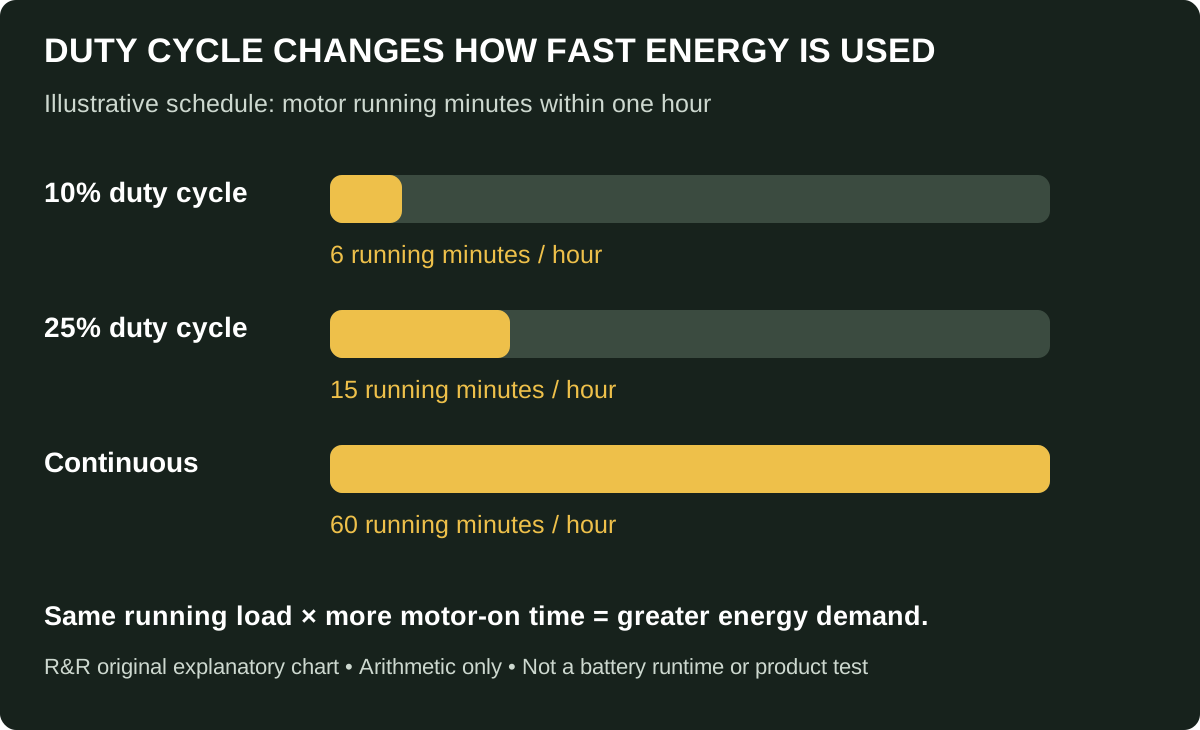
For planning, record how often the installed pump cycles during a safe, observed rain event and have the installer assess capacity at the actual discharge conditions. A pump curve relates flow to head, the resistance the pump must overcome. Vertical lift matters, but piping losses and fittings also affect the installation. A headline gallons-per-hour figure at zero lift should not stand in for a design check.
Ask what runtime evidence applies to your battery and system, what condition triggers replacement and how it is tested. A fresh battery on a lightly cycling system and an aging battery on a continuously running pump are not comparable. Keep a dated maintenance record alongside our emergency kit maintenance plan, rather than treating a successful installation years ago as a current result.
Can a portable power station run your sump pump
Possibly, but watt-hours alone do not establish compatibility. The inverter must supply the pump's required voltage and frequency, continuous demand and motor-starting surge. The pump and power-station manufacturers must support the intended use. A unit that charges phones well is not automatically suitable for an inductive motor.
Start with the exact pump manual or manufacturer confirmation, not a generic chart based only on horsepower. Identify other loads that might start at the same time. Ask about protective-device requirements, grounding arrangements and any restrictions on automatic pass-through operation. A claimed UPS or EPS transfer time does not by itself prove that the whole pump installation is supported.
Here is a deliberately simplified energy example, not a product runtime estimate: assume 1,000 watt-hours of usable AC energy and a pump drawing 600 watts while running. At continuous operation, the arithmetic gives about 1.7 hours. At a 25% duty cycle, its average pump load is 150 watts, giving about 6.7 hours before accounting for idle draw and other limits. Actual usable energy, starting behavior and operating conditions must be verified.
The purpose of that example is to show why cycling matters, not to size a purchase. Our BLUETTI Elite 100 V2 research review covers a portable power station's broader role. It is not a certification that the unit will start your sump pump. Keep any battery power equipment dry and outside the area that could flood.
Choose a generator for a sump pump by starting demand
A generator must handle both the motor's startup and its sustained load. Running watts and maximum output are different ratings. Select against the actual pump and any simultaneous loads; do not treat a generator's largest printed number as continuously available power.
For example, Honda lists the EU2200i at 1,800 watts rated and 2,200 watts maximum, with 120-volt output. Those specifications describe the generator. They do not establish that every 120-volt sump pump will start on it. Confirm the exact pairing before relying on it, including the intended cable arrangement and overload behavior.
Fuel-powered generators belong outdoors, at least 20 feet from doors, windows and vents, with exhaust directed away from the building. Maintain the manufacturer's required clearances and a dry operating location. Never run one in a basement, garage or partially enclosed space. Use working carbon monoxide alarms. The CDC's generator precautions explain why open doors do not make indoor operation safe.
The CPSC portable-generator safety alert also covers appropriate outdoor cords and the danger of backfeeding. Never plug a generator into a household wall outlet. Building connections require properly installed transfer equipment and qualified electrical work. Follow both equipment manuals for any direct appliance connection; do not extend ordinary household pump wiring as an improvised permanent installation. Stop and cool the generator before refueling.
When a water-powered backup makes sense
A water-powered backup uses pressurized supply water to move sump water. Its independence from electricity can be useful, but it depends on another service remaining available. It is not a sensible outage solution for an ordinary private-well installation whose electric pump has also stopped, or where the water utility has lost pressure.
Liberty's current SumpJet installation manual recommends at least 30 psi ahead of the backflow device with the valve open. Check flowing conditions, not only static pressure. The manual specifies separate discharge from the primary pump and additional backflow protection meeting local requirements. This is a plumber-and-water-authority compatibility check, not a hose-and-adapter shortcut.
Supply-water consumption, installation costs and service restrictions belong in the comparison. Ask what happens during a pressure loss or water advisory and how the unit is tested. An unlimited-duration claim means little if the supply it needs is not dependable during the same storm. The standard SJ10 has no alarm; decide how a failed backup or high-water condition will be detected.
Prevent basement flooding without relying on one device
Before the next storm, ask a qualified contractor to review the pump, float clearance, basin, discharge, check valves where specified and backup activation. Keep the manufacturer's test and maintenance schedule. Do not wait for a regional outage to discover that the backup battery is disconnected or the exterior outlet has been obstructed.
Keep battery enclosures, controllers and power equipment where the manufacturer permits and away from likely inundation. Preserve access to service points. If you rent, coordinate with management rather than altering a shared drainage or electrical system. A household plan should identify who receives alarms, who can authorize repairs and where people can go if basement access becomes unsafe.
Also address the water route outside the building. Safe ground-level inspection can identify obvious gutter, downspout or drainage concerns to report; roof work and changes to grading or drainage need appropriate expertise. Our El Niño home preparedness checklist and regional flooding guide put those tasks into a broader weather plan. Seasonal outlooks do not replace local flood warnings.
Prepare upstairs essentials so protecting people does not depend on saving the basement. Keep medicines, documents, lighting and communications accessible. The 72-hour emergency kit guide helps organize supplies, while the family go-bag plan covers leaving when needed. Do not carry heavy possessions through rising water to protect them.
After the pump restarts, check the damage separately
A falling water level is progress, not a complete recovery assessment. If water reached electrical equipment, have it assessed before energizing it. If a breaker trips again, the motor hums without pumping, or the pit repeatedly overflows, arrange service rather than assuming the outage was the only fault.
Once access is cleared, document affected rooms, materials and the known wetting time. Our flooded-house drying guide explains extraction, cleaning, drying and verification. Follow it with mold prevention after a flood for wet carpet, drywall and concealed moisture decisions. Removing visible water does not dry a wall cavity.
Other disrupted services need their own checks. Use the refrigerator food-safety guide for temperature-history decisions, the toilet power-outage guide for electrically dependent wastewater systems, and the post-boil-water-advisory guide for drinking-water restart steps. A working sump does not clear food, plumbing or tap water.
Questions about sump pumps and power outages
Will my sump pump work without electricity?
A conventional AC pump will not. It needs compatible backup electricity, or a separate battery-powered or water-powered backup pump must remove the water. Identify which system you own before following reset instructions.
Can I plug the pump into a computer UPS?
Do not assume compatibility. Confirm motor-starting surge, continuous output, runtime and permitted operation with both manufacturers. A UPS intended for electronics may not support the pump's load or intended environment.
Does a battery backup power the main sump pump?
Many systems use a separate DC pump and do not energize the main AC pump. An inverter-based backup is a different arrangement. Read the model's system diagram rather than interpreting “battery backup” as a universal design.
Why is my backup pump running but the basement still flooding?
It may be overwhelmed, have a discharge problem, or be handling a different water path from the one flooding the room. Keep out of unsafe water and get the source and system assessed. More battery capacity alone may not solve it.
Can I use the sump pump for sewage backup?
Do not assume a groundwater sump pump is suitable for sewage. Equipment and contamination requirements differ. Stop using affected fixtures when directed and contact the sewer authority or an appropriate contractor; see our linked sewage-backup guide.
What should I tell an emergency pump contractor?
Give the location, utility-power status, approximate water level and trend, pump and backup models if safely known, exact alarm indications, suspected contamination and any electrical exposure. Explain whether you are the owner or a renter and who can authorize work. Do not enter the basement to collect missing details.
Sources and how we built this guide
Ready & Resourceful checked the linked CDC, CPSC, Nebraska Extension and manufacturer documents on October 18, 2026. The decision tree, symptom matrix and duty-cycle graphic are original explanatory work. The numerical runtime example is explicitly hypothetical; no household measurements or hands-on product tests are claimed. Illustrative photographs show planning scenes, not a documented installation inspection or storm event.
The product shortlist compares three failure-coverage approaches rather than awarding unsupported scores. Current equipment instructions and local electrical, plumbing, water-authority and flood-response requirements govern installation and operation. Specifications can change; match the model and manual revision before purchase. Our editorial standards explain the distinction between researched comparisons and field testing.