
What to put in a family bug out bag
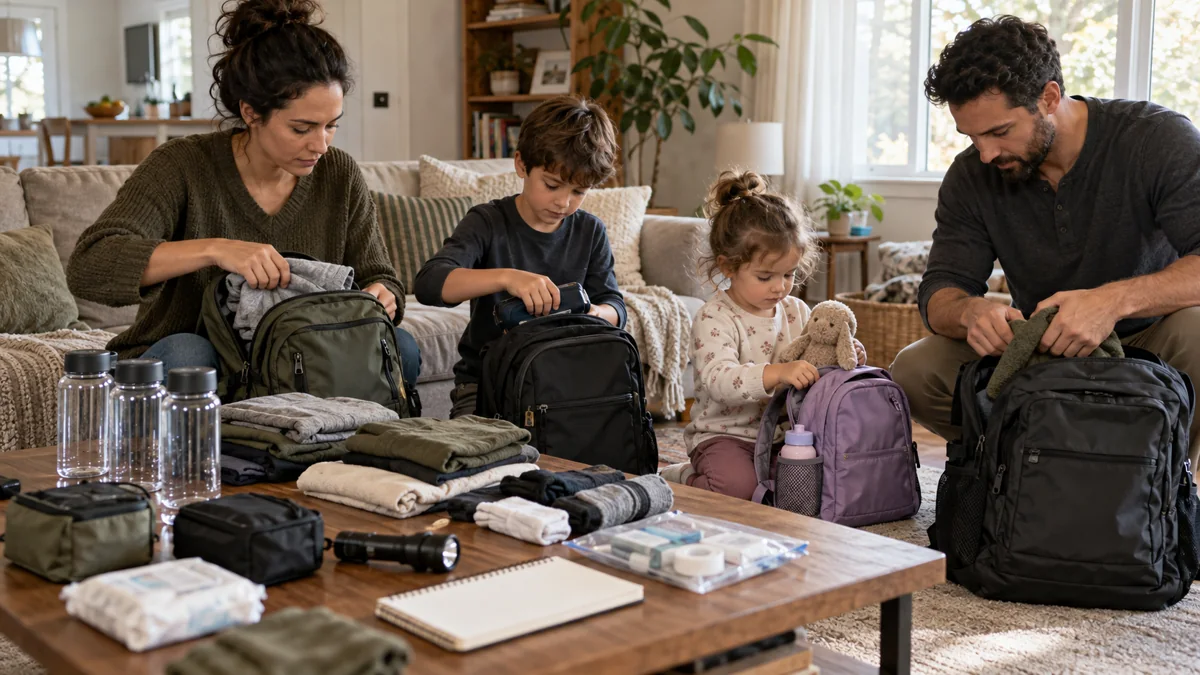
A family bug out bag needs drinking water, suitable ready-to-eat food, personal medication and care supplies, lighting, communication, clothing, hygiene items and essential information. The useful question is not simply whether your household owns those items. It is whether they are packed where the right person can reach them when leaving home.
Start with the checklist below, then adapt quantities to the household and the evacuation plan. For each row, record who needs the item, where it is packed and who carries it. Keep extra household reserves separate from portable supplies. A family of four may need several containers, but those containers must still fit the transport and assistance actually available.
| Supply category | What to account for | Family-specific decision |
|---|---|---|
| Water | Portable drinking water plus a separate household and transport plan | Record usable quantity, carrier and refill assumptions |
| Food | Suitable ready-to-eat food and any needed utensils | Account for allergies, feeding needs and who can open it |
| Medication and care | Necessary medicines, care equipment and private instructions | Resolve storage, refills and assistance with the relevant professional |
| Light | A working light and matching power arrangement | Identify who needs independent access |
| Communication | Phone, compatible charging, contacts and local information arrangements | Plan for an unavailable device or network |
| Clothing | Current-size clothing, suitable layers and footwear | Match people, season and destination |
| Hygiene | Personal hygiene, diapers where needed and suitable supplies | Separate individual care from shared items |
| Documents | Appropriate copies and necessary contact details | Protect private information and confirm access |
| Children | Feeding and care items plus a manageable familiar activity | Adults retain essential responsibilities |
| Pets | Suitable restraint or carrier, identification and care supplies | Check destination rules and who handles the animal |
| Last-minute items | Everyday essentials that cannot remain permanently packed | Record exact collection task and backup |
If you only have time for one improvement today, identify the supplies that cannot be substituted easily: a person's necessary care equipment, compatible chargers, individual feeding needs and the information required to continue care. Resolve those gaps before adding another optional tool. A familiar backpack with the right supplies can be more useful than a specialized bag with the wrong contents.
A family bug out bag checklist starts with who can carry what
Four people do not necessarily need four identical backpacks. A toddler cannot be assigned the same responsibility as an adult, and the person helping a child may have less capacity for shared equipment. Start with your destination, transport and actual household needs. Then assign the supplies to named carriers and containers.
The first planning question is simple. If one adult leaves with the children while the other is away, does the departure plan still work? That question exposes a weakness that a long shopping list can hide. The only medication pouch might be in the absent adult's car. The children's clothes might be mixed into a heavy storage tote. A bag can look complete while the family arrangement remains unfinished.
This guide uses “bug out bag,” “go bag” and “evacuation bag” for portable supplies intended for leaving home. It does not assume wilderness travel. A friend's home, an arranged accessible destination or an officially directed shelter can require very different preparation from an overnight camping trip. Follow current local evacuation instructions; do not delay departure to finish packing.
Use the main bug out bag checklist and free Excel workbook for the starting inventory. Use this page to decide who carries it, which supplies are shared and which must remain available to an individual.
The family go bag checklist at a glance
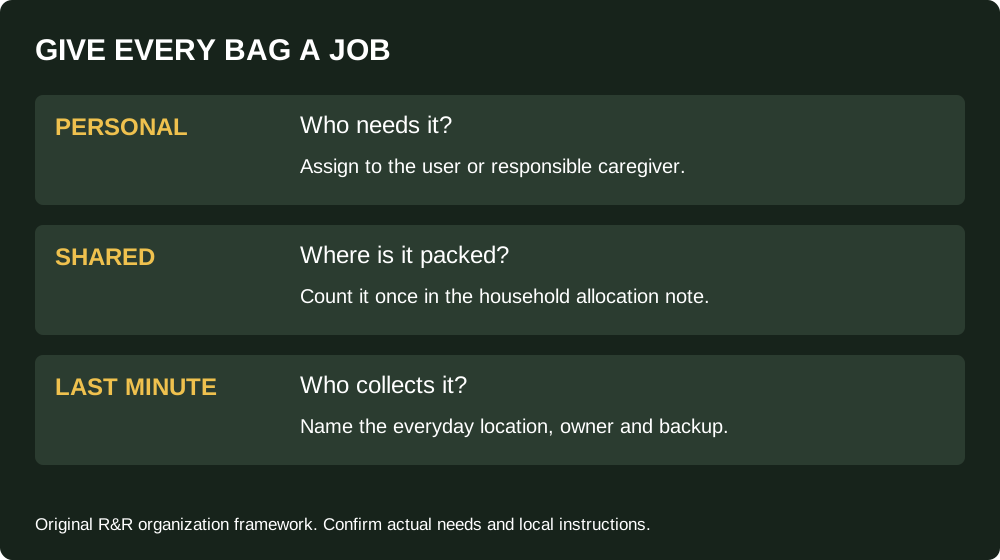
Build three lists rather than one oversized pile. The personal list records needs belonging to a specific person. The shared list records equipment serving the household. The last-minute list identifies everyday essentials that cannot remain permanently packed. Each entry needs a location and an owner, not just a checkmark.
The following is an R&R organization framework, not a universal quantity prescription. Match it to official local guidance and your family's care arrangements.
| Group | Items to account for | Ownership question |
|---|---|---|
| Personal | Clothing, personal care, necessary medication and equipment, suitable food and water | Who needs it, and who can safely carry it? |
| Children | Current-size clothing, feeding and hygiene supplies, familiar activity | Which adult is responsible if the child cannot carry a bag? |
| Shared | Household communications, common supplies and agreed backup items | Which bag actually contains each item? |
| Documents | Appropriate copies and essential contact information | Who can access the private information if needed? |
| Pets | Carrier or restraint, identification, food, water and care supplies | Who handles the animal and what does the destination permit? |
| Last minute | Everyday-use care items, phone and other essential items | Who collects them, from where, and who is the backup? |
Do not interpret “shared” as “there must only be one.” A household might choose separate lights for adults because they need to move independently. It might keep contact information with each person because one phone can be unavailable. Make deliberate decisions about redundancy rather than duplicating every item automatically or concentrating everything in one bag.
A worked example for a family of four
Consider a fictional household with two adults, a school-age child and a toddler. They have an agreed destination reachable by car, with a separate plan if the car is unavailable. One adult might need to carry or assist the toddler. The older child is not responsible for medication, household documents or the family's only communication device.
Adult A's bag holds that adult's personal items, the toddler's immediate care supplies and one assigned shared pouch. Adult B's bag holds their personal items and other shared supplies. The older child's small bag contains manageable personal items and a familiar activity. Additional supplies travel separately only when transport, time and conditions allow. This is an allocation example, not a claim that every household should use this arrangement.
Now test it on paper with Adult B absent. Move the toddler's critical supplies to the available caregiver's plan. Identify shared items that would otherwise be inaccessible. If the remaining load is not manageable, resolve the transport and assistance problem before treating the checklist as complete. Writing a second adult's name beside a heavy bag is not a backup plan.
| Fictional assignment | Normal arrangement | If only one adult is available |
|---|---|---|
| Adult A | Personal bag plus toddler care and assigned shared pouch | Reassess available carrying and assistance |
| Adult B | Personal bag plus other assigned shared supplies | Identify essentials that must remain available |
| School-age child | Manageable personal items and familiar activity | An adult remains responsible for essential needs |
| Transport-dependent reserve | Additional containers and supplies when feasible | Use the separately agreed alternative plan |
When you use the Excel checklist, keep one working copy per bag. Rename the copies clearly, then write a separate household allocation note identifying the shared items. Count a shared radio once in that note. Do not count it as physically packed in both adults' workbooks. The spreadsheet does not automatically merge separate files or detect duplicate household entries.
Pack for children without giving them adult responsibilities
Start with care needs, familiar routines and clothing that currently fits. A child's bag can help organize personal belongings, but it should not become the only place an essential item exists. A child may be tired, distressed, asleep or unable to carry their bag when the family needs to move.
Invite children to choose a small comfort item or activity and help identify their own pouch. Let them practise finding a familiar item during an ordinary, calm packing session. Avoid dramatic simulations or telling them they are responsible for keeping everyone safe. Adults retain responsibility for the departure decision, the children and essential supplies.
There is no universal age-based pack weight established by this guide. Age alone does not tell you whether a child can manage a load. Fit, individual ability, the route and the need for assistance matter. Do not copy a competitor's pound limit and treat it as medical advice. Seek individual advice when a health or mobility concern affects carrying.
For a baby, separate feeding preparation from general snacks. The CDC's emergency feeding checklist identifies ready-to-feed infant formula as the safest formula-feeding option during emergencies and advises reviewing a baby's changing needs monthly. Plan the feeding supplies, storage and hygiene needed for the child's existing care arrangement. Discuss individual feeding questions with the child's clinician; a general go-bag list cannot replace that advice.
Infants, younger children and teenagers need different packing decisions
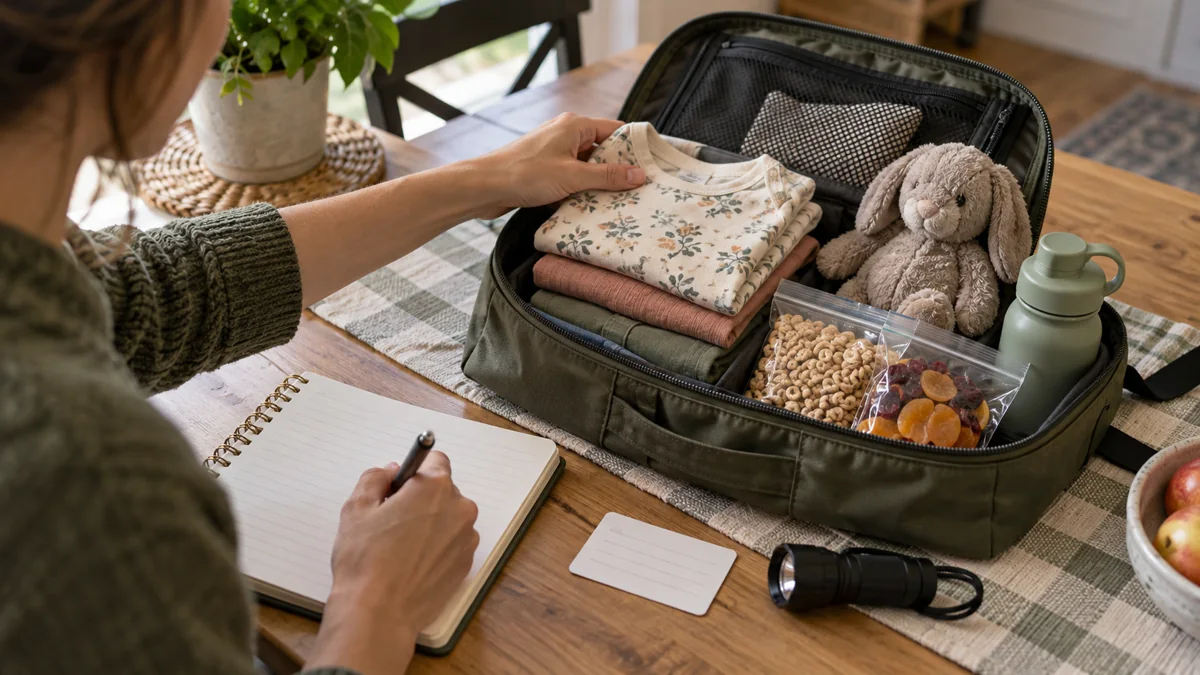
For an infant, the caregiver's checklist should identify feeding supplies, diapers, clothing, hygiene and the items required by the existing care plan. Decide who carries those supplies while also handling the infant. A bag allocation that leaves both of that person's hands permanently occupied deserves another look.
For a younger child, keep the personal pouch recognizable and straightforward. Avoid packing so many unfamiliar gadgets that the child cannot identify ordinary clothing or a comfort item. Pack items the adult can explain and retrieve easily. Check clothing fit, footwear and any changed food needs rather than treating last year's bag as finished.
For an older child or teenager, agree a useful role without making that person the only holder of a household essential. They may be able to help organize their own clothing, identify a charged device or check a contact card. Discuss what to do if separated using the family's established communication and reunification plan. Do not use a general article to override school procedures or a child's individual support arrangements.
The American Academy of Pediatrics' family disaster resources include an emergency information form for children with special health care needs. Families can use that resource with their care team to keep important information available. That is a stronger approach than improvising a medical summary from a public packing template.
Separate the water requirement from backpack capacity
Water is where many family kit lists stop being realistic. The CDC emergency water guidance recommends storing at least one gallon per person per day for three days and trying for two weeks where possible. Needs can be greater in heat or for particular people and pets.
For four people, the three-day baseline is twelve U.S. gallons. That is a household supply calculation, not an instruction to put twelve gallons into backpacks. It also excludes any additional pet requirement. Record how water will be stored, moved and accessed rather than quietly reducing the need until the bags look light enough.
Separate the portable water you can actually carry from additional transportable containers and your home reserve. If your evacuation plan depends on a vehicle, identify what changes when that vehicle is unavailable. Resolve the alternative destination, assistance and supply arrangements in advance where possible. A filter does not create a reliable water source, and not every filter addresses every contaminant.
Our small-apartment emergency water guide helps organize stored supplies. For treatment distinctions, read water filters versus purifiers. During a specific incident, follow public-health and utility instructions rather than assuming every available water source is suitable.
Choose food around your destination and household needs
The American Red Cross kit list distinguishes three days of evacuation supplies from a longer home reserve. Its list also includes lighting, communications, first aid, personal records and individual needs. Use that guidance as a baseline, then make the family-specific decisions a generic list cannot make.
Write down which foods people actually eat, what they can open and whether preparation needs equipment or water. Record relevant allergies and texture or feeding needs privately. A large packet of food is not automatically four usable meals if some members cannot eat it. Keep a suitable utensil or opener with food that needs one.
Separate food packed for departure from the pantry reserve. Label the review date and check the manufacturer's storage instructions. Do not assume a hot car is suitable long-term storage for everything in the bag. The power-outage food-safety guide covers a different task: assessing food when refrigeration stops. Keeping those two jobs separate prevents an evacuation bag from becoming a collection of questionable leftovers.
Keep personal care items available to the right person
Assign medication and necessary care supplies to the person who needs them or their responsible caregiver. Work with a pharmacist or clinician on refills, storage, temperature requirements and what can be kept ready. Do not transfer medicines into anonymous containers or use a checklist to decide dosing.
The CDC checklist for children with special healthcare needs specifically directs families to ask the child's doctor about emergency medicine supplies and the pharmacist about storage. It also includes current care information and backup-power planning. Use those questions with the child's care team rather than assuming a standard retail kit covers individual needs.
Include the actual equipment needed to use an item. A rechargeable device needs a compatible charging arrangement. Glasses are useful only if they are the right pair. A care plan that depends on electricity or specific assistance needs more than a larger backpack. Record unresolved questions and agree the arrangement with the relevant professional or service.
Keep a private last-minute list for items in everyday use. Give each task an owner and a backup. “Pick up care pouch from the marked shelf” is more actionable than “remember medication,” but the public version of a shared checklist should not reveal sensitive diagnoses or storage locations.
If you live above ground level, connect this task to your apartment and upper-floor earthquake plan. The supplies and assistance needed to leave are related, but having supplies does not establish a safe route through a damaged building.
Make the bag work with your evacuation destination
A family evacuation kit for a relative's home is not identical to a kit for an uncertain overnight stay. Before choosing equipment, write down the intended destination and an alternative, the available transport and the information needed to confirm access. Contact the destination where appropriate; do not assume a building will be open, accessible or able to accommodate every care need.
Think in terms of three transport arrangements. In a vehicle, additional supplies can be packed separately from the personal bags, provided the vehicle and route are usable. On public or arranged transport, luggage limits, pick-up procedures and assistance need advance confirmation. On foot, carrying and helping another person compete for the same physical capacity. Do not assume an optional vehicle tote can simply become another backpack.
Ready.gov's planning guidance starts with household communication, shelter and evacuation questions. Our practical extension is to write the transport assumption next to each container. Label an extra tote “vehicle supplies” in the inventory if that is its role. That makes the limitation visible rather than counting every stored item as portable readiness.
Keep the essentials reachable rather than at the bottom
Organize bags by how items will be retrieved. A rain layer or a personal care pouch that may be needed during travel should not require unloading everything. Protect papers and electronics from spills. Keep food separate from leaking hygiene products and follow storage directions for everything packed.
Use plain labels that make sense to the household. “Child clothing” or “charging cables” can be more useful than an elaborate color system nobody remembers. Do not place passwords, complete account information or sensitive care details on an outside label. A clear inventory is meant to help the family find supplies, not expose private information.
Take a photograph of the organized contents for your private record if useful, then update it when the bag changes. A photograph can show where a pouch belongs, but it does not verify expiry dates, functioning batteries or quantities hidden inside sealed containers. Keep those checks in the inventory.
Split shared supplies without creating a single point of failure
Some duplication is purposeful. Some is simply two adults buying the same item without realizing it. Distinguish the two in the household allocation note. Write “primary” and “backup” where that is the intended arrangement, and record which bag holds each item.
Run a simple availability review. If Bag A is unavailable, which essential function disappears? Ask the same question for Bag B and for a missing phone. This is an original planning exercise, not a numerical risk score. It helps you find dependencies that a total item count would miss.
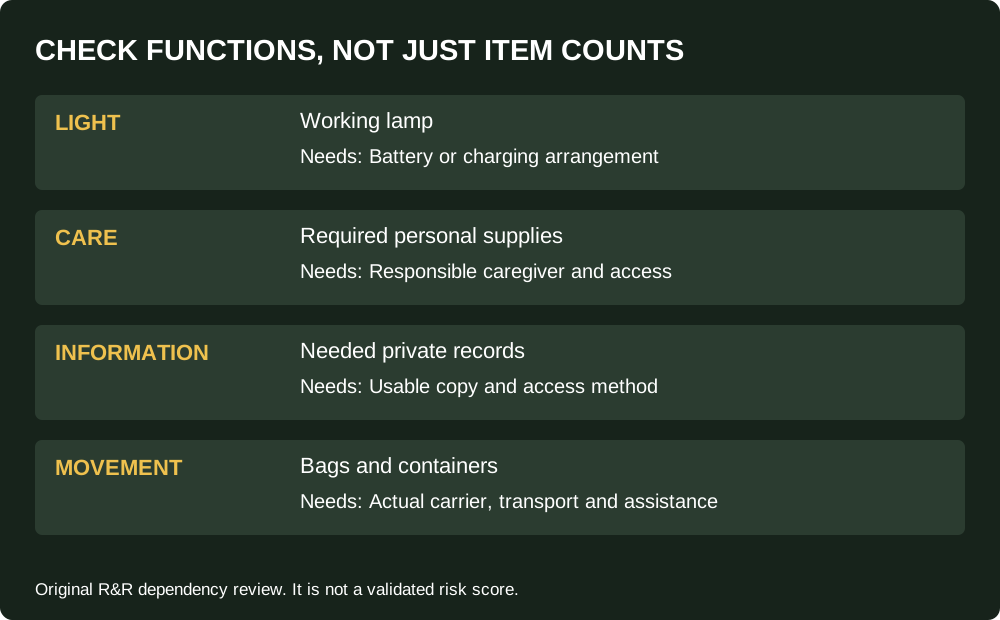
For example, two rechargeable lights do not provide independent charging if both need the one cable packed elsewhere. Separate bags do not provide independent access to private information if every copy is on one locked phone. Conversely, packing multiple bulky items may be unnecessary when the family has a confirmed alternative arrangement. The decision should follow the function and the user's needs, not a rule that every object must be duplicated.
Keep individual care decisions with the relevant professional. A missing medicine is not equivalent to a missing spare charging cable, and this exercise does not authorize substituting one treatment for another. Record that issue as a specific care-plan question.
Give pets a place in the departure plan
Check the intended destination's animal policy before relying on it. Ready.gov's pet preparedness guidance covers planning for animals, supplies and travel. Record the carrier or restraint, identification, food, water and individual care needs with the person responsible for them.
Practise ordinary carrier familiarity ahead of time where appropriate. Keep the carrier reachable rather than buried behind supplies. If one adult manages a child and a pet, count those responsibilities when assigning shared equipment. A transport plan should not require that person to carry three incompatible loads at once.
Check carrying and access without staging a disaster
Use a calm household review to check the actual bags. Can the intended user lift their bag and put it on? Are straps adjusted? Does anything leak or fall out? Can the relevant caregiver find the child's pouch without emptying every compartment? These are useful observations, not a professional fitness assessment.
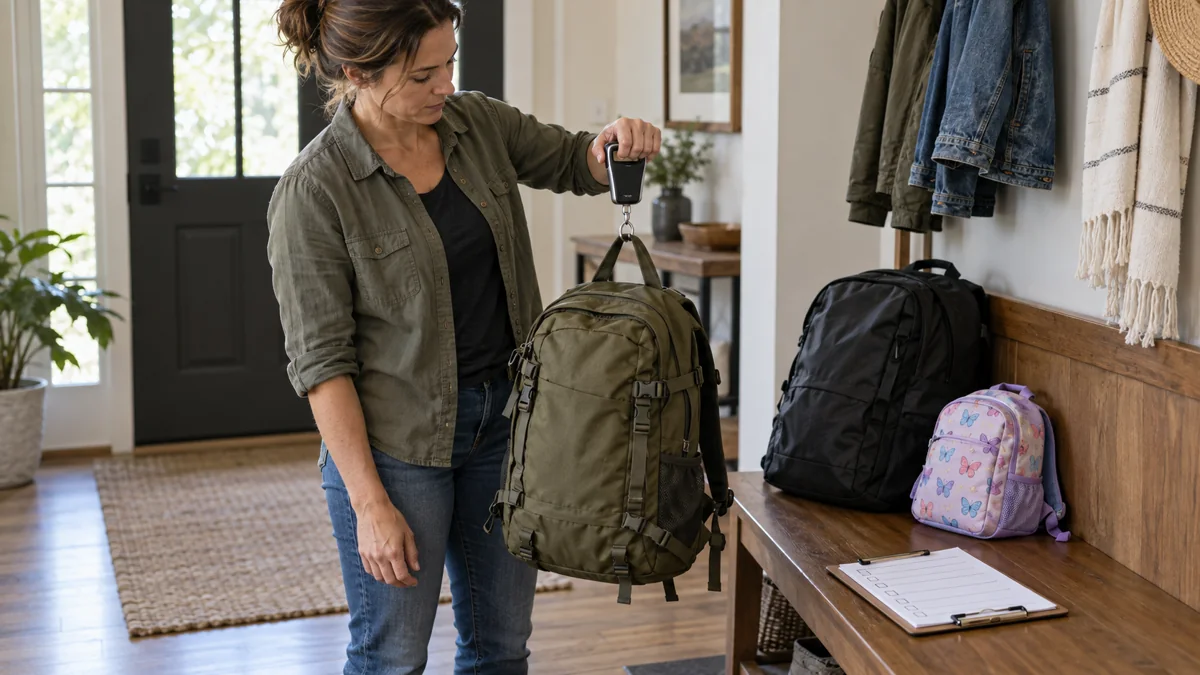
Weigh the complete bag separately from the spreadsheet. The workbook totals only known entered item weights, so blanks can make an inventory look lighter than the real bag. Keep units consistent and account for the bag itself, containers and items added at the last minute.
A useful spreadsheet total has a clear boundary
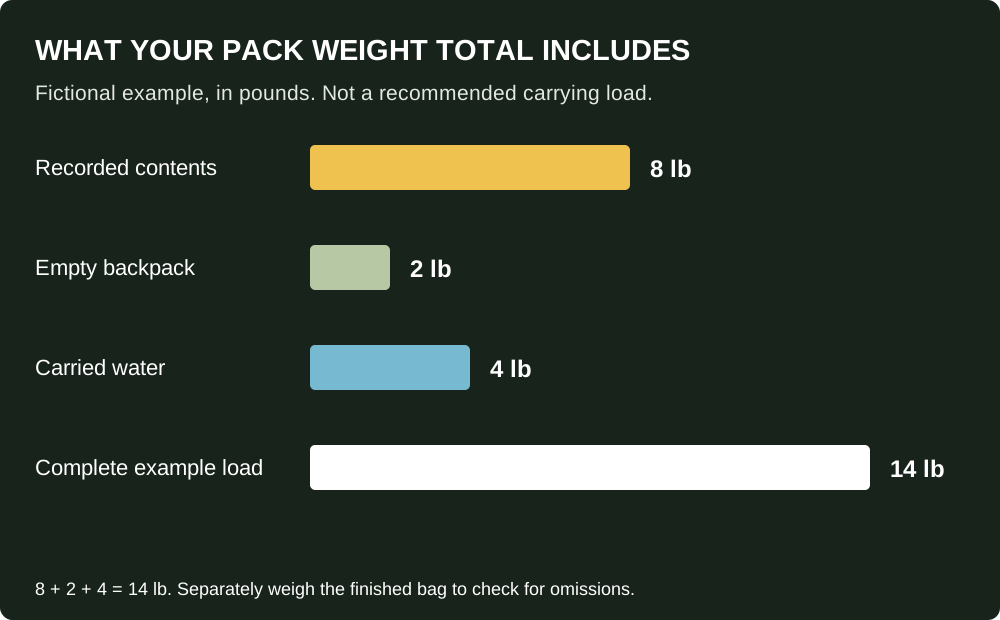
Here is a fictional inventory example. Recorded contents weigh 8 pounds, the empty backpack weighs 2 pounds and carried water weighs 4 pounds. The complete load is therefore 14 pounds before anything else is added. If the sheet contains only the 8 pounds of contents, its total is incomplete even when every entered formula is correct. These numbers demonstrate accounting, not a recommended adult or child load.
Create explicit inventory entries for the bag and for carried water if you want them included in the workbook total. Do not count the same water twice in both a shared-container entry and a personal-bottle entry. When an item has no measured weight, leave a visible note rather than silently treating the blank as proof it weighs nothing.
In the current workbook, “Needed” is your target and “Packed” is what is physically present. A plan to buy something next week does not belong in Packed. Mark the next action separately. This distinction makes the spreadsheet a useful preparation record instead of a wish list disguised as a completed bag.
If the load is too much, revisit allocation, unnecessary duplicates and the transport arrangement. Do not solve it by removing essential care items simply because they weigh something. A smaller inventory with clearly identified gaps is more honest than a completed checklist built on quantities nobody checked.
Review the plan when your household changes
Pick a review date, then also review after meaningful changes. A child's clothing size changes. A prescription changes. A phone cable stops matching the current device. Someone who agreed to help moves away. Those changes can matter more than whether a bag was purchased recently.
Our suggested review sequence is to empty one bag at a time, verify contents, replace or resolve unsuitable items and update the inventory. Check manufacturer dates and storage instructions. Confirm that the named carrier and destination still make sense. Keep a visible list of unresolved tasks with an owner and a date.
Do not make completion depend on buying everything immediately. Begin by recording what you have and the most important unresolved household needs. Avoid assigning an unverified purchase budget or a universal ready-made kit to every family. A product count does not show whether the contents fit your circumstances.
Questions families ask before packing
How many bags does a family of four need?
There is no universal bag count. Start with who can carry, who needs assistance and which supplies must be independently reachable. Two adult bags, a child's personal pouch and separate vehicle supplies may suit one household; another may need a different arrangement. Count responsibilities and loads before buying containers.
What is the difference between a family go bag and a home emergency kit?
A go bag is intended to leave with you. A home reserve can include heavier supplies that remain stored. Some items overlap, but their locations and transport assumptions differ. The earthquake kit guide separates bedside supplies, portable bags and household reserves in more detail.
Can we build the family kit on a budget?
Begin with an inventory of suitable items already owned, then prioritize unresolved essentials and individual care needs. Buy containers after understanding what they must hold. A blanket dollar target can hide important differences between households, so this guide does not assign one. Review existing supplies for condition and suitability before counting them as ready.
What should we leave out of the shared public checklist?
Leave out sensitive medical details, passwords, full account numbers and information exposing private document storage. Use the public checklist for categories and assignments; keep necessary personal information in an appropriately protected private record accessible to the people who need it.
Does every family member need a bug out bag?
Each person needs their needs accounted for, but separate bags are an organizational choice. A baby or a person needing assistance may depend on a caregiver's bag. Name the carrier and backup rather than assuming everyone can carry an identical pack.
Can one large bag hold everything for a family of four?
It might hold some shared supplies, but capacity is not the only issue. Consider who can lift it, whether personal essentials remain accessible and what happens if that bag is unavailable. Use the assignment table to distinguish personal, shared and transport-dependent supplies.
Is a 72-hour kit enough for every emergency?
No fixed duration guarantees that support or normal services will return. Three days is a common planning baseline, not a countdown to recovery. Local hazards, official advice, individual needs and the destination can require a different plan. Our 72-hour household preparedness guide covers the broader home-supply task.
Can I use the free Excel checklist for each person?
Yes. Save a separate working copy for each bag and use a household allocation note for shared supplies. The free editable workbook does not automatically consolidate several bags. Keep a clean master, preserve formula cells and verify the loaded weight separately.
What should we do first today?
Write the intended destination and available transport, list each person's care needs, then assign what you already have. Use the main checklist's worked example to learn the input fields. Finish with one specific unresolved task for each responsible adult. A useful family checklist tells you what still needs doing.
Sources and editorial method
This is a research-based household organization guide. Official references inform emergency supplies, water, infant feeding, pets and planning. The bag-allocation framework and fictional family scenario are original R&R planning examples, not field tests, clinical advice or an officially validated evacuation protocol. Follow current local instructions and individual professional advice where needed.
- Ready.gov family planning
- Ready.gov building a kit
- American Red Cross survival kit supplies
- CDC emergency water storage
- CDC supplies for infants and young children
- Ready.gov pet preparedness
- AAP disaster preparedness resources for families
- CDC emergency medical kit for children with special healthcare needs