
Quick answer
A bug out bag is a portable emergency kit for leaving home quickly. Start with drinking water, ready-to-eat food, needed medicines, essential documents, communication, lighting, weather protection, and personal hygiene. Add supplies for the people and animals coming with you. Then carry the packed bag, check that you can find things, and remove equipment that does not serve your evacuation plan.
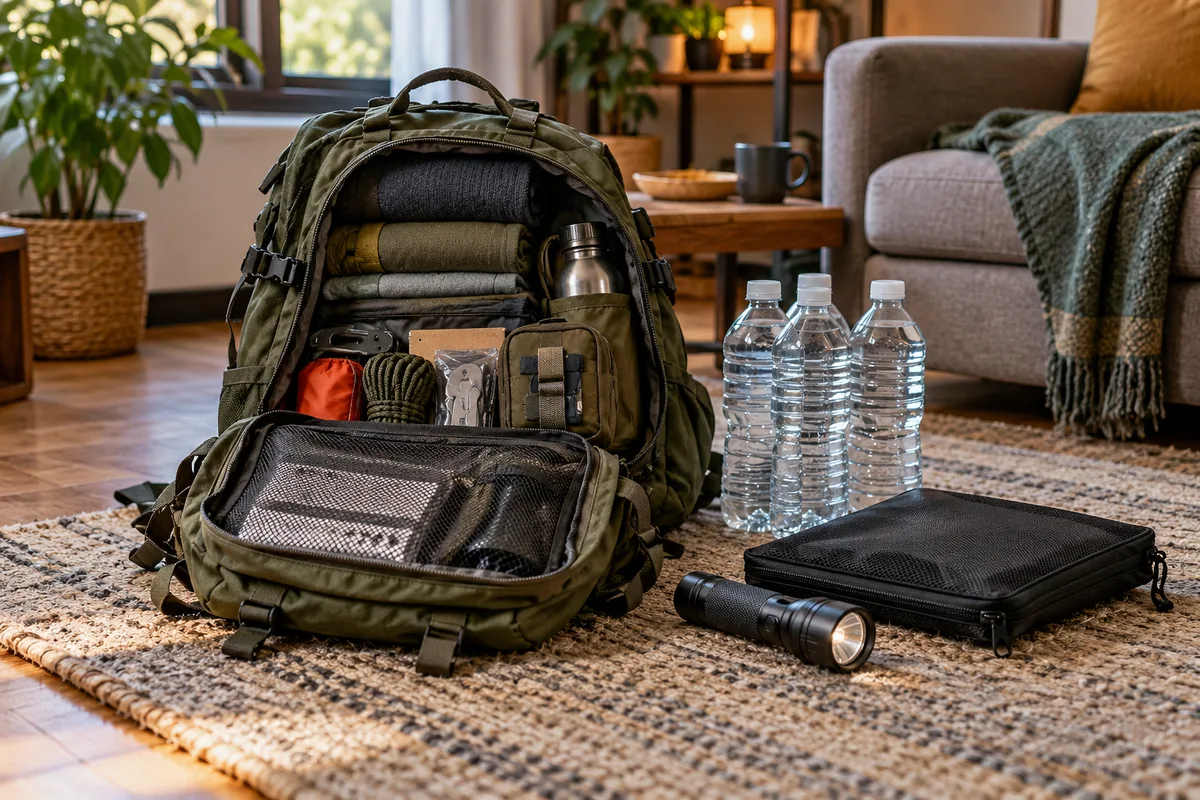
You do not need to look like someone heading into a wilderness expedition. Your destination might be a relative’s home, a hotel, or an emergency shelter. The difficult part may be getting everyone out of an apartment, finding your medication list, or charging a phone while you wait for transportation. A useful go bag is built around those moments. This guide offers a practical packing method, not a guarantee that a bag will make any evacuation safe.
Before packing: where are you going?
Write down two plausible destinations and how you would reach them. Include the person you would contact, the route you would normally use, and a backup arrangement if that route is closed. Follow evacuation instructions from local authorities; do not wait to complete a shopping list when you have been told to leave.
Picture the actual departure. Are you walking down several flights of stairs? Does someone need mobility assistance? Will one adult be carrying an infant? Will you have your own car, or depend on a pickup? The answer changes what you can carry and where shared supplies belong.
Use the term “72-hour kit” as a planning label, not a promise of independence. A bag may help with the first portion of an evacuation while larger reserves travel in a vehicle or remain at home. Do not reduce a person’s necessary drinking water simply to meet a fashionable pack weight. Plan transportation and resupply alongside the bag.
The core bug out bag checklist
Use this list as a starting point and write household-specific quantities beside each item. Ready.gov’s emergency kit guidance and the American Red Cross survival-kit list provide broader official checklists.
- Drinking water in containers you can manage, with a plan for additional safe water.
- Familiar ready-to-eat food that suits allergies and dietary needs.
- Needed medicines, a medication list, and essential medical supplies.
- Identification copies, emergency contacts, and important records in a protective pouch.
- Phone, correct charging cable, charged power bank, and written contacts.
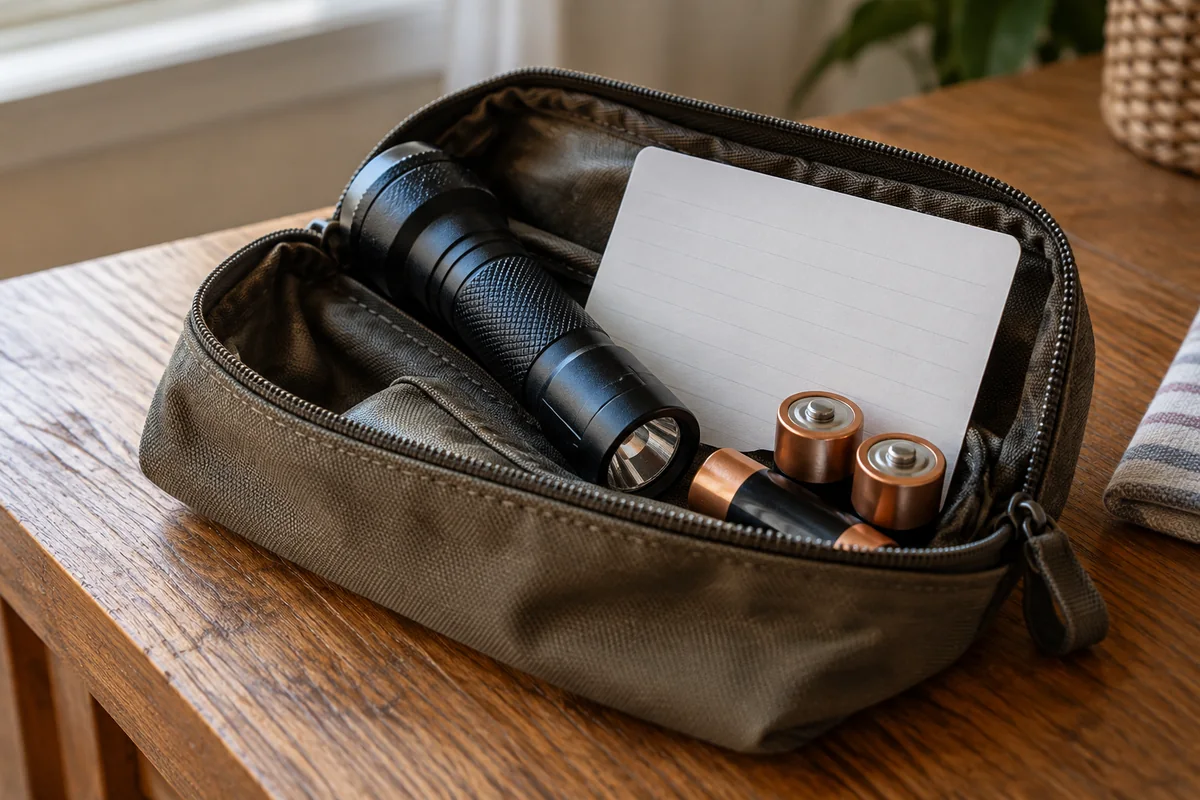
- Flashlight or headlamp, with compatible spare batteries where applicable.
- Weather-appropriate clothing, spare socks, and a compact blanket or other suitable warmth layer.
- Basic first-aid supplies that you know how to use.
- Hygiene supplies, menstrual products, and household-specific sanitation needs.
- Cash in manageable denominations, keys, glasses, and other daily essentials.
- Supplies for infants, children, pets, or anyone requiring assistance.
- A short packing list showing where critical items are located.
Choose the simplest version of an item that meets the need. A regular flashlight that you can operate confidently is more useful than an elaborate tool with controls nobody recognizes. The checklist is complete only when it fits your household, not when every possible gadget has been bought.
Water: separate the bag from the household reserve
Water is heavy, so avoid pretending that an ordinary backpack can comfortably hold every person’s full household supply. Ready.gov’s basic checklist uses one gallon per person per day for at least three days. That is a reserve-planning reference; it is not an instruction to carry the entire amount on your back. See the official basic kit checklist.
Choose a portable portion and document where additional safe water will come from. If travelling by car, securely packed extra containers can be part of the vehicle load. If leaving on foot, accessible transportation and a known destination matter even more. Needs vary with conditions and the person, so do not treat a bottle count as universally sufficient.
Keep caps accessible and inspect containers for leakage. Separate water from paper records and electronics. A compact outdoor filter is not permission to drink floodwater or water affected by chemical contamination. For a home reserve, use our small-apartment water storage guide. Outdoor treatment belongs to a separate, source-specific decision.
Food that works without a kitchen
Select foods you already eat and can open with the equipment in the bag. Imagine eating them while sitting in a car or waiting at a shelter. A product that requires a pot, fuel, washing water, and a long preparation process creates more dependencies than its packaging suggests.
Put dietary restrictions on the packing record. Keep a manual opener if any chosen food needs one. Consider mess, portion size, and the amount of waste created. Several manageable servings can be easier to use than one large container that needs refrigeration after opening.
Mark the earliest review date on the food pouch, then rotate through ordinary meals. If an item is consistently left uneaten at home, it is a poor candidate for an unfamiliar emergency meal. Avoid a menu made entirely from expensive specialist products unless they meet a real need. This is a practical selection approach, not a nutritional prescription; seek individual advice when a medical diet requires it.
Medicines and medical information
Ask your pharmacist or prescriber how to prepare for disrupted refills, travel, refrigeration, and power. Requirements differ by medicine and device. Do not move prescriptions into anonymous bags or apply food-storage rules to medical products.
Make a current medication record with names, instructions, relevant allergies, and contact details. Keep it readable without unlocking a phone. Decide who carries it and who can explain a person’s needs if the usual caregiver is unavailable.
Daily-use equipment needs a departure reminder. Glasses, hearing aids, mobility devices, or a medication kept elsewhere cannot simply be left permanently in a backpack. Attach a short “add when leaving” card to the bag. Avoid relying on memory for this final step.
A prepacked first-aid pouch can reduce rummaging, but supplies do not replace training. Learn the limits of what you can safely do. Do not let medical supplies become scattered across several pockets whose contents no one else knows.
Documents, contacts, and privacy
Pack only records needed for your realistic destination and circumstances. Useful candidates include identification copies, insurance information, a household contact sheet, and records relevant to dependents or pets. Protect papers against ordinary moisture while keeping them easy to retrieve.
Keep sensitive information inside the bag, not on an external label. An outside tag can identify the owner without advertising account numbers or detailed medical records. Consider what would happen if the bag were lost in a crowded location.
Include an out-of-area contact and a household meeting arrangement. Write numbers down rather than assuming your phone will always work. Record the address of a destination as well as its nickname; someone helping with transport may not know what “Aunt’s place” means.
Back up important records securely according to your own privacy needs. A digital copy is useful redundancy, but it should not be the only way to find an emergency contact when battery power or access is unavailable.
Lighting and communication
Keep a light in a pocket that you can find without unpacking food or clothing. Test its switch in normal conditions, then try locating it with the room lights off. Keep battery types simple where practical. A bag full of incompatible batteries is harder to maintain.
Match the charging cable to the actual phone. Label shared cables if family members use different connectors. Charge the power bank before storing it and set a review reminder. Check the device instructions for storage, travel, and temperature restrictions.
Download useful maps and keep an address list, but do not confuse downloaded information with a functioning communication network. Discuss who will update the household contact person. Agree on a brief message format: who is together, where you are going, and whether help is needed.
An emergency radio may support access to local broadcasts. Learn how to tune it before relying on it, and confirm which station or alert service is relevant to your area. Avoid buying communication equipment you do not know how to operate.
Clothing and personal comfort
Pack for the weather you could actually encounter while leaving, waiting, and arriving. Indoor clothing may be inadequate for a long wait outside. A spare layer is useful only if it fits the person and can be put on without emptying the bag.
Use a small labelled clothing pouch for each person. Keep socks and other dry essentials protected. Review children’s sizes as they grow. Clothing packed a year ago may technically still be present while being practically unusable.
Comfort items deserve a deliberate place, especially for children, but keep them compact. A familiar object can be easier to carry than a large collection of toys. Include personal hygiene supplies that preserve dignity during an unexpected overnight stay.
Do not treat an emergency blanket as a complete cold-weather sleeping system. Match protection to circumstances and arrange a suitable destination. Where exposure is a concern, follow official local instructions instead of attempting to make a backpack substitute for safe shelter.
Children, pets, and people needing help
Write a separate needs card for each dependent. Include food, daily care, necessary equipment, and the person responsible for transporting it. Shared assumptions are easy to miss: each adult may believe the other packed the child’s essentials.
Pet planning includes a manageable carrier or restraint, food, water, medication where needed, and relevant records. Check the destination’s pet arrangements ahead of time; do not assume every lodging option accepts animals. Keep the animal’s supplies identifiable without making them the heaviest part of an already overloaded bag.
Plan accessibility before the emergency. A wheeled case might help in some settings but become awkward on stairs. A backpack may leave hands free while being unsuitable for a person with pain or balance difficulties. The right container is the one that works with the person and route.
Include a trusted neighbour or contact where appropriate. Assistance should be discussed in advance rather than assumed from proximity. Write down the backup arrangement if that person is away.
Pack for retrieval, not appearance
Divide the bag into immediate-use, arrival, and reserve items. Put lighting, essential contacts, medicines, and weather protection where they can be reached quickly. Group hygiene supplies and clothing so the contents do not spill everywhere when one item is needed.
Keep a simple inventory just inside the opening. It should say what is present, where critical items are, and which items must be added at departure. You do not need an elaborate colour system; plain labels are easier for another person to understand.
Choose a bag that opens conveniently and does not have damaged straps or unreliable closures. Use what you already own if it meets the need. Tactical styling, camouflage, or a premium logo does not establish usefulness.
Leave room for the last-minute essentials. A pack filled tightly to the zipper during preparation may not accept the medication pouch, glasses case, or device charger that must be added later.
Rehearse a realistic departure
Try this ordinary practice session when there is no emergency. Put on suitable shoes, add daily-use essentials, pick up the bag, and move along the route you expect to use. Do not obstruct communal exits or involve others without agreement.
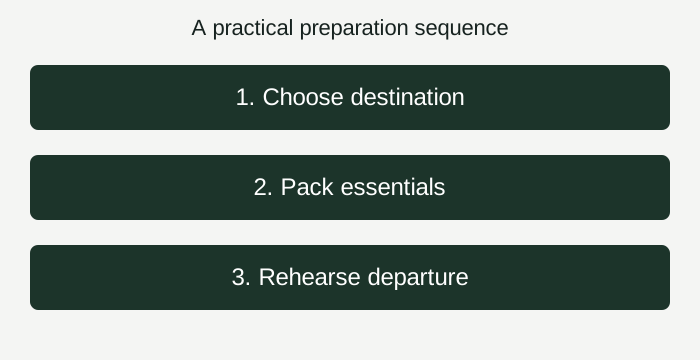
Notice the practical problems. Does the handle dig into your hand? Can you carry the bag while helping a child? Are keys buried? Is there a strap that catches on a doorway? Fix the awkward part instead of adding equipment.
Next, find five items without laying everything on the floor: light, contact sheet, water, medication record, and weather layer. Ask another household member to do the same. If they cannot locate the essentials, improve the labels and pocket arrangement.
This is a packing rehearsal, not an evacuation drill that overrides building or local safety rules. Follow the applicable emergency plan for actual incidents.
Maintenance that stays manageable
Review the bag when household needs or seasons change and before forecast disruptions. Check food dates, water containers, battery charge, clothing fit, medical information, and contact numbers. After borrowing an item, replace it promptly and mark the change.
Keep a small replacement list rather than emptying the entire bag every time you inspect it. Use our supply tracker to record review dates if that suits you; entries stay in your browser, so keep a separate backup where needed.
Store the bag where it can be retrieved without blocking an exit. Tell everyone where it is. If several bags look alike, label them clearly enough to distinguish ownership at a glance.
Start with one workable bag and a known destination. Add only what solves a genuine gap. The strongest improvement is often a better departure plan, not another item.
Questions about go bags
Is a bug out bag different from a go bag?
The names are commonly used for the same evacuation-oriented portable kit. Focus on destination, household needs, and carryability rather than terminology. A home supply reserve and a vehicle kit serve related but different purposes.
Should I buy a premade survival kit?
A premade kit can be a starting point, but compare every item with your plan. It will not automatically include personal medicines, correct contacts, suitable clothing, or the right charging cable. Inspect quality and fill those gaps before relying on it.
Where should I keep it in a small apartment?
Choose an accessible place that remains clear of exits and ordinary household traffic. Keep essential records protected and temperature-sensitive items according to their instructions. Our emergency supply storage guide helps you plan a workable layout.
Keep a local checklist
Download the plain-text checklist and print or save the relevant official instructions before you need them. Review this guide for the conditions behind each item.
Download all 11 free planning checklists (ZIP). No sign-up required. Complete and print the sheets locally; read each guide for safety context.