
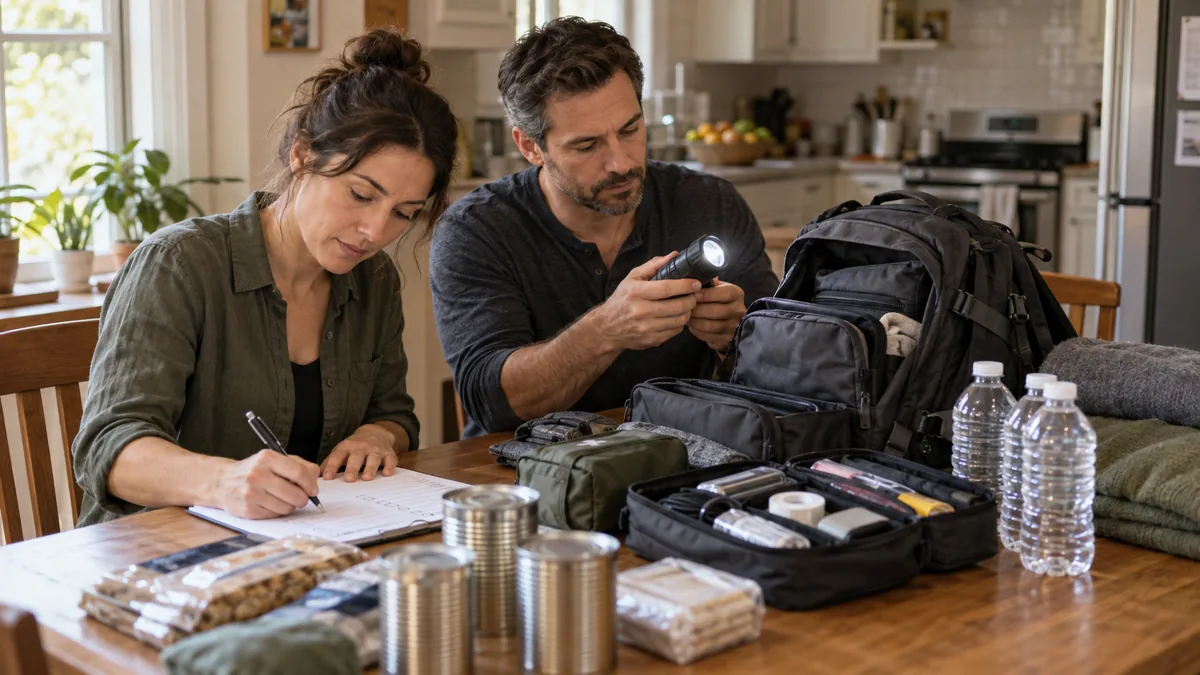
A packed bag can still have missing functions
The easiest mistake is counting an item without checking whether it works. A flashlight can be present with no usable power. A water container can be full but difficult for its intended carrier to lift. A printed contact list can be neatly packed and already out of date. Maintenance closes the gap between owning supplies and being able to use them.
Our approach is to review the job each item must do, then record one specific next action. That gives you a more useful result than another long shopping list. This guide is for household emergency supplies in the United States and other Western markets; local authorities and product instructions determine the details that apply to your situation.
Start with the bug out bag checklist and free Excel inventory if you have not recorded your supplies yet. This page covers what happens afterward: inspection, rotation, repair, replacement and an honest record of what remains unresolved.
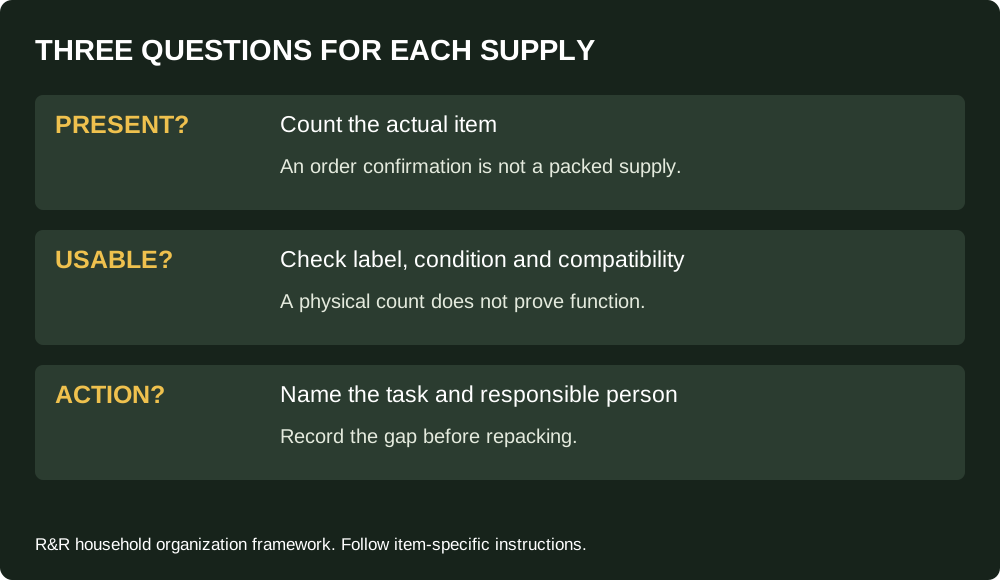
How often should you check your emergency kit?
Choose a recurring full review that your household will actually complete. A six-month household appointment is a practical organizational choice, not a universal shelf-life rule. Check sooner after using supplies, moving the kit, exposure to water or excessive heat, a household change, a recall or a manufacturer-specified deadline. Do not wait for the calendar appointment to replace something already damaged or expired.
The American Red Cross recommends annual first-aid-kit review and replacing expired or damaged components. The CDC gives a specific six-month replacement interval for water you fill into storage containers yourself; commercially bottled water follows its labeled expiration date. These are different instructions for different items. A single date written on the outside of a bag cannot replace them.
Book the next review before you repack. Assign a person, a date and a location. “Check supplies sometime” is easy to postpone; “review the hallway bag on Saturday and record missing batteries” is a task someone can finish.
| Trigger | Review task | What controls the deadline |
|---|---|---|
| Recurring household appointment | Count supplies, inspect condition and update locations | Your chosen routine; earlier item-specific instructions still apply |
| Home-filled stored water | Replace and update container dates | CDC: every six months |
| Commercially bottled water | Check label and storage condition | Labeled expiration date |
| First aid and medicines | Check individual labels, packaging and storage | Product instructions; pharmacist for medicine questions |
| After use or a household change | Replenish quantities and update responsibilities | As soon as practical; do not wait for the next appointment |
The emergency kit maintenance checklist
Work on a clean, dry surface with enough room to separate items. Keep household medicines secure and away from children throughout the review. If an active emergency is already underway, follow official instructions rather than delaying action to complete this routine.
- **Locate every supply group.** Find the portable bag, home reserve, vehicle supplies and everyday items that must be collected separately.
- **Inspect the containers.** Check the bag, pouches, water containers and closures for damage, moisture, leakage and obvious contamination.
- **Compare the inventory with reality.** Count what is physically present. A receipt or an order confirmation does not mean an item is packed.
- **Read individual labels.** Record relevant expiration dates, storage conditions and manufacturer maintenance instructions.
- **Check compatibility.** Match lights to batteries, devices to cables and containers to the fittings needed to use them.
- **Identify household changes.** Revisit clothing sizes, care needs, pets, contacts, transport and assistance arrangements.
- **Write the next action.** Separate replenishment, repair, professional advice and items intentionally removed.
- **Repack for retrieval.** Put supplies where another responsible household member can find them.
- **Check the complete load.** Include the bag and carried water rather than relying only on entered component weights.
- **Date the review.** Record who checked it, unresolved gaps and the next appointment.
The printable emergency kit maintenance checklist provides a one-page record. The editable Excel inventory is better for changing quantities and keeping locations or next actions alongside each entry. Neither download requires an account or contains product links.
Water storage dates need their own record
Separate commercially bottled water from water you fill at home. For home-filled storage, follow the CDC’s container cleaning, filling, labeling and storage instructions, and replace the water every six months. Follow the labeled expiration date on store-bought water. Avoid assuming that an intact-looking container proves its contents are safe after poor storage or contamination.
Record the storage date and next action on the container as well as in the inventory. A spreadsheet is useful when planning, but the person retrieving water may not have access to the file. Keep identification readable and do not cover necessary manufacturer information.
Inspect closures and the space around the containers. Check that they remain accessible and separated from household chemicals. If you moved your reserve, update the location rather than leaving the old address in the worksheet. Our small-apartment emergency water storage guide explains the space and access questions in more detail.
Do not count the same water in two plans. Water kept at home is not automatically available during an evacuation, and an empty refillable bottle is not a stored supply. Keep the portable quantity and the household reserve identifiable as separate arrangements.
Food rotation without unnecessary waste
Read the instructions on each product rather than applying one replacement interval to every food. Record dates that matter for your supplies and storage conditions, inspect packaging and replace items that no longer meet the applicable guidance. A package that is leaking or damaged needs attention even if its printed date is months away.
Choose suitable emergency food you can reasonably rotate through ordinary household use. Put the earlier-use items where they will be noticed and update the packed quantity when they leave the kit. Consuming a packet for lunch and forgetting to replace it is an inventory problem, not a failure to buy enough supplies in the first place.
Check whether the food still suits the people who may use it. Allergies, feeding needs and the ability to open or prepare packaging can change. Record any required preparation equipment as a dependency. If a food relies on cooking or added water, those arrangements must be considered separately rather than silently assumed.
A useful next action names both the item and the task: “replace two suitable ready-to-eat portions” is clearer than “food needs work.” Avoid putting private medical details into a document that may be shared outside the household.
First aid and medicines are not one expiry date
Inspect the individual components in a first aid kit. The Red Cross explains that the date on a kit may identify the first component due to expire, not every item inside it. Check packaging condition and each relevant label rather than discarding an entire kit automatically or assuming the outside date covers everything.
Separate organizational decisions from medical decisions. An inventory can show that an item needs replacement; it cannot decide whether a medicine remains suitable, authorize a different dose or solve a temperature excursion. Ask a pharmacist or relevant care professional about medicine storage, refill arrangements and individual needs.
Keep a private record of what must be collected from everyday storage. Where a medicine cannot remain permanently in the bag, identify who collects it and who is the backup. Do not label that task “packed” merely because it appears on the checklist.
Maintain privacy while keeping necessary information accessible to the appropriate person. A public or shared workbook should not expose prescription details, identity numbers, access codes or sensitive document locations. First-aid supplies also do not replace training or emergency assistance.
Test the light-and-power combination
Treat a flashlight and its power source as one usable arrangement. Check the device according to its instructions, confirm the correct battery type or charging connection and inspect for visible damage. A bag containing several unrelated cables may still lack the one needed by its phone or lamp.
For rechargeable devices, follow the manufacturer’s storage and charging guidance. Do not invent a universal recharge interval or assume that a charging indicator proves how long a device will operate. If the manufacturer specifies a maintenance task, record it with that device.
Check spares without mixing incompatible battery types or relying on damaged components. If a device or battery appears damaged, follow manufacturer advice rather than experimenting with repairs during the review. Keep an unresolved fault visible in the inventory until it is addressed.
Our apartment power outage checklist covers the wider household plan. This maintenance check has a narrower purpose: verify that the equipment you already count is present, compatible and maintained as instructed.
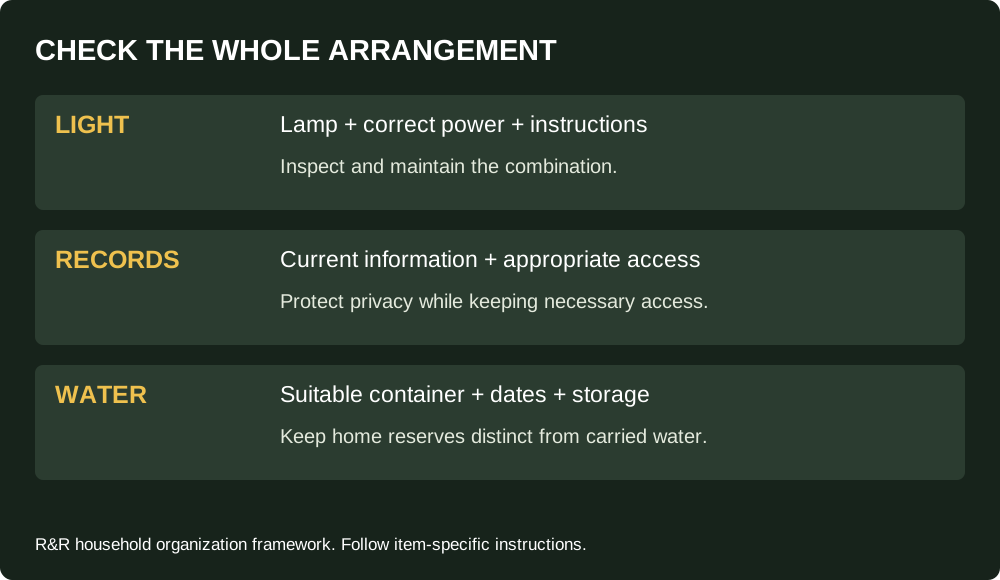
Update documents, contacts and everyday collection tasks
Look at the information another household member would need. Are the telephone numbers current? Does the agreed meeting arrangement still make sense? Is an appropriate offline copy available if a device cannot be used? Check access without placing private credentials in an openly shared file.
A document can be current and still inaccessible. Avoid relying on one person's memory of a folder name or on a locked phone that nobody else can use. Decide what information the appropriate responsible person needs and store it with suitable privacy protections.
Keep last-minute collection tasks separate from packed contents. A short note should identify the item, its usual location, the responsible person and a backup. Review the arrangement after a move, a change of caregiver or a change in routine.
You do not need to copy every personal record into every bag. Select what is appropriate to your plan and protect it. This is a household organization exercise, not a reason to create extra uncontrolled copies of sensitive information.
Recheck children, pets and assistance arrangements
Clothes and supplies that fitted last season may not fit now. Review current-size clothing, feeding and care requirements, familiar items and the adults responsible for them. A child's small backpack is not a substitute for adult responsibility for essential supplies.
Use the family bug out bag checklist to assign personal and shared items. When you transfer a shared pouch to a different bag, update both records so that two people do not count the same physical supplies.
Check pet identification, suitable transport or restraint arrangements and the destination's requirements. Record what needs verification rather than assuming every shelter or accommodation accepts the same animals and equipment.
If someone needs help retrieving supplies or moving, review who can provide that help and what happens if that person is unavailable. For renters, the earthquake preparedness guide for apartments separates household tasks from questions for building management. An equipment checklist cannot certify a building or guarantee assistance.
A worked inventory example
Consider a fictional household with one portable bag and a separate home reserve. Its workbook lists two flashlights as packed. During inspection, one light works and the other does not turn on with its intended power arrangement. The household does not need to invent a readiness score; it needs to record the fault and resolve it.
Keep the physical inventory accurate and distinguish it from condition. If two lamps are present, recording two physically packed lamps may be correct, but the next-action field must make clear that one is not usable. Alternatively, keep a separate usable-quantity record if you extend the template. Do not silently redefine a column halfway through the list.
| Fictional finding | Inventory entry | Next action |
|---|---|---|
| Two lamps present; one does not work | Physical count remains two; note one unresolved fault | Inspect per instructions; replace or repair appropriately |
| No date recorded on a container | Date unknown | Check the record; do not invent a filling date |
| Shared pouch moved to another bag | Update location in both records | Confirm only one household quantity is counted |
| Everyday medicine not permanently packed | Collection task, not a packed quantity | Confirm private instructions and responsible person |
The same household discovers that one water container was moved from a closet to the garage. That creates a location and storage-condition question, not automatically proof of unsafe water. The next action is to assess the actual conditions against the relevant instructions, update the record and take the appropriate replacement action if needed.
The point is to make uncertainty visible. A blank date or unknown condition is not a pass, but it also does not justify a fabricated expiry date. Write “check label” or “ask manufacturer” and assign an owner.
Keep the Excel inventory useful after the review
Download a local copy and preserve an untouched master. Use a recognizable filename and decide which household copy is authoritative. Independent copies do not merge automatically, so agree who records changes and how everyone sees the latest version.
Enter quantities and unit weights in the intended input fields and preserve the formula cells. The workbook's missing-quantity calculation concerns counts; it does not detect a broken lamp, expired medicine or an inaccessible container. Those findings belong in the condition notes or next actions you maintain alongside the inventory.
Use pounds consistently for the existing weight calculation. Blank weights are excluded from the known-weight total, so do not present that total as a measured complete load. Weigh the packed bag separately and consider the actual carrier's circumstances without relying on an invented universal safe limit.
If you import the file into another spreadsheet application, verify the calculations and formatting before relying on them. The download is an Excel workbook, not a hosted Google Sheets document or an automatic reminder service. Put appointments in a calendar you already use; this worksheet will not notify you by itself.
Finish with three decisions
At the end of the review, identify what is ready to repack, what needs action and what requires an answer from someone else. This is a simple organization method, not a validated safety rating. Do not hide an unresolved critical gap behind a checked box.
Repack so that the intended person can retrieve the supplies without unpacking everything else. Put the review record somewhere appropriate and let the other responsible household members know what changed. If an essential item remains in everyday use, keep the collection task visible.
Then schedule the next review and close the inventory. A short, maintained record is more useful than a perfect-looking spreadsheet nobody updates. You can return to the complete emergency kit checklist for broader planning context or the earthquake emergency kit guide for that hazard's supply considerations.
Questions about emergency kit maintenance
Does every emergency supply expire after six months?
No. Six months is not a universal product life. Home-filled stored water has a specific CDC replacement interval; medicines, food, batteries and equipment have their own labels and instructions. A household review appointment does not override them.
Do I need to replace the whole first aid kit?
Check individual components and the container. Replace expired, damaged or unsuitable supplies according to the relevant instructions. An outside kit date may refer to the earliest-expiring component rather than everything inside.
Can I use the spreadsheet as an expiration tracker?
You can record dates and next actions, but this workbook does not automatically decide product safety or send reminders. Check the actual label, keep dates understandable and use your own calendar for follow-through.
Should I buy more gear before checking the kit?
Start by identifying what you have and what your plan requires. Inspection can reveal a missing cable, an outdated location or duplicated shared supplies. Buying another complete kit may leave those problems unresolved.
What changes should trigger an extra review?
Review after supplies are used, storage conditions change, a kit is moved, household needs change or a relevant product notice requires action. Follow any earlier deadline set by the product instructions or a qualified professional.
Sources and scope
This research-based household workflow combines original inventory examples with specific supply guidance from the CDC emergency water storage page, the American Red Cross first-aid-kit expiration guide and the Red Cross emergency supply list. Sources checked October 16, 2026. Fictional examples illustrate record keeping; they are not household field tests. Follow local emergency directions, product instructions and individual professional advice where applicable.