PREPAREDNESS / MONEY & PAYMENT OUTAGES
If Cards and ATMs Stop Working, How Much Emergency Cash Should You Keep?
A working bank balance does not always mean a working checkout. Build a sensible cash reserve around the purchases your household would actually need.

THE SHORT ANSWER
How much cash should you keep for emergencies?
Keep enough physical cash to cover the essential purchases your household may need during a short payment outage, using your own local prices. Start by budgeting for three days, add likely one-off transport or care costs, and adjust for local emergency guidance. Use small bills and some useful change. Build the reserve gradually and keep the amount proportionate to what you can safely afford and protect.
There is no single amount that fits every household. A stocked home, a family with an infant, and someone who may need to evacuate have different cash needs. The calculator below makes those differences visible.
WATCH / ORIGINAL R&R EXPLAINER
Your payment backup, explained in 77 seconds
Real cash, checkout and planning footage, with an original animated budget, voiceover and captions.
Open the dedicated video page · Use the cash calculator
Read the video transcript
Your card fails. The ATM is down. How much emergency cash should you have? Start with the essential purchases your household would still need, not a random round number.
Count daily food, water, transport and care costs for your whole household. Allow for supplies already at home. Choose a planning period, then add one-off expenses and a buffer.
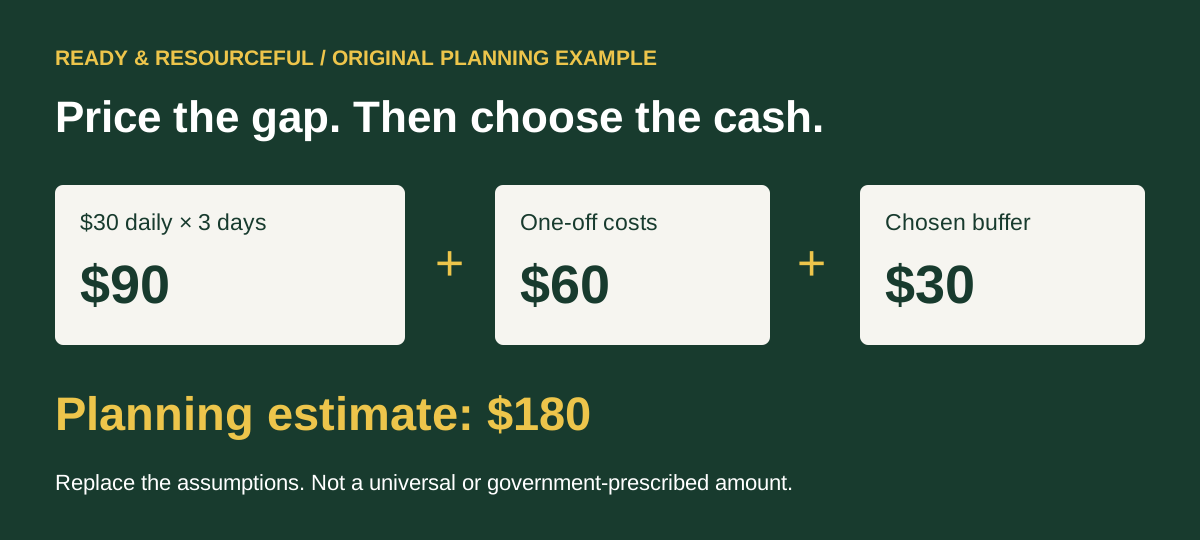
For example, thirty dollars a day for three days is ninety dollars. Add sixty in one-off costs and thirty as a buffer. That makes one hundred eighty dollars. This is an example, not a government recommendation.
Keep a useful mix of small bills. Build the reserve gradually, without missing essential bills or medication. Your payment backup is different from your longer-term emergency savings.
Cash cannot guarantee a purchase. Shops may be closed, fuel pumps may need power, and some services may require a card. Plan supplies and alternatives, too.
Protect your cash from theft, water and fire, while keeping it accessible. Use the free Ready and Resourceful cash calculator, print your plan, and review it when your needs change.
Footage and production credits
Pexels license. Original R&R edit, animated budgeting example, English synthetic narration and original quiet instrumental music. Illustrative stock footage from 2021; not a record of an actual outage. No endorsement by the people shown is implied.
You reach the checkout with food in your basket. Your card fails. The ATM outside is unavailable, and your phone wallet cannot complete the transaction either. Having money in an account and being able to spend it are suddenly different problems.
That is the problem an emergency cash reserve addresses: temporary access to everyday essentials. It cannot reopen a closed pharmacy, run an unpowered fuel pump, or make an unsafe trip worth taking. A useful plan combines cash, supplies already at home, several payment options, and a way to receive local instructions.
What authorities actually recommend in 2026
The guidance below was checked on October 29, 2026. It reflects different countries, currencies and planning assumptions. These are local benchmarks—not interchangeable amounts and not exchange-rate targets for an American household.
| Authority / location | What the guidance says | How to use it |
|---|---|---|
| United States: Michigan emergency preparedness | Keep a small amount safely at home, including small bills, because cards and ATMs may be unavailable. | This source gives no universal dollar target. Calculate your household’s likely purchases. Read the guidance. |
| Netherlands: De Nederlandsche Bank | €70 per adult and €30 per child for essential expenses during the first 72 hours; adjust for personal needs. | Two adults and two children gives €200 under that Dutch guideline. Read DNB’s explanation. |
| Sweden: Sveriges Riksbank | A benchmark of around SEK 1,000 per adult, in mixed denominations; smaller amounts can still improve preparedness. | Pair the benchmark with a household assessment. Swedish civil-defence guidance also emphasizes having necessities for a week. Read the Riksbank’s advice. |
| United Kingdom: Be Ready | Keep a small amount of cash for essential purchases if electronic payments or ATMs are disrupted. | The power-cut page does not specify a fixed pound amount. Read the power-cut guidance. |
The shared principle is practical: have a way to pay if your usual method becomes unavailable. Differences in the published amounts do not establish that one country expects an earlier or more severe emergency. For the wider context, read our comparison of household preparedness guidance across countries.
Emergency cash calculator: price the purchases you still need
Use costs for your whole household, not a per-person amount. Count only purchases you expect to need after allowing for usable supplies already at home. Change the currency label to your local currency; the tool does not convert exchange rates or retrieve prices.
This is an original R&R budgeting method, not an official formula or a guarantee that shops will be open.
Before accepting the total: check that it does not divert money from rent, utilities, food or medication. A large result may reveal a need for a safer evacuation arrangement, a supply gap or support from family and local services—not a reason to withdraw more than you can protect.
How much might a household need? Three transparent examples
These are fictional budgeting examples in US dollars. They are not government recommendations, current market-price estimates or a range every reader should adopt. Replace each assumption with a realistic local cost.
| Example | Daily purchases | Three days | One-off + buffer | Cash target |
|---|---|---|---|---|
| One adult, useful supplies at home | $30 | $90 | $60 + $30 | $180 |
| Family, larger remaining essentials | $60 | $180 | $120 + $60 | $360 |
| Household with a separate evacuation allowance | $60 | $180 | $360 + $120 | $660 |
The last household needs more because of the assumed one-off expense, not because its cash must last longer. Likewise, a well-stocked household might need less than the first example. For a seven-day plan, update the number of days and reassess the one-off costs; simply multiplying a three-day total would wrongly multiply those costs too.
Start with the items cash cannot replace
Having food that does not need cooking and stored drinking water reduces the purchases you depend on making during an outage. Keep transport fuel and medical arrangements in your broader plan. Do not assume a cash reserve can obtain an urgent prescription or power an essential medical device.
What denominations should emergency cash be in?
Choose a useful mix that lets you pay small amounts without relying on a retailer to make change. Philadelphia’s Office of Emergency Management specifically includes ones, fives and tens in its go-bag guidance. Larger notes can be less convenient for a small purchase when change is scarce.
An illustrative $200 bill mix
- 5 × $20 = $100
- 5 × $10 = $50
- 6 × $5 = $30
- 20 × $1 = $20
Total: $200 in 36 bills. This demonstrates a mix, not an official allocation. If you add coins, account for them within your chosen total. Adapt denominations to your currency and likely purchases.
Some transit systems, parking machines and ticketing services have their own payment rules. Useful coins for one town may be useless on another town’s cashless bus. Check your actual options during normal conditions, and keep notes in usable condition.
Where should you keep emergency cash?
Choose a secure place you can reach when needed, with appropriate protection from water and fire. The FDIC’s disaster guidance suggests a waterproof bag inside a fire-resistant box or safe, and warns against keeping more cash at home than immediate disaster needs justify. Storage must also fit your household: a container that children can easily open or a location inaccessible to the person evacuating is a poor fit.
- Protect it without making it unreachable. Know who can access the reserve and what happens if the usual person is away.
- Decide what travels. If some cash goes in a go bag, count it as part of the same reserve. Moving $50 from home to a bag does not create an extra $50.
- Keep locations private. Avoid posting amounts, hiding places or pictures identifying your home’s storage arrangement.
- Check the protection you actually have. Product labels and an insurance policy’s cash limits need checking. Do not assume a document pouch, small portable lockbox or “fireproof” marketing claim guarantees protection against burglary, flooding or a house fire.
Physical banknotes at home are not FDIC-insured deposits. The FDIC also excludes safe-deposit-box contents from its deposit insurance coverage. A bank box may be useful for certain records, but is an awkward sole location for outage cash if the branch cannot be accessed.
Use an existing suitable container before buying equipment. If you need storage, compare independently specified fire and water protection, dimensions, access and anchoring options. A costly safe should not consume the money you needed for essentials.
If cards and ATMs stop working: a practical sequence
- Find out what has failed. A single card, bank, retailer connection or ATM may be affected. Check the provider’s official app or previously verified contact details when communication works.
- Ask what the merchant can accept. Another physical card or payment method may work in a limited outage. Ask whether an unsuccessful attempt created a pending charge before making repeated payments.
- Use cash for necessary purchases when safe. Ask about change before handing over a large bill. Record spending and keep receipts where possible.
- Preserve supplies and follow local instructions. Avoid unnecessary journeys just to test ATMs. Plan how you will receive updates and contact family without ordinary cell service.
- Review after service returns. Check transactions, report problems through official channels, replenish cash gradually and update your figures.
Why cash is useful—but cannot guarantee a purchase
A shop may be closed, unsafe, out of stock or unable to process sales. A fuel pump and other equipment may need power even if a cashier accepts banknotes. A hotel may require a card for incidentals or a deposit. Check arrangements before relying on them.
In the United States, the Federal Reserve explains that federal law does not generally require private businesses to accept cash for goods or services; state requirements can differ. Do not assume “legal tender” means every checkout must accept your notes. Verify applicable local rules if the distinction matters to your plan.
Several payment options help most when they have different dependencies
The Riksbank recommends physical cards, different card networks where possible, mobile payments and cash. Two apps relying on the same unavailable phone or account do not remove that dependency. An alternative can help in some failures; it does not guarantee payment during a wide power or communications outage. Remember your PIN without writing it on your card, and follow your bank’s security instructions.
What if you cannot afford the target yet?
Start with what is manageable. A small amount in usable notes can still provide an option. Choose a gradual contribution that leaves essentials paid for; do not borrow at high cost simply to hit a preparedness number.
Work on a second track at the same time: reduce what you must buy during a disruption. Use ordinary pantry purchases you will eat, keep accessible contact information, agree on help with a trusted person, and find local emergency support information before you need it. Shared planning matters especially if someone cannot carry cash, travel independently, recognize notes or communicate easily with a retailer.
Review the reserve after using it, after household changes, and when local prices or likely evacuation arrangements change. Add a check to your normal preparedness review: count it privately, confirm denominations, check access, and update the spending estimate. Avoid leaving a forgotten amount untouched while your needs change.
Emergency cash questions, answered
Is $200 enough emergency cash?
It may cover some households’ short-term purchase needs, but it is not a universal target. Price the essentials you still need, add one-off costs and a buffer, and compare the result with what you can afford and protect. The Dutch €200 example applies to two adults and two children under that country’s 72-hour guidance; it is not a $200 US rule.
Should I keep $1,000 in cash at home?
Only if that follows from your needs, affordability and safe storage. A round number alone is not a plan. Review the actual expenses it would cover and the risk of loss. A payment outage reserve does not require withdrawing your broader emergency savings.
How much emergency cash should a family of four keep?
Use whole-household costs and the number of days you are planning for. Our fictional family example totals $360 for three days, including its stated one-off costs and buffer. A different family could need less or more. Follow any applicable local guidance and make separate arrangements for evacuation or care needs.
Should emergency cash be in a go bag or at home?
Plan for both staying home and leaving safely. Decide how much of your existing reserve needs to travel, who can access it, and how it stays protected. Count each amount once; do not double-count cash listed in both a household inventory and a bag checklist.
Will a phone wallet work if the power or internet is down?
It depends on the specific service, device and merchant setup. A charged phone alone does not ensure that the payment can be completed. Keep appropriate alternatives and check provider instructions; do not assume that a physical card, mobile wallet or cash will work at every location.
Should I withdraw all my money before an emergency?
No. Build a proportionate purchase reserve rather than moving your savings into banknotes. The FDIC cautions against holding more at home than immediate disaster needs justify. Cash can be lost, stolen or damaged, and it cannot make unavailable goods or services accessible.
Sources and editorial method
Checked October 29, 2026. This guide uses central-bank, regulator and government preparedness sources. The calculator, household scenarios and denomination example are original editorial planning aids, clearly separated from official recommendations. We have not conducted outage field tests or independently tested storage products. No claim is made that a payment disruption is imminent.
- Michigan emergency management: Financial Preparedness
- De Nederlandsche Bank: Cash in your emergency kit
- Sveriges Riksbank: Recommendations to the general public regarding payments; updated September 21, 2026
- Swedish Civil Defence and Resilience Agency: Payments and cash in times of crisis
- UK government Be Ready: Power cuts
- Philadelphia Office of Emergency Management: Make a go bag
- FDIC: Natural Disaster Impact—Advice for Consumers and Business Owners; October 9, 2024
- FDIC: Understanding Deposit Insurance
- Federal Reserve: Cash acceptance and legal tender
- CFPB: An essential guide to building an emergency fund
- CFPB: Get prepared before a disaster or emergency strikes
- FTC: Never move your money to protect it; March 2024
For the documents to keep alongside your cash plan, use the CFPB’s disaster-preparation guidance. See our editorial policy for how Ready & Resourceful develops and updates guides.