INVESTIGATION & EDITORIAL / THE PREPAREDNESS SHIFT
Why Countries Are Urging Households to Prepare Emergency Supplies
Ten countries. One EU framework. Different dates and different reserve targets. A document-based investigation into the preparedness shift—and the public responsibilities behind it.
THE FINDINGS / A TWO-MINUTE READ
A real preparedness shift, with different clocks and different risks
Governments are asking households to keep emergency supplies because interruptions can outlast the immediate response, and help cannot reach everyone at once. Our review of ten national sources and an EU strategy finds shared planning logic, documented European policy exchange and important national differences. It does not establish a coordinated prediction of one imminent catastrophe.
- The documents are not all new. Some campaigns date to 2024 or earlier; the UK announcement supplied here is from October 2026.
- Some connections are explicit. UK officials describe learning from other countries; EU documents promote coordinated household preparedness.
- The contents matter more than the number. Water, information, food, medicines, sanitation and people needing support must work together.
- Our editorial judgment: household reserves are a useful buffer. They cannot substitute for reliable infrastructure, accessible assistance or public accountability.
WATCH / ORIGINAL NARRATED R&R EXPLAINER
The preparedness shift explained in 135 seconds
Real moving EU-flag, Tokyo and supply-packing footage, original animated comparisons and an English synthetic voiceover. Includes captions and a complete transcript. Illustrative stock is not footage of the government announcements.
WATCH ON THE DEDICATED VIDEO PAGE
Read the voiceover transcript
Why are governments telling households to prepare emergency supplies? Ready and Resourceful compared ten national sources and the European Union framework. The shared concern is disruption. The documents do not establish one imminent catastrophe.
First, check the dates. Norway changed its advice in twenty twenty four. The European strategy followed in twenty twenty five. The supplied UK campaign announcement is from October twenty twenty six. These are not simultaneous new warnings.
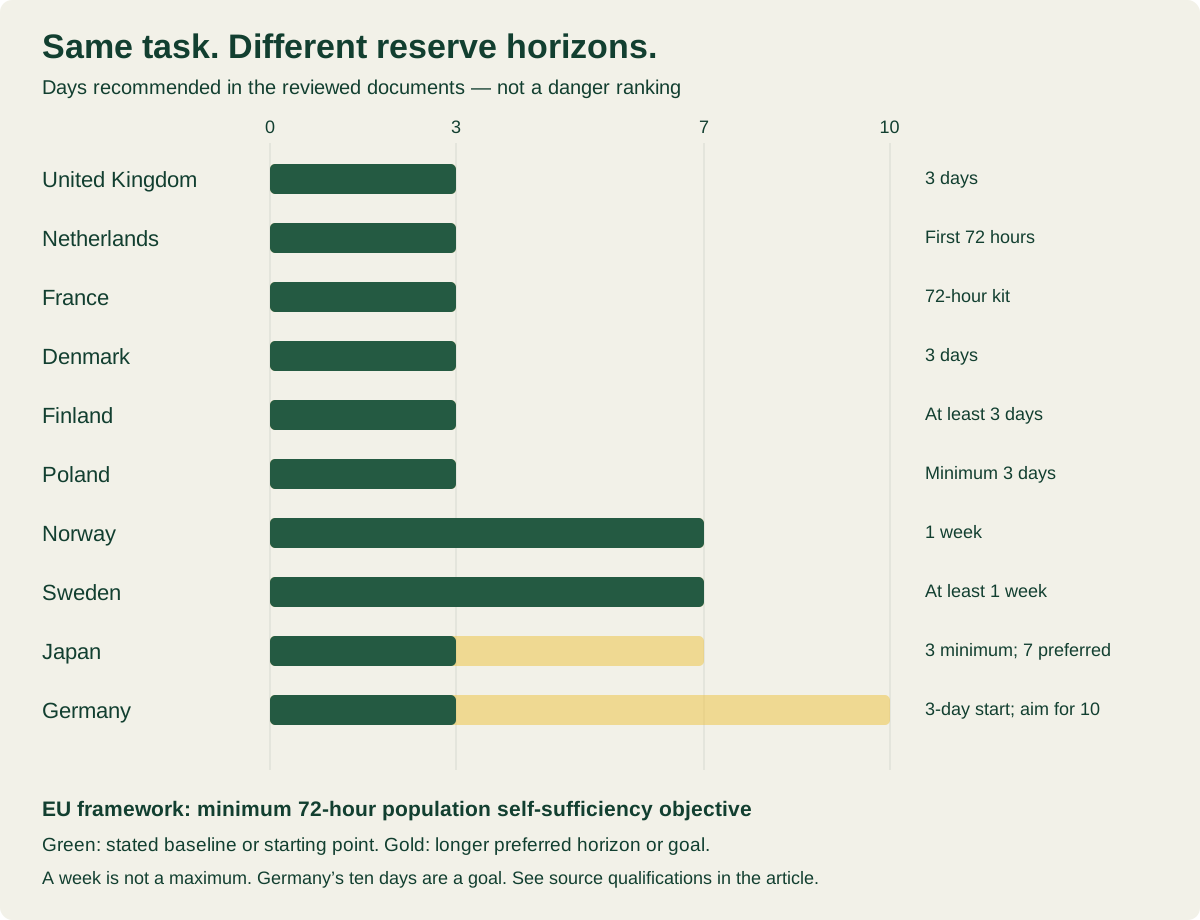
The reserve periods differ. Three days is common. Norway and Sweden recommend a week. Japan pairs a three day minimum with a week where possible. Germany describes a three day starting reserve and a ten day goal.
Japan’s supplied checklist sits within natural disaster planning. Similar supplies do not prove that every country copied the same campaign. A home reserve and an evacuation backpack also serve different purposes.
Some connections are explicit. The UK describes learning from other countries. European documents promote coordinated preparedness, and Germany’s civil protection publication links an adaptation of its advice to the Niinisto report.
A power interruption can affect communications, water, payments and refrigeration. Actual effects depend on local systems and backups. These are possible dependencies, not a fixed sequence. A reserve period is not a promise that services return on schedule.
Preparation also requires support. Money, storage, housing and individual needs affect what households can do. Our editorial judgment is that personal reserves should complement reliable public services, accessible assistance and accountable institutions.
Start with local guidance and what your household already has. Agree who needs help and who checks on them. Read the full investigation for the country comparison, official sources and practical planning questions.
Footage credits and production notes
Pexels license. Original clip sound removed. Narration and quiet original instrumental bed were produced for this edit; diagrams are explanatory, not forecasts.
A government emergency-kit announcement can be read in two very different ways: as a practical request to prepare for disruption, or as a hint that officials expect an undisclosed disaster. Put several announcements beside one another, remove their dates and circulate the collection, and the second interpretation can seem persuasive.
The documents deserve a closer reading. Why are countries telling people to prepare emergency supplies? Is the repeated three-day target evidence of coordination? Why do some authorities recommend a week or ten days? And what obligations remain with governments once citizens have filled a cupboard?
We examined the supplied official sources, checked linked booklets and added publication histories, current national explanations and supporting policy documents. This is a document-based investigation and editorial analysis, not a report of private intelligence or interviews with officials. The distinctions below separate what the records say from what we infer.
01 / THE COMPARISON
Emergency preparedness guidance by country: 72 hours, a week or longer?
The ten countries and the EU do not issue an identical instruction. This comparison records the relevant reserve horizon, what kind of document carries it and a qualification that can disappear in a headline. The EU is a policy framework, not an eleventh country.
| Country or framework | Reserve horizon | Document and crucial distinction |
|---|---|---|
| United Kingdom | 3 days | October 2026 Be Ready campaign; earlier household advice dates to May 2024. |
| Netherlands | First 72 hours | November 2025 booklet combines a kit, a plan and cooperation. |
| France | 72 hours / 3 days | Kit guidance covers staying home or a sudden departure; not a dated event alert. |
| Denmark | 3 days | 2024 campaign; utilities, weather and deliberate disruption all feature. |
| Norway | 1 week | May 2024 revision explicitly lengthened the earlier three-day recommendation. |
| Sweden | At least 1 week | 2024 crisis-or-war brochure sits within a longer total-defence tradition. |
| Poland | Minimum 3 days | The linked 2025 Safety Handbook specifies a home stockpile; the landing page hosts multiple materials. |
| Germany | 3-day start; aim for 10 | English stockpiling page emphasizes ten days; current German FAQ explains the gradual approach. |
| Finland | At least 3 days | Suomi.fi guidance is part of a wider preparedness system; the guide launched in November 2024. |
| Japan | Minimum 3 days; preferably 1 week | Existing natural-disaster checklist distinguishes a home reserve from an evacuation backpack. |
| European Union | Minimum 72-hour policy objective | March 2025 strategy calls for guidelines; it is not a uniform EU household stockpiling law. |
02 / CHECK THE DATES
These are current resources, but they were not all issued together
Publication, revision, distribution and a fresh advertising campaign are different events. A document can be current without being newly issued. That is the first correction needed before interpreting this collection as a trend.
- 2018 — Norway’s campaign begins. Its initial planning horizon was at least three days. DSB’s campaign history
- May–August 2024 — revision and distribution. Norway moves to one week; Denmark’s three-day material is prepared for Digital Post distribution in August. Danish distribution notice
- November 2024 — Nordic public communication. Finland launches the Suomi.fi guide on November 18. Sweden’s latest public brochure is distributed that November. Finland’s launch record · Sweden’s subsequent account
- 2024–March 2025 — a European policy pathway. The Niinistö report recommends coordinated 72-hour campaigns; the Commission presents its Preparedness Union Strategy on March 26, 2025. Report summary · Commission strategy
- July–November 2025 — material reserves and household outreach. The EU launches stockpiling and medical countermeasures strategies on July 9. The supplied Dutch booklet is dated November 25. EU announcement · Dutch publication
- October 22, 2026 — the supplied UK announcement. A three-year Be Ready campaign begins with updated messaging; the government says much earlier advice remains unchanged. UK release
France’s supplied kit page and Japan’s checklist are treated here as standing guidance. We do not assign them an original issue date from a footer, search-engine crawl date or the day we accessed them. Poland’s PDF identifies itself as publication 1/2025; that does not date every item on its landing page.
03 / READ THE COUNTRIES CLOSELY
What each government is actually asking households to do
UNITED KINGDOM / 3 DAYS
A new campaign around an existing baseline
The October 22, 2026 release describes the first stage of a three-year campaign. It combines food and water reserves with free actions, including checking the Priority Services Register for extra utility support. It says household advice has existed since May 2024 and much of it is unchanged.
Why it matters: a communication relaunch should not be reported as the invention of emergency preparedness. The release also acknowledges people with insecure housing and those using foodbanks. Read the Cabinet Office announcement. Our small-flat UK preparedness guide translates that context into a practical plan.
NETHERLANDS / FIRST 72 HOURS
The kit is only one of three tasks
The November 2025 booklet asks people to assemble supplies, make an emergency plan and talk with others about helping one another. Its 72-hour blackout sequence is explicitly an example. It says emergencies can last longer.
Why it matters: the sequence is a teaching scenario, not a prediction that every network will fail at the illustrated hour. Its account of connected services explains why planning extends beyond a torch and canned food. Official publication page · Read the booklet, especially printed pages 6–11.
FRANCE / 72 HOURS
Plan for both sheltering and leaving
French Civil Security describes a kit for three days of autonomy, whether authorities advise staying home or order an immediate evacuation. It includes ready-to-eat food, radio, medicines, cash, water and protected copies of documents. Its infographic specifies six litres of bottled drinking water per person for the kit.
Why it matters: a portable emergency kit is not automatically a complete household reserve, and a drinking-water quantity is not an all-purpose sanitation allowance. The page calls for accessible storage, annual checks and replenishment after use. Read the French guidance and infographic transcript.
DENMARK / 3 DAYS
Preserve response capacity for the greatest need
Denmark’s explanation links a three-day household buffer to authorities’ ability to stabilize a crisis and assist people who need help most. Its risk account includes severe weather, cyberattacks, sabotage, accidents and technical failures. It describes the immediate problem in terms of lost utilities and ordinary services.
Why it matters: deliberate attacks are part of the reasoning, but not its entire scope. The material was already being distributed through Digital Post in 2024. Read Prepared for crises · Check the 2024 distribution record.
NORWAY / 1 WEEK
A documented increase, not merely a new headline
DSB records a clear policy change: in May 2024, the recommended self-preparedness duration increased from at least three days to one week. Its campaign began in 2018. Assistance is framed around prioritizing people who cannot manage without support.
Why it matters: this is a stronger example of an actual change in reserve duration than a repackaged checklist. DSB’s cited survey reports drinking-water storage rising from 21% in 2017 to 47% in 2024. Those are self-reports, not an audit of how long supplies would last. Read the history, revision and survey summary.
SWEDEN / AT LEAST 1 WEEK
Household readiness within total defence
The 2024 crisis-or-war brochure addresses a worsened security environment and the population’s part in total defence. Current official guidance asks people to meet basic needs for at least a week. The agency explains that one-week planning follows a 2020 defence-policy decision; wording since 2024 emphasizes “at least”.
Why it matters: this is not just a weather kit with a dramatic title. Nor is public crisis communication new to Sweden: the current official account identifies earlier national brochures, including 2018. Current official explanation · Duration and policy history.
The supplied older MSB PDF address failed during our check. We used the current official agency pages and 2024 English-edition record, rather than silently treating a broken link as verified content.
POLAND / MINIMUM 3 DAYS
Separate the landing-page title from the edition
The RCB Crisis and War Guide page links several materials. We checked its English Safety Handbook, publication 1/2025, which gives a minimum three-day home-stockpile list on printed pages 20–22. It also covers preparation, warnings, evacuation, blackouts and crisis communication.
Why it matters: an evacuation backpack and a home stockpile are separate parts of the handbook. A comparison should name the specific edition, rather than attribute everything on a resource page to a single release. RCB resource page · Verified 2025 handbook.
GERMANY / BUILD FROM 3 TOWARD 10 DAYS
The English page needs the current German qualification
The supplied English stockpiling page emphasizes food and drink for ten days. BBK’s current German guide FAQ explains that households should aim for ten days, while a reserve of at least three days already helps and can be extended gradually. Its guidance also recognizes storage constraints, individual needs and food preferences.
Why it matters: reporting only “Germany says ten days” misses the accessible starting point. Reporting only “Germany says three days” drops the longer goal. BBK also traces its advice back to 2004 and the previous central brochure to 2013. Supplied English page · Current German explanation.
FINLAND / AT LEAST 3 DAYS
Supplies, skills and accessible support
Suomi.fi recommends home emergency supplies for at least three days, while saying even a smaller reserve helps if everything cannot be obtained at once. Its checklist includes food, water, information, backup power, medicines, hygiene and pets. The guide also addresses limitations in individual functional capacity.
Why it matters: it treats preparedness as more than purchasing a standardized box. The guide launched on November 18, 2024, within a broader individual-preparedness communications package begun in 2022. Read the home-supplies guidance · Check the publication history.
JAPAN / 3 DAYS MINIMUM, A WEEK PREFERRED
Established natural-disaster planning
The Cabinet Office checklist recommends reserves for at least three days, preferably a week, with three litres of drinking water per person per day. It describes rotating familiar long-life food and keeping additional essentials, including portable toilets. It separately discusses a backpack of items to take when leaving.
Why it matters: this source sits within natural-disaster risk awareness and home preparedness. Its existence does not demonstrate that Japan imported a European war-warning campaign. Read the Cabinet Office checklist. Our Japan emergency-supplies report separately examines the planned November 2 appeal.
EUROPEAN UNION / MINIMUM 72-HOUR OBJECTIVE
A framework for coordination, not a household decree
The March 2025 Preparedness Union Strategy calls for guidelines to reach minimum 72-hour population self-sufficiency. It combines an all-hazards approach with coordination across government and society. Its actions extend to early warnings, schools, public-private cooperation, critical services and response capacity.
Why it matters: the household objective is one component of a wider strategy. It does not, by itself, create a single legally binding stockpiling rule for every European household. Read the strategy’s actions · Current civil-protection overview. See also our EU 72-hour guidance explainer.
04 / FOLLOW THE DOCUMENT TRAIL
Are the emergency preparedness campaigns connected?
Yes, some connections are documented. That is different from proving that every campaign shares the same origin or hidden trigger. Three links are especially informative.
1. Governments openly borrow communication practices
The UK release explicitly says officials worked with other countries and learned from their experience. It identifies the three-day advice used by France, Ireland and the Netherlands as a shared reference. This is evidence of policy learning, not merely a resemblance between shopping lists. UK description of international learning.
2. The European policy documents call for convergence
The 2024 Niinistö report’s executive summary recommends a 72-hour self-sufficiency target supported by coordinated campaigns, with national differences taken into account. The Commission’s subsequent strategy makes minimum 72-hour population preparedness an action item. The sequence provides a public institutional pathway for similar messages. Read the report’s population-preparedness proposals · Compare the strategy.
3. Germany records an adaptation, not just a coincidence
In its Bevölkerungsschutz 1/2025 publication, BBK discusses adapting the time dimension of its preparedness advice and references the Niinistö report. It describes a three-day reserve as a starting point that can be expanded. That is a concrete documentary connection between European discussion and national communication. It does not mean the EU originated all national preparedness policies. BBK’s 2025 explanation.
Our inference: the pattern is best described as overlapping national traditions, shared risk concerns and deliberate policy exchange. The Norwegian and Swedish histories predate the March 2025 EU strategy. Japan’s supplied source has its own natural-disaster context. A single chain of instructions connecting all ten governments is not demonstrated by this record.
05 / THE COMMON PROBLEM
Different threats can interrupt the same everyday services
A storm, technical failure or deliberate attack need not look alike to create a similar problem at home: a service the household relies on stops being available. That is why the overlap between emergency-supply lists is less mysterious than it first appears.
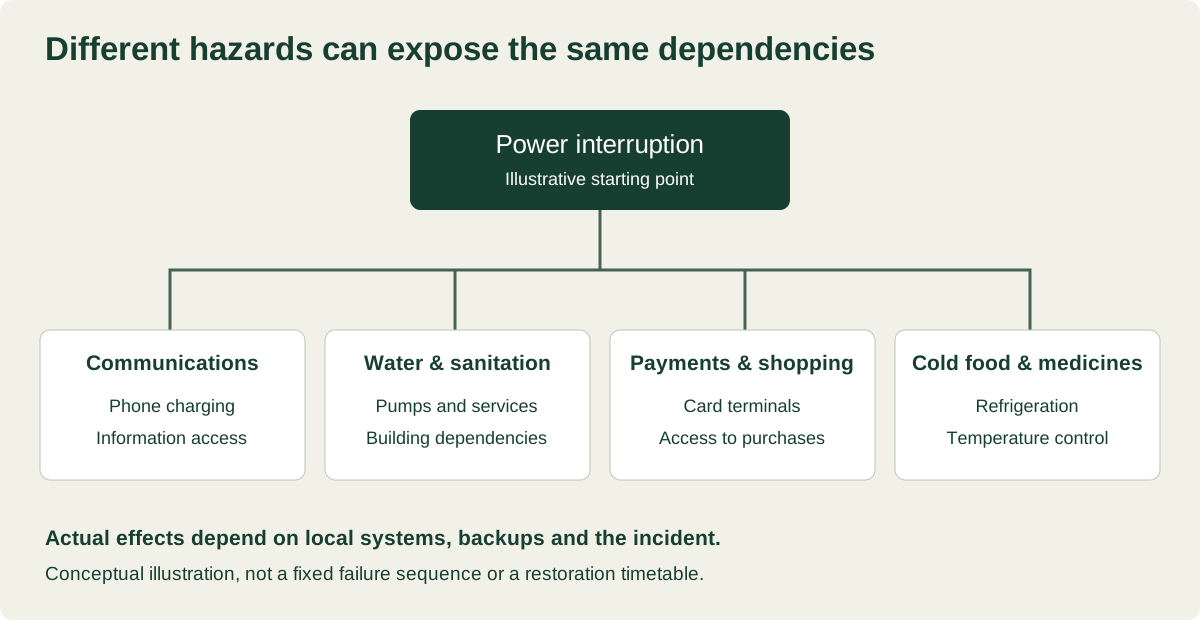
The Dutch booklet makes interconnection unusually explicit: its example follows a power outage through ordinary systems and includes uncertainty about duration. Denmark similarly translates several hazards into utility and service interruptions. Our analytical reading: authorities are often asking citizens to prepare for consequences that recur across hazards, rather than to guess the precise initiating event.
A real case: the Iberian blackout
On April 28, 2025, continental Spain and Portugal experienced a major blackout. The expert panel’s final report, announced by ENTSO-E on March 20, 2026, identifies interacting technical factors involving oscillations, voltage and reactive-power control, output reductions and generator disconnections. Read ENTSO-E’s final-investigation summary.
This case does not prove why any particular country launched its campaign. It demonstrates why an analysis of preparedness cannot assume that infrastructure disruption must begin with warfare. Different causes can make the same household dependencies relevant. Conversely, an all-hazards label should not obscure the explicit conflict and hybrid-threat concerns in some European documents.
Why 72 hours is a planning horizon
A reserve period gives a household something concrete to organize and discuss. A vague instruction to be resilient is difficult to turn into a cupboard, a contact list or a community support arrangement. A period of days makes those tasks more tangible.
That is our interpretation of the communication function of the number, not a scientific finding that three days is optimal everywhere. The documents do not supply a common calculation that makes 72 hours sufficient for every hazard, home, season or person. A planning target is not a guarantee that assistance arrives, utilities return or risk ends when the period expires.
06 / TAKE SECURITY SERIOUSLY, WITHOUT INVENTING A COUNTDOWN
Do these emergency-kit campaigns mean war is imminent?
The records support a narrower conclusion: several European authorities are openly concerned about conflict, sabotage, cyberattacks and information manipulation. Sweden’s explanation is explicit about armed-attack risk and total defence. Poland’s materials address crisis and war. Denmark’s account includes a deteriorating European security situation. That context should not be edited out to make the story reassuring.
But the reviewed documents do not identify one shared imminent event, date or target. Nor does the repetition of “72 hours” supply that missing evidence. A government can increase preparedness because risks are serious and uncertain without claiming that one event has been predicted.
The appropriate response to uncertainty is proportionate preparation and better questions. Ask which threat assessment supports a campaign, how often the advice is reviewed, what assistance arrangements exist and what changed from the previous edition. Treat a claim about secret knowledge as a separate claim requiring separate evidence.
Preparedness communication can be significant even when it is not an emergency alert. The distinction is practical: standing advice helps you prepare in ordinary time; a current warning can require location-specific action now. A general stockpile recommendation never cancels an official evacuation instruction.
07 / THE EDITORIAL TEST
Household resilience cannot become an excuse for weak public systems
There is a defensible public-interest logic to home reserves: if households with capacity can manage a short disruption, responders can prioritize people who cannot. The harder issue is what happens when capacity is assumed rather than established.
A household may understand the advice and still lack money, secure housing, storage, transport or someone to help. A person dependent on powered equipment cannot solve continuity of care by buying the same kit as a healthy neighbour. A landlord, employer, water operator or public authority may control the decisive part of a resident’s plan.
The UK’s stated attention to people with insecure housing and foodbank users is therefore substantive, not a footnote. Finland’s individual-capacity guidance and the emphasis on helping others in Nordic communication point toward a better standard: readiness must include a workable support arrangement.
Equally, public documents do not describe household action as the whole response. The EU’s July 2025 stockpiling strategy includes coordination of reserves, identifying gaps, expanding EU-level stocks and improving logistics. Sweden’s 2026 business brochure broadens communication beyond residents to workplaces. These are stated initiatives, not proof that every stockpile is adequate or every business prepared. EU material-readiness actions · Sweden’s workplace initiative.
Five questions a serious campaign should answer
- Who cannot follow the advice? What support reaches people without money, space, secure housing or independent mobility?
- What continues when networks fail? How do residents receive instructions if phones, internet or ordinary payment systems are unavailable?
- Who owns each dependency? Which tasks belong to utilities, building managers, care providers, employers and government?
- How is readiness measured? Are officials recording completed plans and usable supplies, or only publicity and awareness?
- What is being improved publicly? What budgets, exercises, backup arrangements and stockpile gaps are being reported?
These questions are our editorial accountability test. This review did not audit national spending, inspect warehouses or measure service restoration capability. A stronger campaign can coexist with unresolved public-system weaknesses; a persuasive leaflet cannot settle those questions by itself.
08 / THE LIMITS OF THE FINDING
What this comparison can—and cannot—tell us
The reviewed sources show published expectations and how authorities explain them. They do not, by themselves, establish whether households can meet those expectations, whether public reserves are sufficient or whether the campaigns reduce losses in a real emergency.
| Supported by this review | Not established by this review |
|---|---|
| Several countries use a three-day baseline; others recommend longer. | That one duration is universally correct or that a longer target signals greater imminent danger. |
| Some European connections and learning are explicitly documented. | That all national campaigns originated in one instruction or one undisclosed threat. |
| The sample contains revisions, older guidance and newer campaigns. | That all ten countries issued new emergency warnings at the same time. |
| Official communication includes technical, weather and security risks. | A numerical probability of war, blackout or disaster derived from the number of booklets. |
| DSB reports changes in self-reported water storage. | Independently inspected household adequacy or a causal estimate of campaign effectiveness. |
This is also a selected sample supplied for review, not a representative survey of the world’s governments. Nine of the ten countries are European; seven are EU members. The UK, Norway and Japan are outside the EU, and EU policy overlaps with member-country sources. Counting the documents as independent votes would exaggerate the strength of the evidence.
09 / TURN THE COMPARISON INTO A USEFUL PLAN
How to prepare emergency supplies without panic buying
The useful lesson is to identify what your household cannot do when an ordinary service stops. Start with current guidance for your location, the people in your home and your building’s dependencies. The longest number in an international comparison is not automatically your correct shopping target.
1. Distinguish staying home from leaving
A home reserve can be distributed across practical storage locations. An evacuation bag must be something its user can actually take. Do not treat an entire multi-day household water reserve as a backpack requirement. Our free bug out bag checklist in Excel, PDF and CSV helps separate a usable inventory from an imagined ideal load.
2. Count what is usable, not what is pictured on a list
Write down the available water, food, light, communication and essential personal supplies. Check how food is opened and eaten, what needs refrigeration or cooking, and whether batteries and cables fit. Our no-cook emergency food guide and small-apartment water-storage guide address two common gaps.
Do not combine water figures from different countries without checking what each figure includes. France’s portable-kit infographic, Japan’s household benchmark and Germany’s food-and-drink explanation have different wording and contexts. Drinking, cooking, washing, pets and toilet needs should not be silently collapsed into one supposedly universal number. BBK’s detailed water explanation.
3. Give sanitation its own plan
A pantry full of food does not answer what happens if normal toilet arrangements stop working. Check your local instructions, building system and disposal arrangements. Our apartment emergency-toilet guide is a starting point for the questions to resolve, rather than a substitute for local public-health advice.
4. Agree who checks on whom
Put important contacts somewhere usable offline. Identify anyone who may need assistance, the person who will check and the next step if contact fails. Avoid relying on a single person or app without discussing the fallback. Sensitive medical and household records should remain private and accessible only to the people who need them.
5. Build gradually and review the arrangement
Check existing supplies before buying more. Prioritize unresolved needs, use suitable foods your household normally consumes and replace what is used. Keep a short dated note of what is missing or dependent on someone else. Our small-space supply organization guide and free household worksheets can help make that record usable by another household member.
A five-question household exercise
Without switching off utilities or interrupting medical equipment, discuss a hypothetical evening without normal power, water or internet:
- Where is drinking water, and how much is usable?
- What meal can everyone eat without normal cooking?
- How will you receive verified information and contact one another?
- What happens to toilets and essential personal needs?
- Who needs help, who provides it, and what is the fallback?
A named unresolved dependency is more useful than a ticked box that nobody has checked. This discussion is an R&R planning aid, not a new official national standard.
10 / OUR EDITORIAL CONCLUSION
The trend is a preparedness culture, not a proven prediction
The most solid connection across these documents is a recognition that modern life depends on services that can be interrupted together. European policy exchange is real and sometimes explicit. National histories, risk environments and reserve targets still differ.
Our judgment is that the right response has two parts: make a realistic household arrangement, and expect public authorities and essential-service providers to show theirs. Citizens should neither dismiss the advice because it is familiar nor accept unsupported claims that a collection of checklists reveals a secret countdown.
A serious preparedness culture needs both personal capability and dependable institutions. The next question is not simply how many days are printed on a leaflet. It is whether the people, supplies and public systems behind that number can work when needed.
Questions about countries’ emergency preparedness guidance
Why are governments telling people to stock up on emergency supplies?
The reviewed documents emphasize coping with disrupted services and preserving response capacity for those needing the most help. Some also explicitly address conflict, sabotage and cyber threats. Their reasoning is broader than a single predicted event.
Are all countries recommending a 72-hour emergency kit?
No. Three days is common in this sample, but Norway and Sweden recommend a week; Japan pairs a three-day minimum with a week where possible; Germany combines a three-day starting reserve with a ten-day goal.
Does the EU require every household to stockpile for three days?
The reviewed strategy calls for guidelines supporting minimum 72-hour population self-sufficiency. That objective is not, by itself, a single binding household stockpiling law.
Does this mean an emergency is about to happen?
Not on the evidence of these documents alone. Standing preparedness guidance and a location-specific active warning are different things. Follow current official instructions where you are.
Should I buy a commercial emergency kit?
This review does not establish that a packaged kit is necessary or complete for your household. First check existing supplies, personal needs, local guidance and the dependencies a purchase would actually resolve.
REPORTING TRANSPARENCY
Sources, verification and how this investigation was conducted
Reviewed for publication October 28, 2026. We compared the ten supplied national sources and the EU framework, followed linked Dutch and Polish booklets, and used current official Swedish pages when the supplied PDF address failed. German, French and Japanese passages are paraphrased in English. We distinguished publication dates, revised advice, distribution records and current access dates.
We also checked supplementary official material on European policy exchange, stockpiling, national publication histories and the Iberian blackout investigation. Some pages are undated; we do not infer their original publication date from a website footer. The BBK 1/2025 policy passage was available in indexed text; direct retrieval of that PDF was blocked during the check. No private briefings, interviews, field inspections or campaign-effectiveness study were conducted.
Analysis labels: descriptions of official advice are attributed to the relevant authority. Connections not explicitly documented, interpretations of communication choices and the accountability questions are R&R analysis. The sample cannot establish global prevalence, causal impact or a common undisclosed threat.
Open the complete primary-source register
- UK Cabinet Office: household emergency campaign, 22 October 2026
- Netherlands: information booklet, 25 November 2025
- Dutch booklet: 72-hour example, printed pages 6–7; kit, pages 10–11
- France: Civil Security emergency kit and infographic transcript
- Denmark: Prepared for crises
- Denmark: Digital Post distribution, 27 August 2024
- Norway DSB: campaign history, May 2024 change and self-reported survey
- Sweden: current official brochure explanation and one-week advice
- Sweden: home preparedness, 2020 decision and at least one week wording
- Sweden: 2024 English brochure publication record, MSB2400
- Sweden: 2026 business preparedness brochure
- Poland RCB: Crisis and War Guide landing page
- Poland Safety Handbook 1/2025: printed pages 20–22 and publication details
- Germany BBK: supplied English stockpiling page, ten-day reserve
- Germany BBK: current guide FAQ, three-day start and ten-day goal
- Germany BBK: food and drink reserve, current German detail
- BBK Bevölkerungsschutz 1/2025: advice adaptation and Niinistö report reference
- Finland Suomi.fi: home emergency supplies and general instructions
- Finland: preparedness guide launched 18 November 2024
- Japan Cabinet Office: existing household supplies checklist
- EU civil protection: preparedness overview
- European Commission: March 2025 strategy and minimum 72-hour objective
- 2024 Niinistö report executive summary: coordinated 72-hour campaigns
- European Commission: stockpiling and medical countermeasures strategies, 9 July 2025
- ENTSO-E: final technical investigation into the 28 April 2025 Iberian blackout, 20 March 2026
Photographs, illustrations and video credits
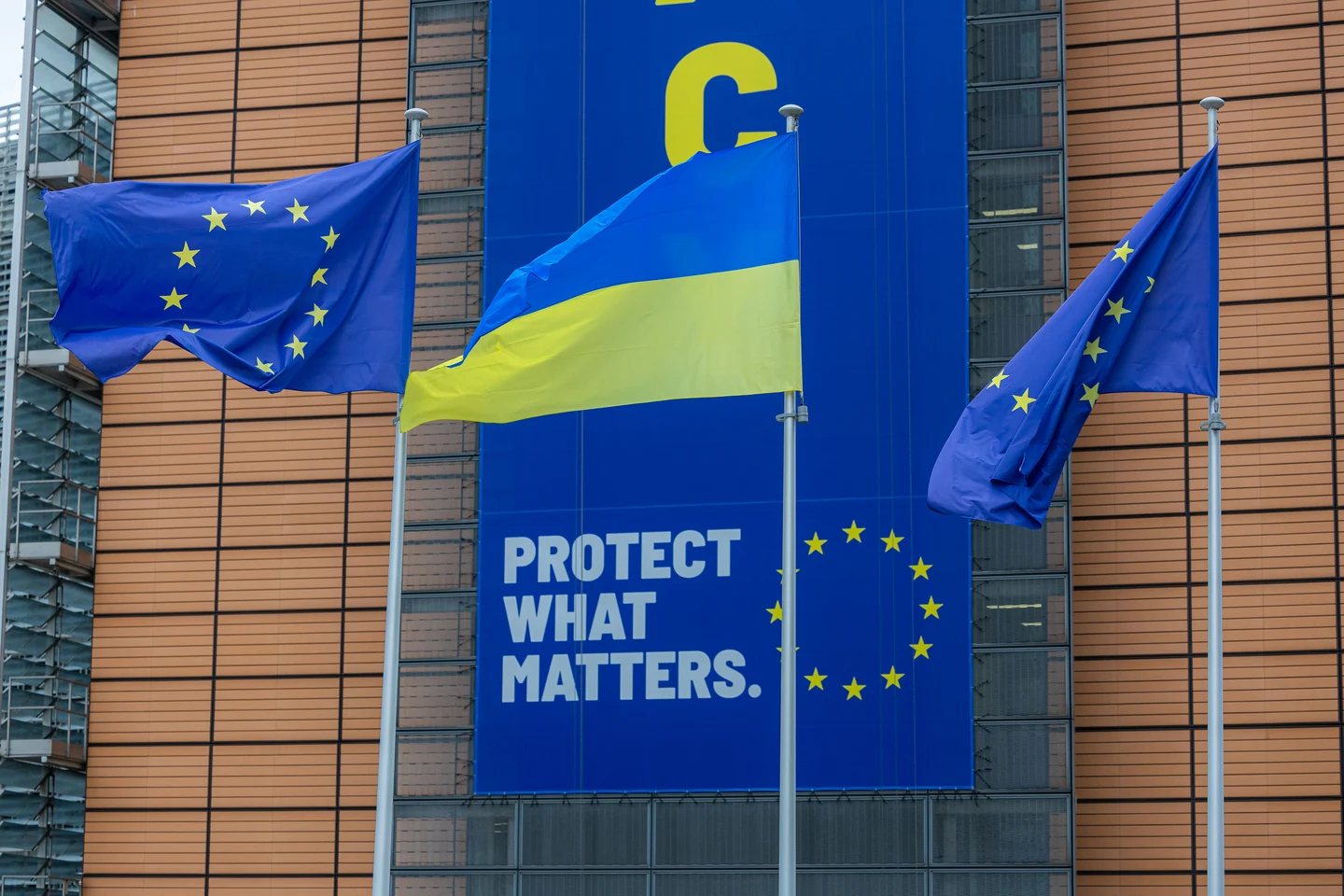
The leading photograph shows European and Ukrainian flags outside the Berlaymont in Brussels on August 21, 2026, photographed for Ukrainian National Day. © European Union, 2026 / Xavier Lejeune, European Commission Audiovisual Service. Original photograph · CC BY 4.0. Resized and cropped for presentation. It is context imagery, not a photograph of a preparedness announcement; no endorsement is implied.
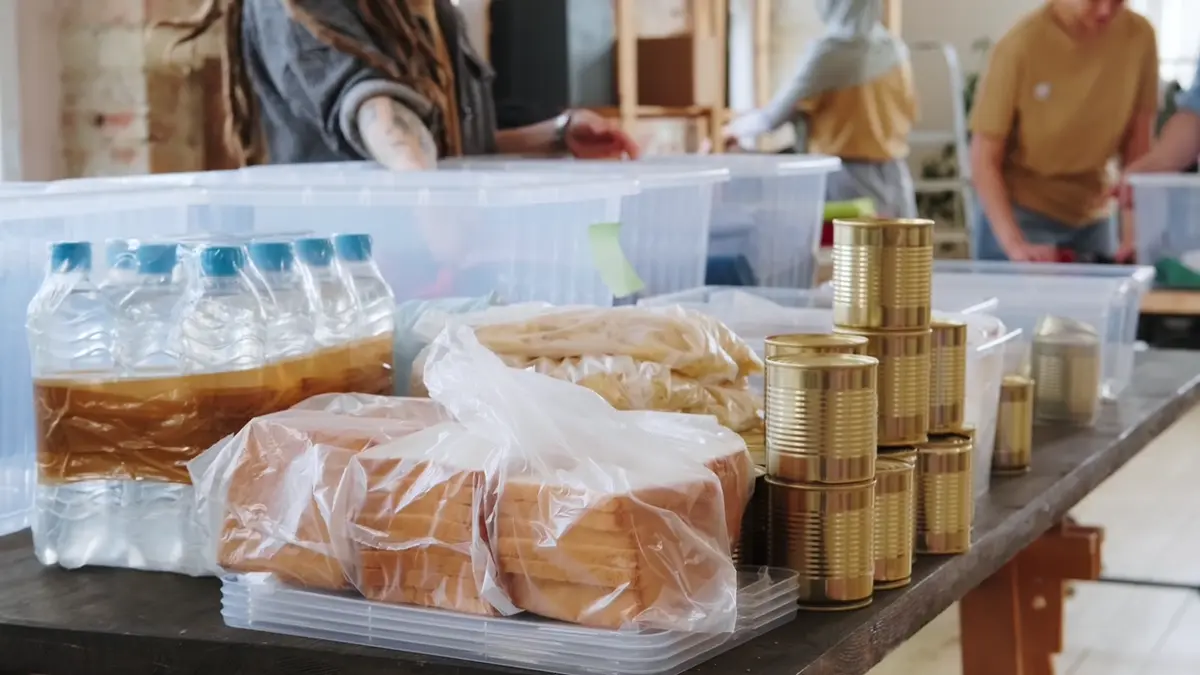
The supply-packing frame and video are Julia M Cameron / Pexels. EU flag video: Tamas Babai / Pexels. Tokyo street video: Maciej Głowiński / Pexels. Credits and original links accompany the player. All diagrams, comparisons, editorial text, sequencing and the instrumental bed were created for this R&R report. English narration is synthetic. No generated scene is presented as a news photograph or current event footage.
For corrections, contact the editorial team with the specific passage and a primary-source reference. Our editorial standards explain source-based reporting and corrections.
Make a family communication backup
A receiver helps you listen; contacting someone needs another route. Use our guide to communicating when cell towers are down to compare working Wi-Fi, satellite and local radio, then make a printable family plan.
Plan for a payment outage, too
If cards or ATMs are unavailable, a modest cash reserve can help with essential purchases. Use our guide to how much cash to keep for emergencies and its free household calculator to price your remaining needs.
Put the essentials into one household plan
Use our complete 72-hour emergency kit checklist for water quantities, a three-day food plan, care supplies and portable essentials. Includes a water calculator, printable planning sheets and an original narrated video.