NEWS EXPLAINER / JAPAN & HOUSEHOLD PREPAREDNESS
Japan Plans November 2 Emergency Supplies Appeal as New Disaster Agency Opens
What Japan’s planned appeal actually says, why the three-day-to-one-week advice is familiar, and how to turn the water benchmark into a household number.
THE VERIFIED TAKEAWAY
A new appeal. An established preparedness baseline.
Japan is preparing a nationwide disaster-readiness appeal for November 2, 2026. The household message is to keep at least three days of food, water and toilet supplies, preferably enough for a week. The stockpiling principle already appears in official Japanese guidance; the forthcoming appeal is a renewed push to act on it.
WATCH / ORIGINAL R&R FOOTAGE EDIT
Japan’s emergency supplies appeal explained
An original 73-second R&R explainer with English synthetic voiceover, captions, real Tokyo and household-supply stock footage, and original water-reserve graphics. Illustrative footage, not a recording of the planned announcement or a current Japanese relief operation.
Read the voiceover transcript
Japan plans a nationwide emergency supplies appeal for November second, alongside the launch of its new disaster management agency. As of October twenty eighth, the announcement is still ahead.
The practical advice is familiar: keep at least three days of food, water and toilet supplies. Prepare for a week where possible. This is preparedness guidance, not a prediction of an imminent disaster.
For water, Japan’s household benchmark is three litres per person, per day. Four people preparing for seven days would need eighty four litres.
That benchmark covers drinking and cooking. Plan separately for sanitation and individual needs. Check portable toilet supplies, medicines and the needs of children or older family members.
Build a rotating reserve of food your household already eats. Use older suitable stock, check dates and replace what you consume. Follow current local instructions.
Read the full report at Ready and Resourceful for verified sources and a household water calculator.
Footage credits and license
Real licensed stock footage and original explanatory animations in an R&R editorial edit. People and organizations shown do not endorse this article. Food-packing clips show charitable work, not a Japanese government operation.
- Tokyo street traffic — Maciej Głowiński / Pexels
- Volunteers packing food — Julia M Cameron / Pexels
- Canned-food packing close-up — Julia M Cameron / Pexels
- Volunteers checking supplies — cottonbro studio / Pexels
- Kitchen food-storage containers — RDNE Stock project / Pexels
Pexels footage used under its free license (see linked credits). Original source audio removed. English synthetic narration generated with Kokoro; quiet instrumental bed created for this edit.Pexels license. Original source audio removed; instrumental score composed for this edit.
Japan’s emergency supplies message is becoming more prominent, but its central recommendation is not being invented this week. Disaster management minister Goshi Hosono has outlined plans for a November 2 appeal to households, local authorities and central ministries as the country’s new Disaster Management Agency begins work.
In a Fuji TV online appearance reported by FNN on October 27, Hosono encouraged households to prepare food, water and toilet arrangements for a minimum of three days, ideally a week, without immediately relying on public assistance. FNN’s original Japanese report is the source for that televised explanation.
For readers asking why Japan is urging households to stockpile food and water now, there are two separate issues: a new administrative push and an existing recommendation about household reserves. Keeping them separate avoids turning a readiness campaign into a prediction of a disaster.
01 / THE NEWS
What Japan plans to announce on November 2
The minister’s official October 20 Cabinet Office briefing sets out three intended audiences: the public, local governments and national ministries. He described differences in local preparedness and stockpiles, and said the details of the requests were still being finalized.
For households, his examples went beyond groceries. He referred to food and toilets, but also preparation to prevent building collapse and falling furniture. For municipalities and ministries, the emphasis was on their own disaster-response responsibilities.
The agency’s launch should not be read as a promise that national authorities can perform every local task. In the same briefing, Hosono argued that communities need capable local arrangements, with national support rather than automatic substitution.
The minister links planned requests to the agency’s November 2 launch.
Official briefing identifies households, local governments and ministries.
FNN reports the minister’s three-day-to-one-week household message.
Agency launch and preparedness appeal are planned.
Timeline: October 13 briefing, October 20 briefing and FNN reporting. Future entries remain plans.
02 / THE CONTEXT
Three days of supplies, ideally a week, is established advice
Japan’s Cabinet Office already recommends household reserves lasting at least three days and preferably about a week. Its 2026 Disaster Prevention Week guidance includes food, drinking water, portable or simple toilets and toilet paper, alongside preparation for disrupted electricity, gas, water and communications.
That matters because “emergency request” can sound like a sudden change in the expected threat. The documented change is the renewed appeal; the reserve period itself is already part of the published preparedness framework.
The Ministry of Agriculture, Forestry and Fisheries explains the practical reason: utilities may take more than a week to recover in some disasters, aid supplies may take several days to arrive, and disrupted distribution can limit access to shops. It recommends checking local hazards and adjusting reserves to local circumstances.
Our reading of the reviewed statements: They support preparing for interruptions and delayed assistance. They do not establish a date for a particular earthquake, eruption, war or cyberattack. The appeal should not be presented as evidence that one specific crisis is imminent.
03 / MAKE THE NUMBER USEFUL
How much water does Japan’s household guidance suggest?
The Cabinet Office’s household preparedness checklist uses three litres of water per person per day as a planning benchmark. Its advice also describes rotating ordinary long-life foods and keeping household essentials ready.
Multiplying that benchmark gives 9 litres for one person over three days, or 21 litres over a week. For four people, the corresponding figures are 36 litres and 84 litres. These are calculations, not measurements of what Japanese households currently have.
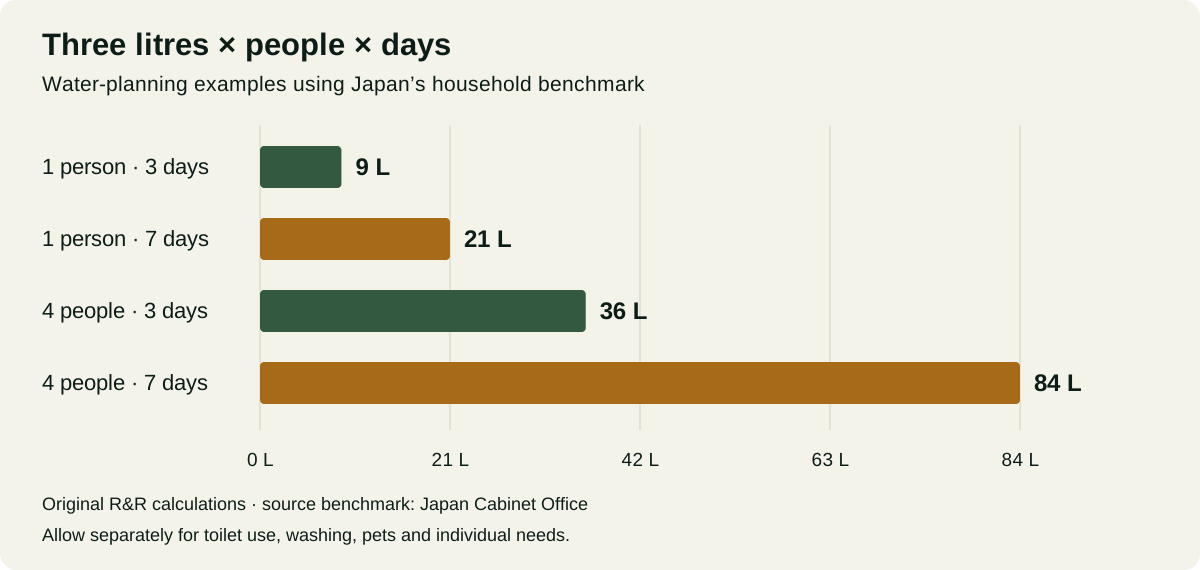
View the graphic’s numbers as a table
| People | Days | Calculation | Water |
|---|---|---|---|
| 1 | 3 | 1 × 3 × 3 L | 9 L |
| 1 | 7 | 1 × 7 × 3 L | 21 L |
| 4 | 3 | 4 × 3 × 3 L | 36 L |
| 4 | 7 | 4 × 7 × 3 L | 84 L |
Calculate a household example
Uses the Japanese 3-litre benchmark. This is arithmetic, not a personalized water-needs assessment.
The benchmark is not a complete allowance for washing or toilet flushing. MAFF’s household food-stock guidance treats water for drinking and cooking together in its approximate three-litre reference and separately calls attention to infants, older people and people with chronic illness or food allergies. Check individual needs and the instructions that apply where you live.
Our small-apartment water-storage guide helps turn a total into a workable storage arrangement. A household reserve is also different from the amount a person can comfortably carry in an evacuation bag.
04 / CHECK DEPENDENCIES
Food and water are only part of household readiness
The useful question is whether the supplies still work if an ordinary service stops. A cupboard full of food can leave a household with a cooking problem. A stored toilet product is useful only if the household understands its instructions and local disposal arrangements.
| Supply or task | Question to settle | Practical next step |
|---|---|---|
| Food | Can it be opened and eaten without normal cooking? | Review actual labels, dietary needs and required utensils. |
| Water | What is physically available for everyone? | Count usable containers and write down the household total. |
| Toilets | What happens if water or sewer service is disrupted? | Check local instructions and compatible emergency-toilet supplies. |
| Communication | Who can reach the household if a phone stops working? | Keep key contacts and the household arrangement available offline. |
| Property | Which unsecured furnishings or known problems need attention? | Use appropriate official guidance and competent help for the task. |
This table is an R&R planning aid, not an additional government checklist. For a food-specific check, use our no-cook emergency food guide. For a flat where sanitation is the missing part, read the apartment emergency-toilet guide.
Build a rotating reserve instead of an unfamiliar pile
MAFF’s rolling-stock method means keeping a little more of the foods normally used, consuming older supplies with their dates in mind, and replacing what is consumed. The aim is to retain a reserve as part of normal household shopping.
Keep a reserve
Choose familiar foods your household will use.
Use and check
Review dates and consume older suitable stock.
Replace
Replenish what was used and check the total.
Our practical addition is to name the person who checks each category. A label reading “water” does not tell another household member whether the containers were counted. A short dated record does. Use a separate note for items that remain unresolved instead of marking the whole cupboard ready.
05 / THE INTERNATIONAL COMPARISON
How Japan’s message compares with the UK’s Be Ready campaign
The UK Cabinet Office launched updated Be Ready messaging on October 22, 2026, encouraging households to prepare for three days of disruption to everyday services. Its official announcement describes severe weather and interrupted power, water, phones and internet, and includes free steps such as checking eligibility for the Priority Services Register.
The UK statement also says household resilience advice has been published since May 2024 and that much of it remains unchanged. That provides another reason to distinguish a new campaign from a newly discovered danger.
Both countries’ messages make household preparation part of a wider response. Their timing alone does not demonstrate a shared warning about an undisclosed event. Readers outside Japan should use the guidance and hazard information for their own location rather than assume every country uses identical quantities.
For the practical UK context, see our three-day emergency kit for a small UK flat. The EU 72-hour preparedness explainer covers the separate European policy background.
Quick answers about Japan’s emergency supplies appeal
Has Japan ordered an immediate evacuation?
The statements reviewed concern disaster preparedness and a planned November 2 appeal. They are not presented as an evacuation order. Follow any actual local warning separately.
Is three days enough, or should households prepare for a week?
The established Japanese guidance describes three days as a minimum and about a week as preferable where possible. Local conditions and household needs can call for a different plan.
Does this mean a specific disaster is imminent?
The reviewed material does not establish that conclusion. Preparedness advice describes how to reduce the impact of disruption; it does not predict the date of an event.
What should readers watch for next?
The November 2 announcement itself: its final wording, implementation details and any instructions issued by local authorities. This article distinguishes the announced plan from that future publication.
REPORTING TRANSPARENCY
Sources and verification
Ready & Resourceful checked Japanese official briefing records, existing government preparedness pages and FNN’s original Japanese reporting. Japanese-language statements are paraphrased in English. Calculations and the household planning table are our own; no on-scene reporting or government endorsement is claimed.
Open the source list and what each establishes
- Cabinet Office, October 13: planned requests and agency launch timing.
- Cabinet Office, October 20: the three audiences, preparedness responsibilities and details still under preparation.
- FNN, October 27: Hosono’s online appearance and household-supply message.
- 2026 Disaster Prevention Week: existing reserve-period and sanitation guidance.
- Cabinet Office household checklist: water benchmark and established supply advice.
- MAFF: why household food reserves matter: disruption context and local adaptation.
- MAFF: rolling stock: rotation method.
- MAFF: household stock examples: water-use context and individual dietary needs.
- UK Cabinet Office, October 22: Be Ready campaign and existing UK advice.
Checked for publication October 28, 2026. Final November 2 appeal wording remains a future development. For corrections, contact the editorial team with the specific claim and an official reference.