HOUSEHOLD PREPAREDNESS / 72-HOUR EMERGENCY KIT
72-Hour Emergency Kit for Your Household: What to Store at Home and What to Carry
THE PRACTICAL ANSWER
Build a home reserve and a bag you can actually carry.
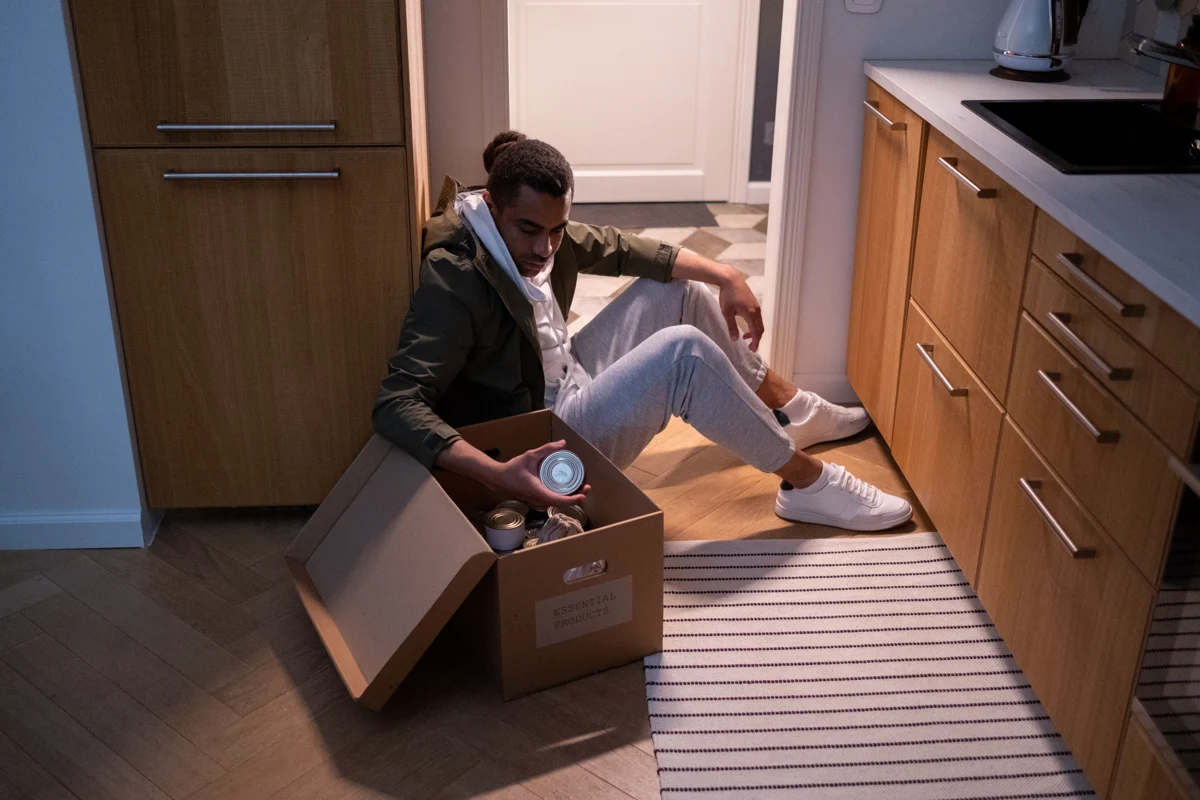
A 72-hour emergency kit is a planned supply of essentials for three days of disruption. For a household, that usually means more than one backpack: bulk supplies stay accessible at home, while portable essentials are ready if you must leave. Adjust both for the people, pets, climate and local hazards involved.
Start here
- Count safe water and food you can use without cooking
- Resolve personal care and medicine needs
- Locate lighting, information and phone power
Keep the limits clear
- Three days is a starting point, not a recovery deadline
- Household water reserves are heavy
- A complete checklist cannot make an unsafe home safe
Imagine the power has stopped, the tap is unavailable and your usual shop cannot take payments. You do not need a more impressive-looking bag. You need to know what everyone will drink, eat, use for light and rely on for personal care tonight. You also need to know which essentials can leave the house with you.
This guide connects those decisions. It does not ask you to duplicate every item in a home box, a car and a backpack. It helps you separate shared reserves from personal essentials, check what is genuinely available and make a short list of unresolved needs. Start with the inventory, then spend money where it solves an identified problem.
What does a 72-hour emergency kit actually mean?
Seventy-two hours means three days. It is a useful initial planning window, not a forecast of how long an emergency will last. Canada advises households to prepare for at least 72 hours; U.S. Ready.gov guidance describes supplies for several days. Follow the current advice for your own location and circumstances.
The reserve is there to reduce immediate dependence on disrupted services. It does not replace evacuation instructions, emergency assistance or a suitable destination. If your home becomes unsafe, do not treat the presence of supplies as a reason to remain there.
Our EU 72-hour preparedness explainer covers the policy background. This page is the evergreen household planning guide: what to store, what to carry and how to check the arrangement. For UK readers, the three-day kit guide for a small flat addresses that setting more specifically.
Home emergency supplies and a go bag have different jobs
The phrase “emergency kit” can hide two separate tasks. One is getting through disruption in a home that remains suitable to occupy. The other is leaving with essentials when instructed or when remaining is unsafe. Some equipment serves both, but the quantity and carrying arrangements differ.
| Decision | Home reserve | Portable go bag |
|---|---|---|
| Main purpose | Support the household while normal services are disrupted | Keep selected essentials accessible while leaving and traveling |
| Water | Stored reserve in manageable containers | A realistic carried amount, with a route and resupply plan |
| Food | Familiar meals, suitable portions and opening tools | Accessible food appropriate to the journey and destination |
| Equipment | Shared lighting, hygiene supplies and planned backup power | Personal light, documents, charging, clothing and individual essentials |
| Storage test | Can people find and retrieve it? | Can the intended person carry or transport it? |
| Key limitation | Cannot make an unsafe building suitable | Cannot carry every bulk household reserve |
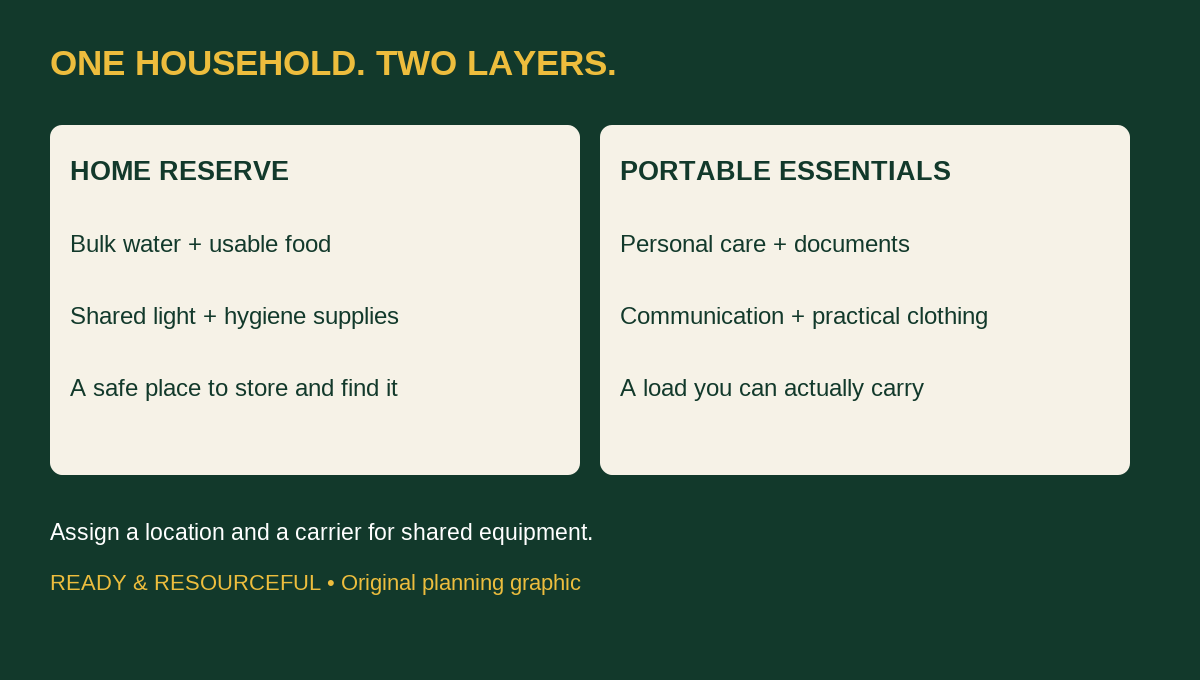
For example, a home lantern might provide light in a shared room, while each person keeps a smaller light accessible when moving around. A household water reserve may occupy several locations; its weight does not become an appropriate backpack load merely because the plan covers three days.
Use our bug-out bag guide and editable Excel inventory for the carrying side. Families can use the parents-and-children packing guide to distinguish personal items from shared supplies.
What should be in a 72-hour emergency kit?
Ready.gov’s basic supply list includes water, nonperishable food, a radio, lighting, batteries, first aid, sanitation supplies, an opening tool and local information. Treat an official list as a starting reference. The question below is whether each category works for your household, not whether you own an object with the right name.
| Need | What to check | Useful detail to record |
|---|---|---|
| Safe water | Count the actual stored volume | Container locations, quantity and review date |
| Food | Meals work without the normal kitchen | Servings, opening tools and dietary needs |
| Personal care | Medicines, medical supplies and assistance are individually planned | Who resolves each question and where instructions are kept |
| Light | Find and operate it without the room lights | Battery type, spare sets or charging arrangement |
| Information | Know the official alert sources and radio functions | Station, setup and power requirements |
| Communication | Have a family check-in method and written contacts | Alternative contact and meeting arrangements |
| Hygiene | Understand what changes if water or sewer service stops | Supplies and building-specific instructions |
| Leaving | Documents, cash, clothing and portable essentials can be retrieved | Bag location, transport and destination plan |
A useful inventory has more than a tick column. Add “where,” “who knows,” and “what is missing.” A power bank without the correct cable is not the same finding as a complete charging arrangement. A sealed food box is not a meal plan until someone has checked the contents.
How much water should you store for three days?
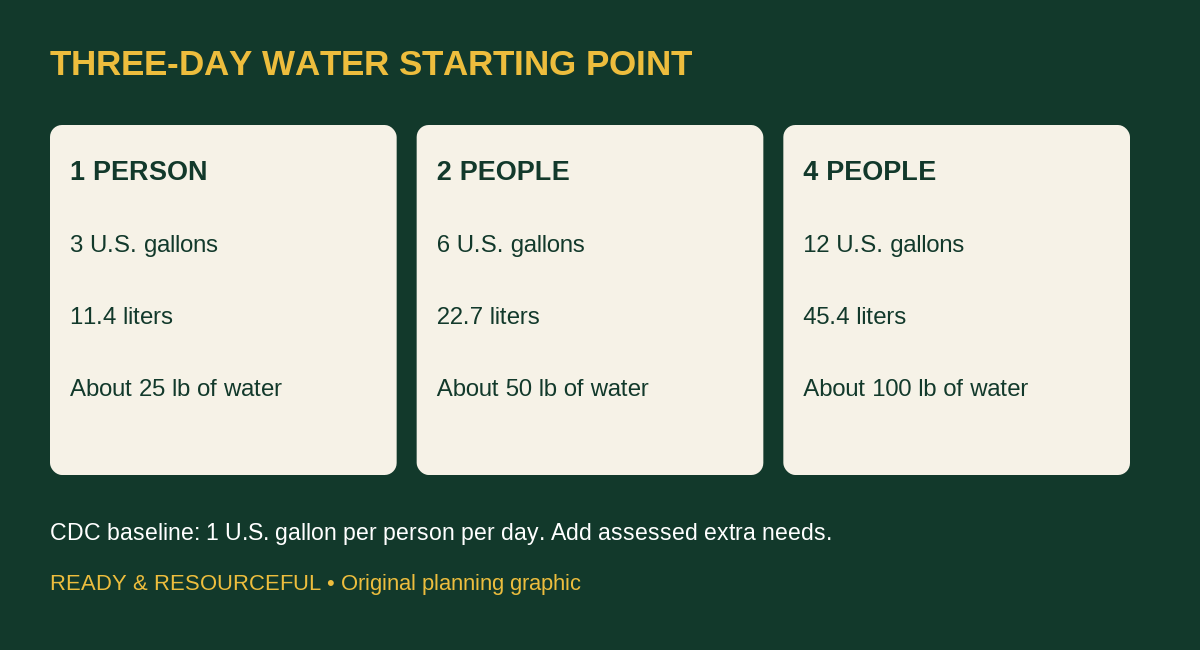
The CDC’s U.S. starting baseline is at least one U.S. gallon per person per day for three days. It advises storing more for needs such as pets, illness, pregnancy or hot conditions, and trying for a two-week supply where possible. This page’s calculator uses that U.S. baseline; it is not a universal international standard.
| People | U.S. gallons | Approximate liters | Approximate water-only weight |
|---|---|---|---|
| 1 | 3 | 11.4 L | 11.4 kg / 25 lb |
| 2 | 6 | 22.7 L | 22.7 kg / 50 lb |
| 4 | 12 | 45.4 L | 45.4 kg / 100 lb |
These are household reserve figures, not a recommendation to carry that weight in one bag. Container weight is additional. Choose manageable sizes and suitable locations; do not assume an unverified shelf or stack can support the load. A container you cannot lift or dispense from comfortably may be an awkward choice even when its advertised capacity looks economical.
For storage, CDC recommends suitable food-grade containers and replacing water you fill yourself every six months. Follow commercially bottled water’s expiry information. See our small-apartment water-storage guide and container buying guide for the practical handling decisions. A filter is not a stored supply and is not suitable for every contamination problem.
Calculate the starting quantities for your household
This planner shows water arithmetic and meal-planning occasions. It does not calculate nutritional adequacy, medicine quantities or whether remaining at home is safe. Extra water is a value you choose after considering relevant guidance; the tool does not estimate pet or medical needs for you. Entries stay on this page and are not submitted.
Your household reserve
Plan three days of usable food, not three days of packaging
Write down what each person would actually eat if the stove, microwave and refrigerator could not be relied on. Include breakfast, lunch, dinner and suitable snacks where that reflects the person’s normal needs. A three-meals-a-day pattern produces nine meal occasions per person over three days; that is an organizing convention, not a calorie prescription.
Check each product’s instructions. A shelf-stable unopened package may require refrigeration after opening. A large container can create leftovers that are awkward without cooling. Choose familiar foods in usable portions, check allergies and keep the opening tool with the supplies. Do not assume dried food works without extra water or cooking.
Consider a fictional dinner for two: unopened ready-to-eat beans in portions the household can use, suitable crackers and shelf-stable fruit. The useful check is whether those people can eat the ingredients, open them, serve them and manage leftovers according to the labels. The example is not a complete diet or a recommendation for every medical condition.
Keep refrigerator food safety separate from the pantry inventory. FoodSafety.gov says a refrigerator generally keeps food safe for up to four hours without power when the door is kept closed; its detailed chart governs individual foods. Never taste food to decide whether it is safe. Use our outage food-safety guide and no-cook meal guide for those decisions.
Download the existing nine-meal planning PDF if paper works better for your household. This hub connects the plan; it does not require another competing food checklist.
Personal care needs come before extra gadgets
Medicines, devices and assistance
FDA advises keeping current medicine information and planning for disrupted pharmacy access and temperature-sensitive medicines. Discuss supplies, storage and any device backup with your pharmacist or care team. A generic “three-day kit” label does not establish the right medicine quantity or acceptable storage conditions.
Keep necessary instructions identifiable and protected. Decide who can help with access, transport or communication. Do not depend on a general power bank to run medical equipment without confirming the device’s actual requirements and an appropriate backup arrangement. If an unresolved care need makes the household plan unworkable, address that before buying optional accessories.
Children, infants and pets
List the supplies used in an ordinary day, then identify what becomes harder without running water, power or a shop. Feeding, hygiene, comfort and communication can each introduce needs absent from an adult shopping list. The CDC’s child and infant emergency-kit guidance is a useful starting reference; follow feeding and medical instructions specific to the child.
For pets, plan familiar food, water, necessary medicines and a practical transport arrangement. Confirm the destination’s rules instead of assuming an evacuation shelter will accept every animal. Record the veterinary or local emergency advice relevant to your pet, rather than using an invented universal water allowance.
Accessibility is a packing requirement
A kit stored high above someone’s reach is not equally accessible to everyone. Check grip, lifting, labels, lighting and the route to the supplies. Ask the person who will use the arrangement what works. A different container or lower location can be more valuable than another specialized item nobody can retrieve.
Lighting, official information and phone power are separate systems
A phone can be a light, a radio stream and a contact device, but those functions compete for the same battery and may rely on a working network. Decide what each piece of equipment is doing. Keep a personal light accessible and choose a shared room light if it serves a real household task.
For a radio, distinguish listening to a broadcast from receiving automatic alerts or communicating with another person. A household receiver does not become a two-way radio. Our emergency-radio comparison explains the differences and regional compatibility. Use the lantern buying guide to compare a useful setting and power plan rather than headline lumens alone.
For phones, inventory the cables, charging source and devices together. A battery percentage shown today is not proof of three days of future use. Check the equipment’s instructions and recharging arrangements. The power-bank guide covers capacity and compatibility decisions without promising a universal number of charges.
Write important contacts and the family check-in arrangement on paper. An address stored only behind an unavailable phone is difficult to use. Our cell-network outage guide develops the communication plan beyond simply buying another device.
Plan for the bathroom and the room temperature
Electricity, water and sewer service are different systems. Losing one does not prove that the others still work. In an apartment, pumps and building instructions can affect what is possible. Before choosing a bathroom backup, identify the actual service problem and follow the relevant utility or building directions.
Use our toilet-during-a-power-outage guide and apartment sanitation guide for the specific decisions. Keep hygiene supplies easy to reach and distinguish water reserved for personal needs from any separate flushing plan. Do not spend the drinking-water reserve casually because a toilet tank appears empty.
Clothing and bedding should fit the expected conditions, and you need somewhere else to go if the home cannot remain suitable. Our winter blackout guide covers a warmer-room and relocation plan. For heat, use the household extreme-heat guide and current local warnings.
A worked example: two adults preparing for three days
Alex and Jo are fictional. They live in a small apartment and want an initial three-day reserve. Their list starts with what is already there: six usable one-gallon water containers, food they normally eat, two working personal lights and the phones’ charging cables.
At the stated U.S. baseline, two people for three days require six gallons before additional needs. The important finding is not “water done forever.” They still need to check the water’s condition, storage dates, container suitability, access and whether their circumstances call for more. They keep the reserve in manageable locations rather than planning to carry roughly 50 pounds of water in a departure bag.
Next they write 18 meal occasions for the pair and identify ingredients that require cooking. They reorganize the usable food, resolve dietary questions and make a small missing-items list. Their personal care arrangements are checked separately; the food calculation does not settle those.
Finally, they identify portable essentials and agree who carries shared equipment. One person cannot be the only one who knows where everything is. They write down a check-in contact, the intended destination and an unresolved building-sanitation question. The result is a plan with named actions, not an unsupported claim that the apartment is disaster-proof.
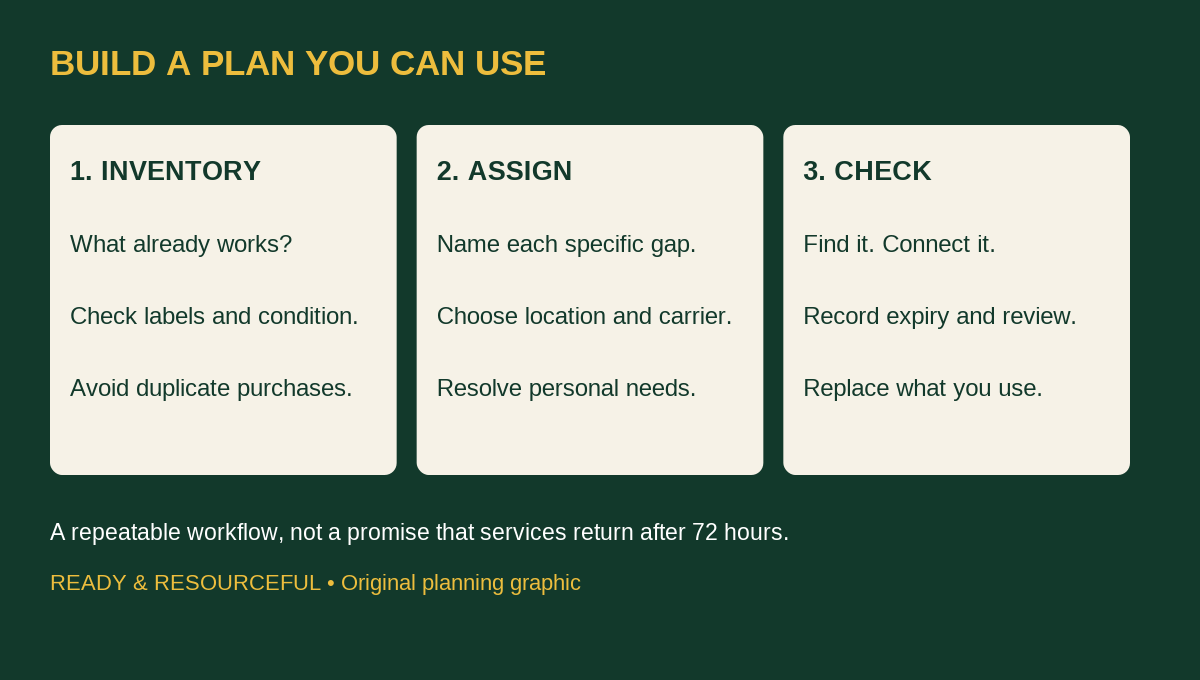
What should you buy after checking the inventory?
Buy the missing function, not the appearance of preparedness. If you already have suitable containers, usable lights and a working receiver, the next purchase may be a replacement battery or an opening tool rather than an expensive backpack bundle. Keep product comparisons separate from the household quantities.
As an Amazon Associate I earn from qualifying purchases. The optional model-search links below are paid links. Check the exact configuration, current instructions, selected quantity and seller. These are examples to investigate, not required purchases or claims of personal product testing.
Home water storage
WaterBrick Standard 3.5-gallon
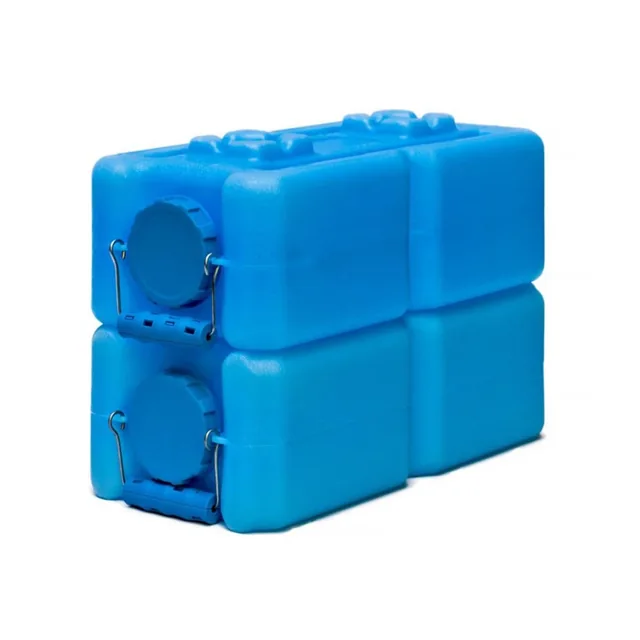
An example to compare for modular household storage. Check filled weight, dispensing, selected quantity and the manufacturer’s stacking instructions. Two containers may appear in the photograph; verify the offer.
CHECK MODEL ON AMAZONShared room lighting
Streamlight Siege AA
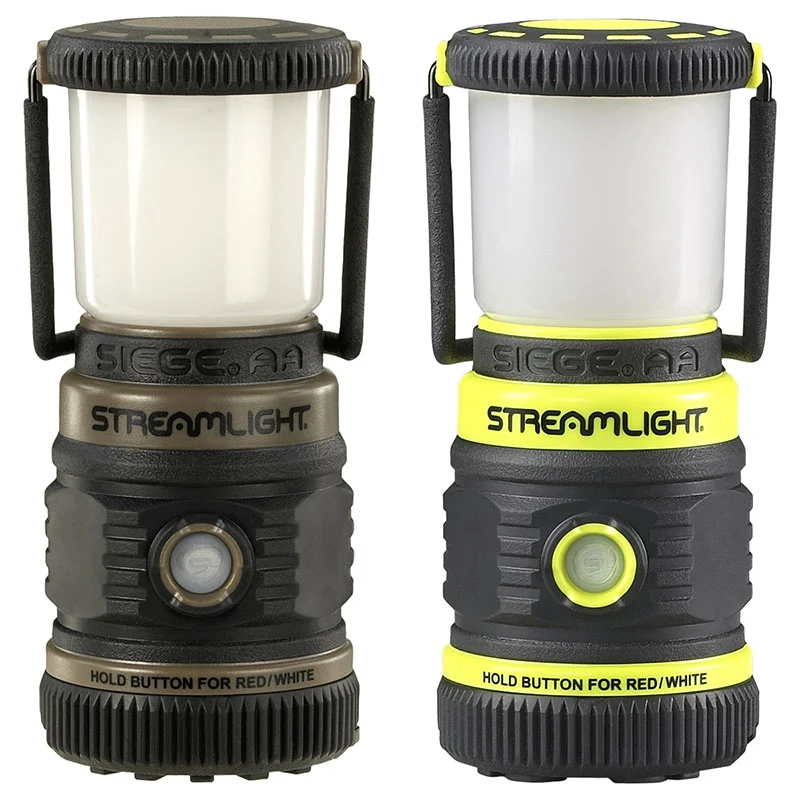
An AA-powered lantern example. Choose a useful setting and prepare the correct spare batteries. Do not read a runtime at a low setting as a promise of that duration at maximum brightness.
CHECK MODEL ON AMAZONBroadcast information
Midland ER310PRO
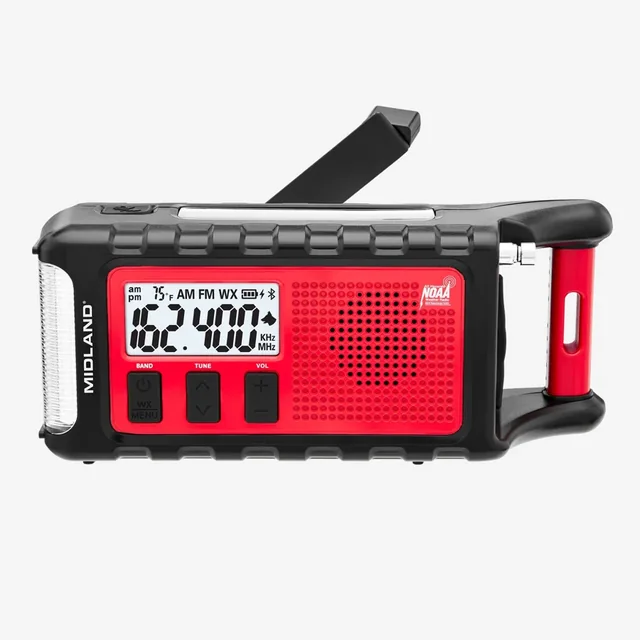
A U.S.-market emergency receiver example. Check local coverage, alert setup and its charging instructions. A receiver does not provide two-way contact, and NOAA reception is not a worldwide service.
CHECK MODEL ON AMAZONBefore buying a premade kit, ask what its person-and-day claim actually includes. Count water volume and usable food portions, inspect the personal-care assumptions and calculate the carrying load. A bundle may be convenient while still requiring substantial additions. Our detailed comparisons should help you audit the contents rather than accept the marketing label.
A practical check before you call the kit ready
- Find it. Ask another household member to locate the supplies without emptying every cupboard.
- Identify it. Read labels and instructions. Keep medicines and personal records appropriately private.
- Connect it. Check the correct cable, batteries, opening tool and necessary accessories.
- Move it. Check whether the intended person can handle containers or transport a packed bag safely.
- Record it. Write the missing item, the responsible person and the next action.
- Review it. Replace supplies after use and revisit the arrangement when the household changes.
This is an organization check, not an equipment stress test or a medical assessment. Do not open sterile packets merely to demonstrate that they are present, run fuel-burning equipment indoors or deliberately interrupt essential care to simulate a failure.
Use the kit-maintenance guide for ongoing review. Keep a copy of the free household PDF offline, and use the site’s supply tracker if a browser-based record suits you. The standalone PDF contains no product links.
Watch the home-reserve and go-bag planning guide
Read the complete transcript
A seventy two hour emergency kit is a household plan, not just a backpack. Keep bulk water, usable food and shared supplies at home. Keep portable personal essentials ready if you must leave. Agree who carries shared equipment. Start with what you already own. Using the U.S. starting baseline, four people for three days need twelve gallons of water, about forty five liters, before extra needs. That is a home reserve, not a suggested backpack load. Plan food you can actually eat without the normal kitchen. Resolve medicines, personal care and pet needs separately. Check lights, radio functions, phone cables and written contacts. Three days is a starting point, not a guarantee that services return. Use the household calculator and free PDF at Ready Resourceful dot com.
Food-checking footage: Ron Lach. Water footage: Peggy Anke. Used under the Pexels license. R&R script, editing, graphics and instrumental bed; synthetic narration. The footage does not document a test of our plan or imply endorsement.
72-hour emergency kit questions answered
What is a 72-hour emergency kit?
It is an initial three-day supply plan for essential household needs during disruption. Organize home reserves and portable essentials separately, and adapt the plan to current local guidance and individual circumstances.
Is 72 hours enough?
It is a starting point, not a universal maximum. Disruption may last longer, and official recommendations differ. The supplies also cannot replace a decision to leave an unsafe home.
Does everything need to fit in a backpack?
No. Bulk home reserves can require several manageable containers. The departure bag needs a realistic carrying and transport plan. Do not interpret household water arithmetic as a recommendation for one backpack load.
What should a family of four prepare?
Begin with the people’s actual needs, shared supplies and intended setting. The water table gives the stated U.S. baseline; the planner shows meal occasions. Neither substitutes for dietary, medical, pet or accessibility planning.
Can I build a kit without buying a premade one?
Yes. An organized inventory of usable supplies can be a practical starting point. Check condition, instructions, quantities and access, then buy to close specific gaps.
Do I need cash in the kit?
A payment backup can be useful when normal access is disrupted, but there is no single amount that fits every household. Use our emergency-cash planning guide to consider likely expenses, security and access.
Where should I keep my emergency supplies?
Choose suitable storage conditions and locations the intended users can reach. Protect contents from foreseeable damage, keep sensitive documents private and make sure the household knows the arrangement. Follow container and equipment instructions.
Sources, calculations and editorial method
Primary references were checked November 14, 2026. This is a household organization guide, not emergency-service, clinical or engineering advice. No field trial, product testing or professional review is claimed. Alex and Jo are fictional examples. The charts and planner make their assumptions explicit rather than assigning an unsupported readiness score.
Conversions use one U.S. gallon = 3.785411784 liters. Water-only mass is approximated at one kilogram per liter, excluding containers. Meal occasions use an optional three-meals-a-day planning pattern and do not calculate calories. The calculator does not validate water quality, prescribe medicine or determine evacuation decisions.
- Ready.gov — preparing around household needs and several-day supplies
- Ready.gov — basic emergency supply categories
- CDC — emergency water quantity, storage and review
- Government of Canada — 72-hour emergency kits
- FoodSafety.gov — food decisions during an outage
- FDA — medicine preparation and storage concerns
- CDC — pregnant women, infants and children
- CDC — outage and carbon-monoxide safety
The header is an actual licensed photograph, not an image of our own household or test. Product photos identify the named models; separate reuse permissions remain unverified. See our editorial standards, affiliate disclosure and correction contact.