
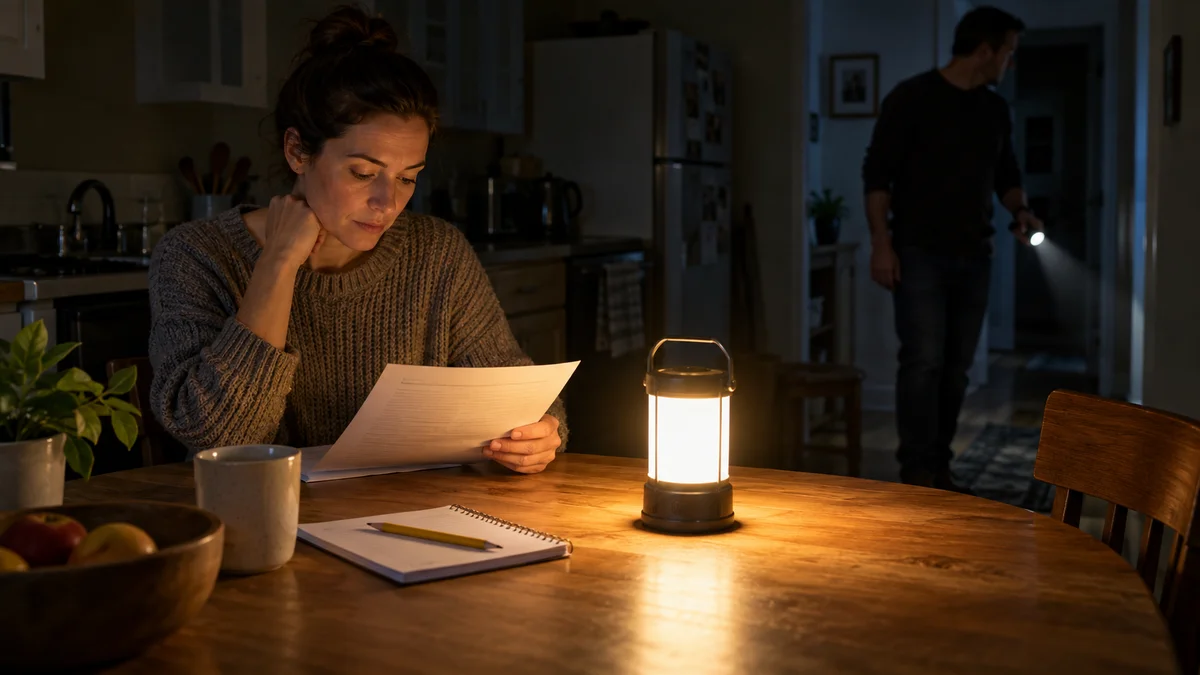
A lantern can make a shared table usable. It cannot follow everyone into separate rooms. Build the plan around one shared light plus a personal flashlight or headlamp for each person who needs to move, rather than buying the brightest lantern and hoping it covers the whole home. Ready.gov recommends flashlights for every household member. Read the official outage guidance.
Three lanterns for three different power plans
You do not need every light on this list. Choose the power arrangement you can maintain, then check the compromises.
As an Amazon Associate I earn from qualifying purchases. The three Amazon buttons open model searches; confirm the exact model and seller. Manufacturer links offer a direct alternative.
For maintained spare AA sets
Streamlight Siege AA
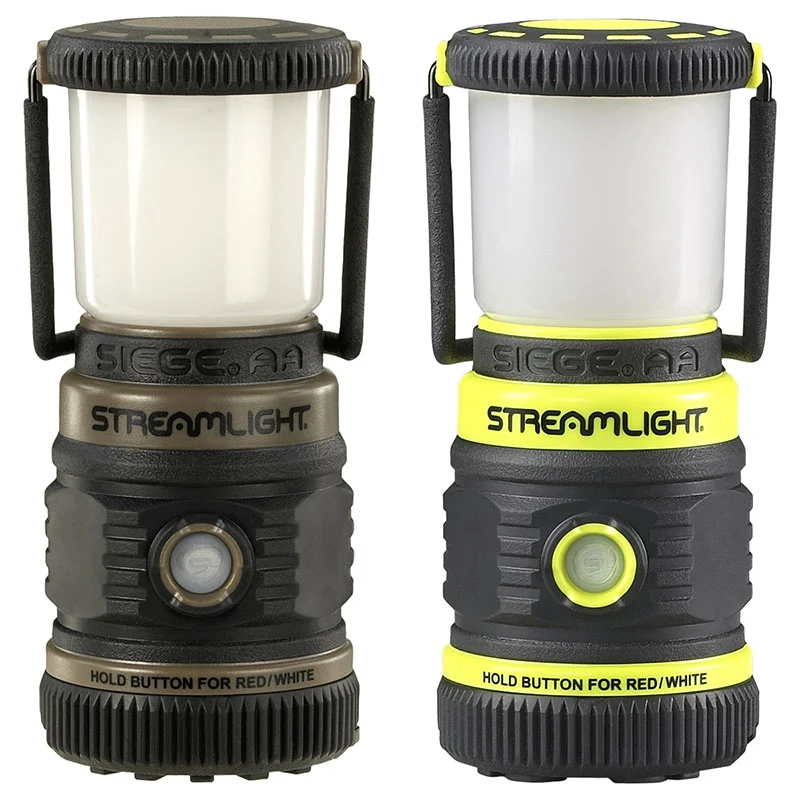
Why compare it Change a complete battery set when charging is unavailable
Tradeoff No integrated USB recharge or phone charging
CHECK ON AMAZONManufacturer detailsFor warm, adjustable rechargeable light
BioLite AlpenGlow 500
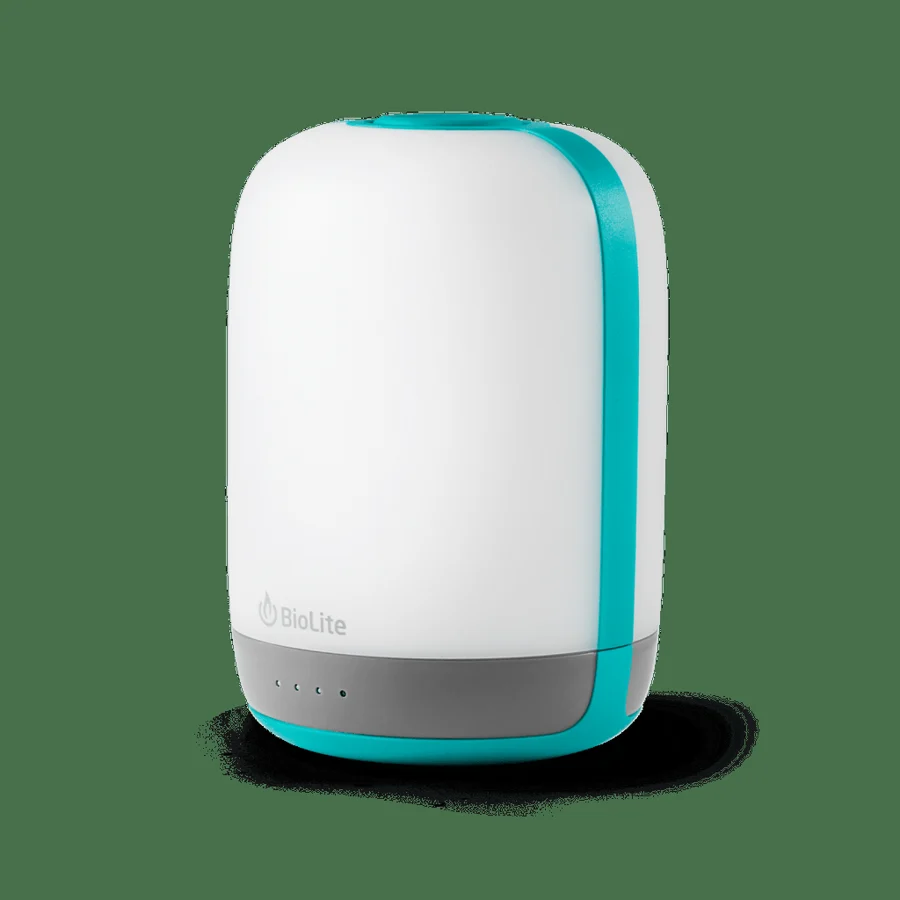
Why compare it A shared table or tent with a maintained USB power source
Tradeoff Micro USB input; ordinary cells cannot be swapped in
CHECK ON AMAZONManufacturer detailsFor directional light and crank fallback
Goal Zero Lighthouse 600
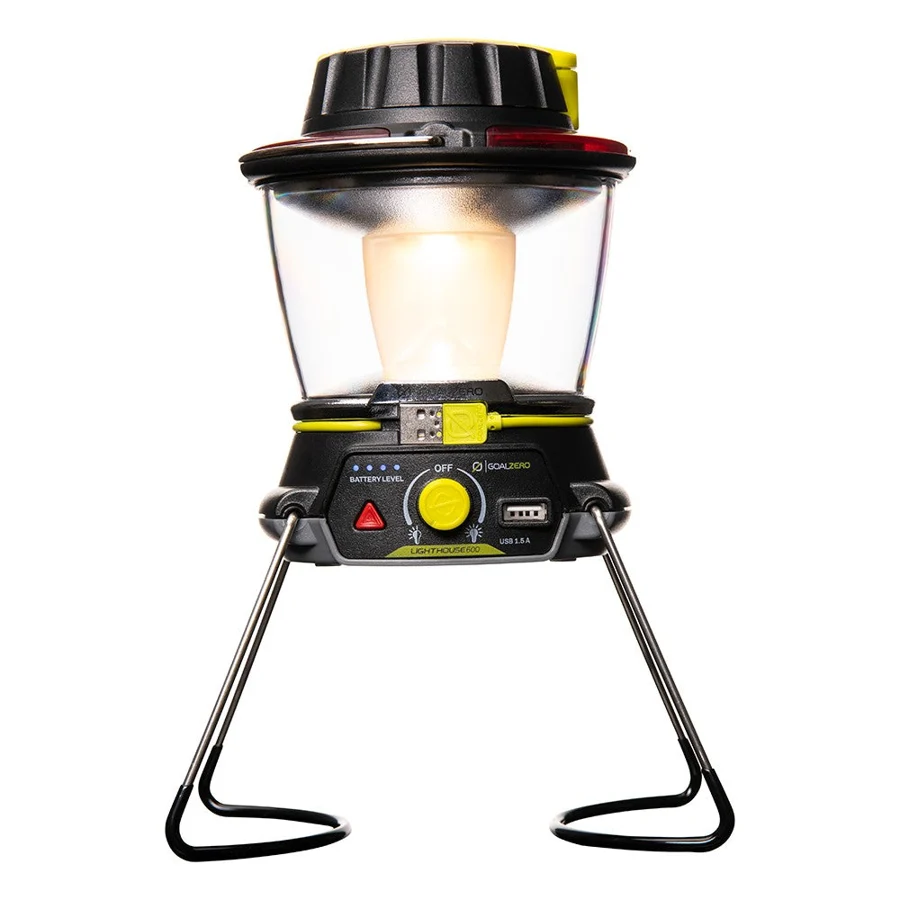
Why compare it Face light toward the task; keep a normal charging plan
Tradeoff Both-sides high has a short stated runtime
CHECK ON AMAZONManufacturer detailsWATCH / THREE POWER PLANS
Which lantern fits your outage plan?
Compare the three models, their useful differences and the compromise to check before buying.
Read the comparison video transcript and credits
Choose your lantern by how you will keep it powered. These three models solve different problems. This comparison uses published specifications, rather than hands-on testing.
The Streamlight Siege double A suits a kit built around spare batteries. It uses three double A alkaline cells. The tradeoff is maintaining complete spare sets. It does not provide integrated USB charging.
The Bio Lite Alpen Glow five hundred offers warm and cool rechargeable light. Check the Micro USB input before buying. Its long low-mode runtime describes only five lumens, so check the setting against your actual task.
The Goal Zero Lighthouse six hundred can light one side or both. Its published runtime is five hours on one-side high, but two and a half hours with both sides high. The hand crank is a fallback, not unlimited power.
Choose spare cells, rechargeable comfort, or directional light with crank backup. Then plan a useful setting, your next power source, and a personal flashlight. Use the full comparison and evening planner below.
Product photographs: Streamlight, BioLite and Goal Zero, linked in the cards above. Original motion graphics and music by Ready & Resourceful. Synthetic narration: Kokoro af_heart. No filmed product test or measured endurance is implied.
Compare the settings—not just the biggest number
The table keeps operating modes together. A long low-setting runtime is not a promise of bright room lighting. Nor are the manufacturers’ endpoints necessarily equivalent.
| Model / power | High setting | Low setting | Important distinction |
|---|---|---|---|
| Streamlight Siege AA3 AA alkaline cells | 200 lm / 7 h | 50 lm / 37 h | 100 lm / 15.5 h medium; IPX7 |
| BioLite AlpenGlow 50023.6 Wh internal battery; Micro USB | 500 lm / 5 h | 5 lm / up to 200 h | IPX4; USB-A output shares the battery |
| Goal Zero Lighthouse 60018.98 Wh internal battery; USB | 600 lm / 2.5 h (both sides) | 180 h both sides; 320 h one side | One-side high: 5 h; low-mode lumens unspecified |
Manufacturer-published specifications, checked October 25, 2026. Model revisions may change. No independent side-by-side endurance test is claimed. The Siege AA lumen figures are published with its outer cover removed.
The runtime trap that changes this buying decision
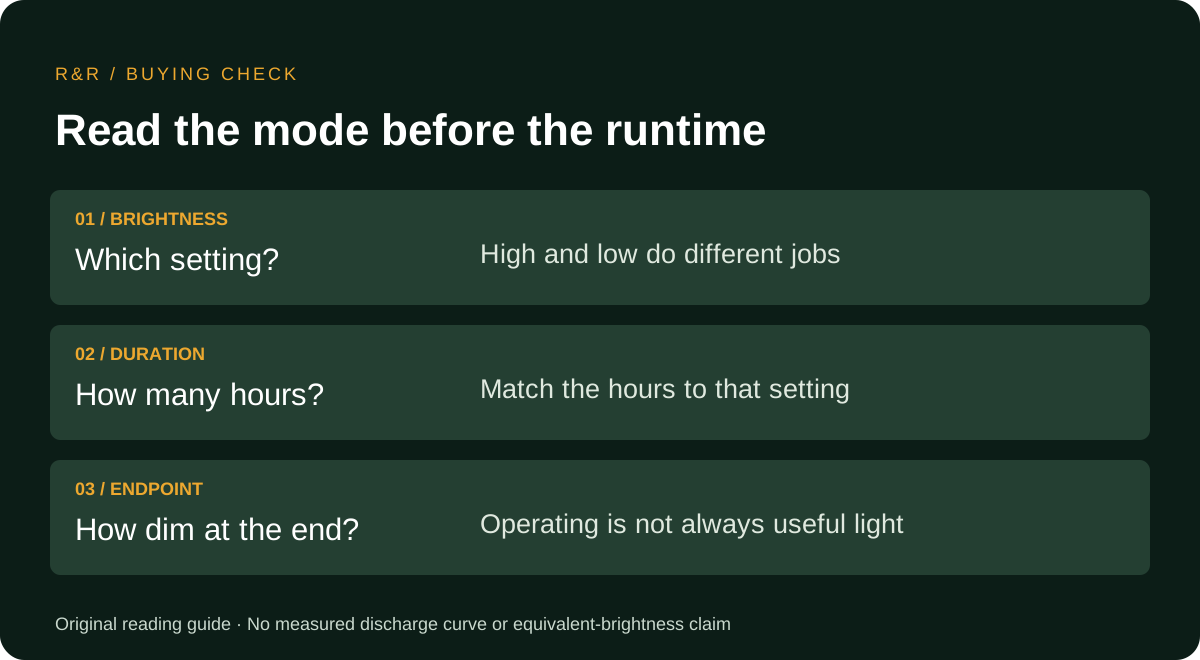
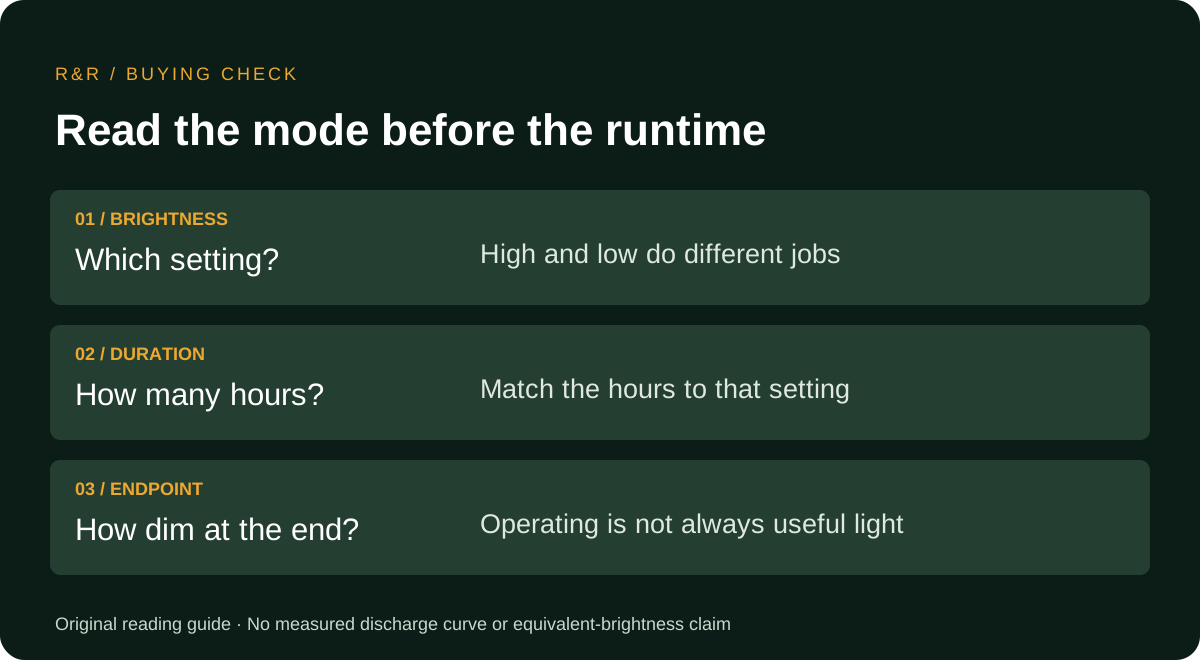
Two packages can advertise a high lumen number and a long runtime even though those figures describe different settings. Putting them beside each other in a headline does not make them simultaneous.
For example, BioLite lists the AlpenGlow 500’s low setting at 5 lumens. That is a very different lighting job from its maximum setting. Its long low-mode figure should not become your expectation for preparing a meal or reading small print. The manufacturer’s specification table gives the modes separately.
There is a second distinction: runtime does not necessarily mean constant brightness. Streamlight’s Siege AA fact sheet defines its runtime endpoint as 10% of initial output. A light can still be operating while being much dimmer than it was at switch-on. We do not assume that definition applies to every other model.
Will your chosen setting cover the evenings you need?
Use this planner to expose a shortfall before checkout. It divides a published runtime by your intended use; it does not predict a battery’s actual condition. Start with a setting you have checked is useful for your task. Low settings across different lanterns are not equivalent.
ORIGINAL EVENING PLANNER
Turn a runtime claim into a power plan
Allowance is a planning choice, not a tested derating factor. No temperature, battery-aging, USB-output load or brightness-curve model is applied. Inputs stay on this page and are not sent in analytics.
A worked three-evening example
Suppose your household wants four hours of shared-table light on each of three evenings: 3 × 4 = 12 hours. A chosen mode rated for five hours provides less than half of that on one full charge. With the planner’s optional 25% allowance, the arithmetic counts 3.75 hours per charge and rounds 12 ÷ 3.75 up to four full-charge equivalents. That means an initial charge plus three opportunities to replenish it—not four lanterns you must buy.
This is a planning example, not a forecast or a validated safety margin. The allowance is user-selected; it cannot account for every temperature, aging battery or brightness change. Do not infer intermediate-mode endurance by drawing a straight line between high and low.
For a removable-cell lantern, the equivalent calculation tells you how many complete battery sets to plan around. A partially used drawerful of loose cells is not the same as complete fresh sets. For a rechargeable light, write down where each recharge would come from. An outlet that is also without power is not a backup plan.
Streamlight Siege AA: a straightforward spare-cell candidate
I would shortlist this model when the household already maintains AA supplies and wants to restore light by changing a complete set. Its appeal is the power arrangement, not a claim that a smaller lantern will light every room. The tradeoff is buying, storing and replacing the prescribed batteries.
Choose the exact AA model: the larger Siege and rechargeable versions are different products. Keep a flashlight accessible while changing cells; otherwise servicing the shared light can leave you working in the dark. If you prefer charging everything by USB, the spare-cell routine may feel like an extra maintenance task.
Skip it if: you specifically need an integrated phone-charging port or a rechargeable lantern. The official AA specification is the basis of this recommendation, not an assumption about alternate battery chemistries.
BioLite AlpenGlow 500: a rechargeable option for shared living space
The case for this lantern is adaptable light around a table or tent, especially if you will also use it between emergencies. Everyday use gives you a reason to notice a depleted battery before the next outage. Its color modes are optional comforts, not reasons to spend more on an emergency kit.
Check the charging connector before ordering: the model reviewed uses Micro USB. A cupboard full of USB-C cables will not solve that mismatch. We would keep the correct cable with the light and use a separate power bank for planned phone charging, so the household’s main illumination is not an unrecorded energy reserve for everything else.
Skip it if: you want to swap ordinary cells when it runs down, or you only want to maintain one cable type. Check the exact version in the listing rather than transferring specifications from the smaller AlpenGlow models.
Goal Zero Lighthouse 600: directional light with a fallback
This is the candidate I would compare when light needs to face a table rather than radiate equally in every direction. The ability to illuminate one side is a useful distinction; decide where people will sit before paying for more maximum output.
The hand crank is a fallback, not a reason to omit charging. Goal Zero specifies its crank conversion at a particular cranking rate and low-light mode. That should not be interpreted as a few turns providing an evening at maximum brightness. Keep a normal charging plan and reserve the crank for a gap in that plan.
Skip it if: you need ordinary replaceable batteries, or expect the headline brightness to run through a long evening on one charge. The official page also gives a 32–104°F operating range, so check conditions before treating this as a freezing-weather camp solution.
Put light where the task happens
Start with the room people will actually share. Place the lantern on a stable, clear surface where it illuminates the table without sitting directly in everyone’s line of sight. Keep it away from the edge and test whether a person sitting down blocks someone else’s view. A wall, door or your own body can leave another area dark even when the main room feels bright.
Try three lighting arrangements
A shared-table position focuses the plan on the task. The separated hallway still needs its own light.
That drawing is a layout aid, not a lux map. It cannot establish fall safety or adequate illumination. Walk the route in your actual home with a personal light, check steps and obstacles, and relocate equipment if it creates a trip hazard. Do not hang a lantern from a fixture unless the attachment and fixture are suitable for that load.
For camping, the same idea means lighting the table where you sort equipment and keeping a wearable light available for moving. A sheltered campsite table and an exposed storm are different conditions. Verify the exact ingress rating and instructions; a splash-resistance label should not be read as permission to submerge a product.
Watch: turn the runtime label into an evening plan
This short original animated demonstration follows a sample five-hour claim through a twelve-hour lighting plan. The moving timeline shows why three evenings need more than one initial charge. It demonstrates arithmetic, not the performance of any reviewed lantern.
Video text and accessible explanation
Three evenings at four hours each means twelve hours of light. A hypothetical five-hour runtime covers only part of that plan. Counting 75% leaves 3.75 hours per full charge. Twelve divided by 3.75, rounded up, means four full-charge equivalents. For one rechargeable light, that is the initial charge plus three recharges. This example does not predict steady brightness or battery performance. Check the task and mode, then record a real charging source.
Five checks that matter more than extra modes
- Can everyone switch it on? Before storing it, ask another household member to find white light, change brightness and turn it off. Write down an unfamiliar sequence. A feature nobody can access is not useful in a blackout.
- Does the low mode let you do the job? Test the actual task, such as reading a printed checklist. Do not assume two lights described as “low” are interchangeable. If you need more light, base your plan on that mode’s documented runtime.
- Can you power it again? Identify complete spare sets or a charged, compatible USB source. Include the right cable. A solar panel is a separate component where specified; recharge time depends on conditions, not just the existence of a sun symbol.
- What happens while it is being serviced? Keep a personal light available during battery changes or charging. One lantern serving a whole household has a single point of failure, regardless of its lumen rating.
- Will you maintain it? A light you regularly check can be more useful than a sophisticated one left untouched. Put the model, power source and next review date into the free supply planner.
Check the controls before relying on a lantern
Try it with the person who will use it. Can they reach the switch, grip the handle, choose useful white light and reconnect the charging cable? Check these tasks seated and in the intended room. A specification sheet cannot establish whether a control suits someone’s vision, grip or reach.
For example, the Siege AA instructions describe a two-second hold to change between white and red light and timed presses to change brightness. Record that sequence beside the stored light. This is a documented control example, not an accessibility test or endorsement.
Will it turn on automatically when the power fails?
Do not assume a portable camping lantern detects an outage. Look for an explicit automatic power-failure function in the exact model’s manual. If that is the feature you need, compare purpose-built plug-in emergency lights separately. Keep a personal flashlight within reach so you can find and operate the shared lantern.
Record the light’s location and power source in your editable emergency checklist; use our apartment power-outage checklist to plan the rest of the room.
Your before-the-lights-go-out check
Tick the checks you complete. Your selections remain in this browser if storage is available. The printed sheet includes room for your own model, setting and power plan.
0 of 8 checks completed
OPEN PRINTABLE CHECKLISTFor long storage, Energizer recommends removing batteries from unused devices and storing them in a cool, dry place at normal room temperature. Keep the correct complete set nearby in suitable packaging, with a small ready-to-use personal light for initial access. Replace cells together using the size and type the device specifies; do not recharge non-rechargeable batteries.
Rechargeable products have their own upkeep instructions. For example, Goal Zero’s product FAQ recommends checking and charging this lantern every three months. Use a recurring household review rather than assuming a charge from last season is still sufficient.
Questions before you buy
What is the best emergency lantern for a home power outage?
Start with the battery plan. A spare-cell model suits a household maintaining compatible batteries; a rechargeable model suits a household with a maintained charging source. Then check useful brightness and documented runtime at that setting. There is no single model that replaces both a shared room light and personal lights.
Is a camping lantern suitable for indoor emergency lighting?
A battery-powered LED camping lantern can serve as a shared indoor light when used according to its instructions. This guide does not recommend fuel-burning lanterns indoors. Ready.gov’s outage information sheet recommends battery-powered lights. Keep access routes and personal lighting in the plan.
How many lumens do I need?
There is no universal room-sized answer from a lumen number alone. Placement, diffusion, task detail, surfaces and individual vision matter. Choose a dimmable light and check the task in the actual space. We have not measured room illumination or established a minimum safe lumen threshold.
Can I use a lantern’s USB output to charge my phone?
Only when the exact model supports it. That draws on the same stored energy needed for lighting, so do not count the full lighting runtime and a phone recharge as separate reserves. We have not tested simultaneous lighting and charging or phone recharge capacity.
Does a long runtime guarantee useful brightness until the end?
No. Read the mode and endpoint together. Some runtime definitions allow output to decline substantially before the reported endpoint. Check a manufacturer discharge curve if available and verify your own task before relying on the last hours of a claim.
How we made these recommendations
We selected three identifiable electric lanterns with different power arrangements, examined their official product information and checked the Siege AA fact sheet for its runtime definition. Recommendations are editorial judgments about household fit. We did not buy, borrow or handle these units for this review; no drop tests, lumen measurements, temperature trials, battery-cycle tests or measured discharge curves were performed.
Our contribution is the setting-specific comparison, the transparent evening calculation, the room-planning interaction and the printable inspection record. The generated hero image is a household illustration. Manufacturer images are product-identification photographs, not evidence of our use. The animation uses a hypothetical example. Prices and stock change; check the seller, exact model, included cable and batteries before purchase. Send corrections through our contact page; read our editorial standards and affiliate disclosure.
Primary sources and specification trail
- Streamlight Siege AA product specifications and AA fact sheet (linked document revised August 2015; current product page checked October 2026).
- BioLite AlpenGlow 500 technical specifications.
- Goal Zero Lighthouse 600 specifications and charging FAQ. The detailed model table is used in preference to differing category-page runtime copy.
- Ready.gov power-outage guidance and outage information sheet.
- Energizer battery care.
Build the rest of your outage plan
Pair lighting with an information source using our emergency radio comparison. Check the household tasks in the apartment power-outage checklist, record maintenance in the emergency kit maintenance guide, and plan food that does not depend on cooking in our no-cook emergency food guide.