PREPAREDNESS / FIELD GUIDE
Food Safety During a Power Outage: Fridge and Freezer Guidance
Understand refrigeration time limits and prepare a simple outage record.
Part of our beginner preparedness guide. Choose a starting task or continue with this topic.
By Ready & Resourceful · Published 7 October 2026 · Research-based guide; no product testing claimed.
Quick answer
Prepare appliance thermometers and an outage record before disruption. During a blackout, keep refrigerator and freezer doors closed and use the CDC time-and-temperature guidance below. Do not judge safety by taste or smell. [CDC guidance]
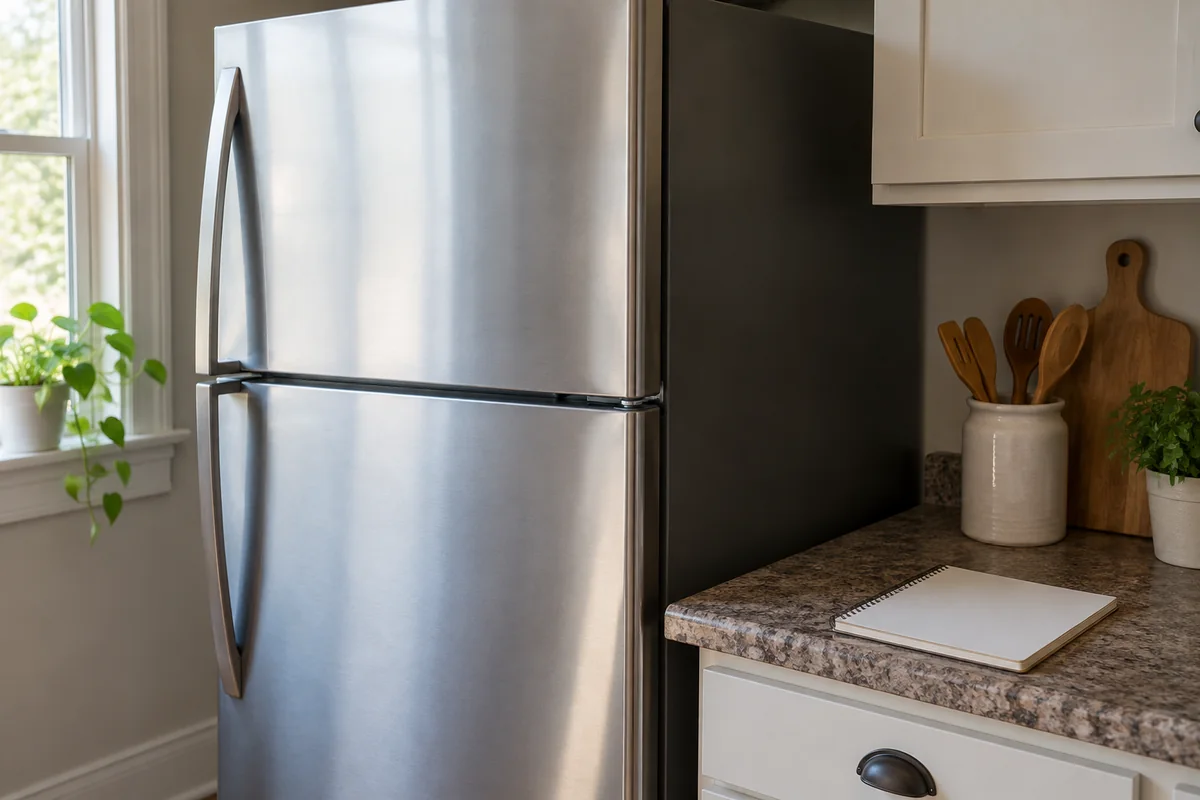
It is frustrating to lose a fridge full of food, and uncertainty makes the decision harder. Write down what you know about the outage instead of trying to judge food by a reassuring smell. This guide puts the basic time limits beside a practical record, with links to official instructions for individual foods.
Know the CDC’s baseline
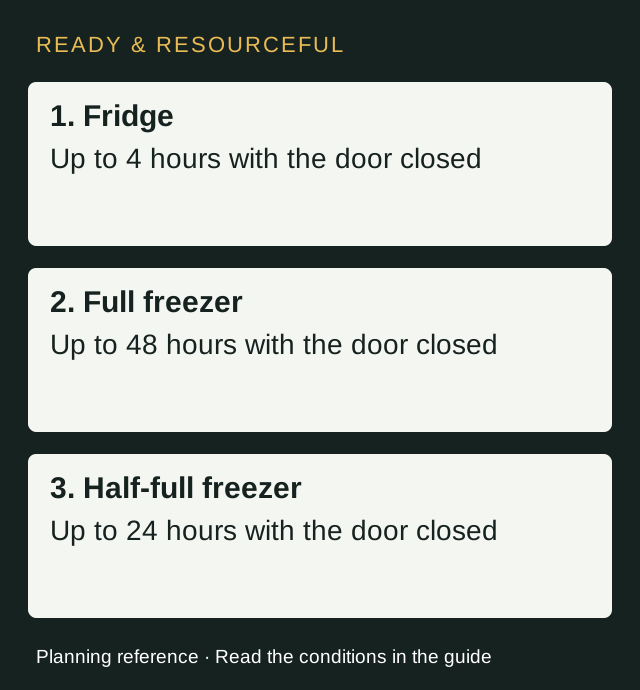
Keep refrigerator and freezer doors closed. CDC states that, with doors closed, food can remain safe for up to four hours in a refrigerator, 48 hours in a full freezer, or 24 hours in a half-full freezer. These are not guarantees for equipment that was already too warm. [CDC guidance]
CDC recommends appliance thermometers: the refrigerator at 40°F (about 4°C) or below, and the freezer at 0°F (about −18°C) or below. After an outage, use the CDC’s detailed discard guidance. Never taste food to determine whether it is safe. When in doubt, discard it. [CDC guidance]
Prepare an outage record
Keep a small sheet beside your emergency contacts. Leave spaces for the date, time you noticed the outage, whether the true start time is known, thermometer readings and any action taken. If you were away, write “start time unknown” rather than guessing. Record measurements when obtained; do not repeatedly open doors just to complete the sheet.
Plan meals that do not depend on the fridge
Choose a few familiar, shelf-stable foods that fit household dietary requirements. Check whether preparation needs water, heat or a can opener. Read instructions for opened containers. A large package can be inconvenient if leftovers require refrigeration you cannot provide.
Write a basic meal plan using foods you already keep. This is a planning suggestion, not a claim that every canned or packaged food is suitable for everyone. Account for allergies, special diets and any clinical guidance your household follows.
Keep a cold-storage backup in mind
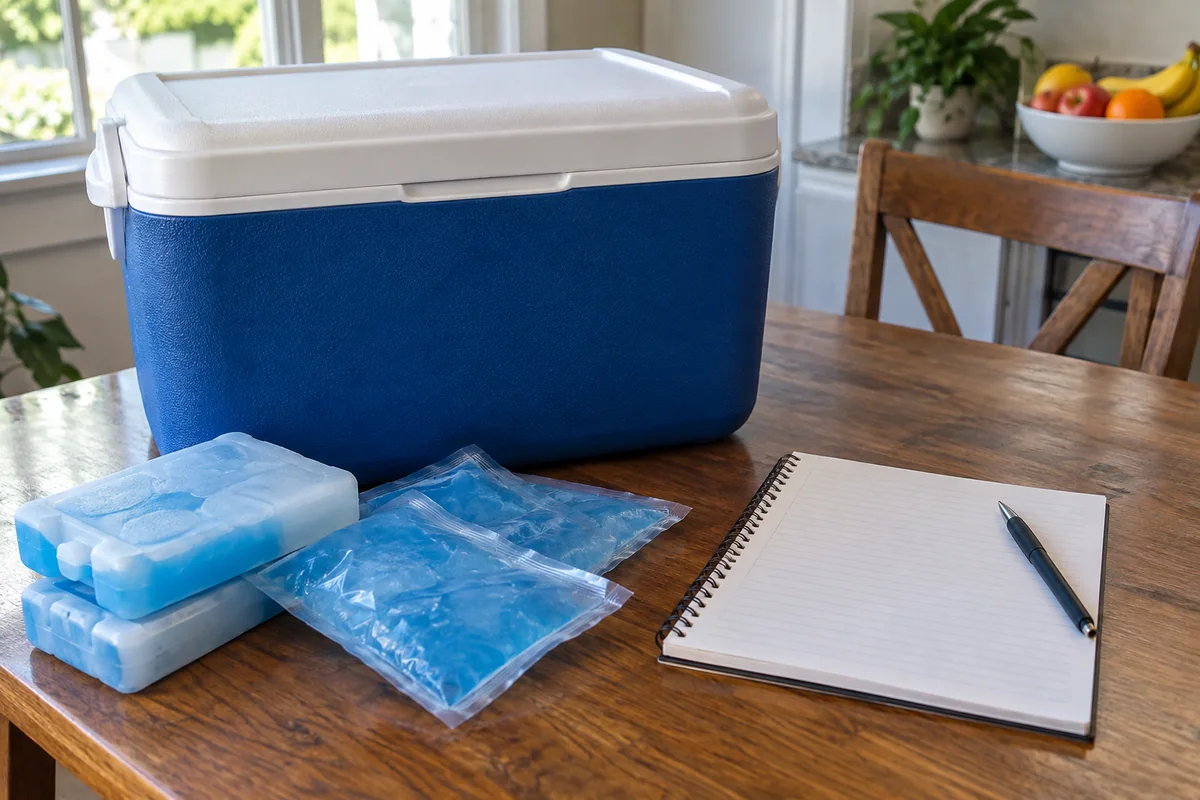
CDC recommends having a cooler and frozen gel packs ready. Plan this before a forecast disruption. A cooler is not proof that food stayed cold; temperatures and time still matter. Medication storage has separate requirements, so ask the pharmacist or prescriber rather than applying food guidance to medicines. [CDC guidance]
When electricity returns
Use the official guidance to assess food before resuming normal use. Note what was discarded and what needs replacing. Review the plan afterward: was the thermometer readable, did you know when power stopped, and were the backup foods easy to prepare? Improve the record rather than treating the event as a reason to buy equipment immediately.
Outage record: capture facts, not guesses
| Record | What to write | Why it helps |
|---|---|---|
| Outage timing | Known start time, or “unknown” | Avoids an invented time window |
| Appliance status | Refrigerator / full or half-full freezer | Helps select the applicable official guidance |
| Temperature | Actual reading and time measured | Separates a measurement from an assumption |
| Action | Moved, discarded or assessed using official guidance | Makes follow-up and replenishment easier |
Suggested planning format. Examples describe a proposed arrangement, not a completed or tested project.
Planning example: leave the blank record with a pen near your contact sheet. If you return to an unpowered fridge and cannot establish when the outage began, record that uncertainty and consult the official guidance; do not manufacture a start time.
Fridge and freezer outage limits at a glance
| Appliance | Closed-door limit stated by CDC | Condition to keep with the number |
|---|---|---|
| Refrigerator | Up to 4 hours | Keep the door closed; use official guidance for assessment. |
| Full freezer | Up to 48 hours | The freezer is full and its door remains closed. |
| Half-full freezer | Up to 24 hours | The freezer is half full and its door remains closed. |
These limits summarize the CDC guidance above. Door opening, unknown starting conditions and missing timing information should not be replaced with reassuring guesses. [CDC food safety]
Use food-specific guidance when power returns
CDC says thawed frozen food may be refrozen or cooked if it still contains ice crystals or is at 40°F or below. Consult the FoodSafety.gov refrigerated and frozen-food charts for the relevant item; power returning does not erase its storage history. [CDC guidance]
Record the decision and what needs replacing. Do not turn the record into a reason to taste questionable food or repeatedly open an unpowered appliance. When timing or temperature is unknown, preserve that uncertainty in the notes and follow the official guidance.
If you come home to an unpowered refrigerator
Write down when you discovered the outage and whether its start time is actually known. If the household has a reliable record, use it; otherwise mark the start time unknown. Keep “noticed at” separate from “started at.” A utility restoration message does not by itself establish every food’s temperature history.
Suggested record fields: discovery time, known outage start, appliance, available temperature information, action taken, and replacement needed. Put a pen with the blank sheet so the record does not depend on a working phone.
Afterwards, review the process. Could you find the official guidance? Was the record easy to complete? Did the backup meal need an opener you could not find? Use those answers to improve the apartment outage plan. Keep food assessment and meal planning as separate tasks.
Common planning mistakes
- Guessing the outage start time after returning home.
- Opening appliance doors repeatedly just to update a log.
- Applying food-storage rules to medication without asking a pharmacist.
Your action checklist
- Prepare appliance thermometers.
- Save the CDC emergency food guidance.
- Keep a blank outage record and pen.
- Note the known outage start time or write “unknown”.
- Keep appliance doors closed.
- Assess food using official guidance, not tasting.
- Record replacements needed.
Download the plain-text checklist
The download includes the guide link and references. Keep a local or paper copy if you may be without internet access.
Questions about this guide
Is food automatically safe when electricity returns?
No. Power returning does not establish the time or temperature conditions the food experienced. Apply the CDC guidance to the actual circumstances. [CDC guidance]
Can I use this article for refrigerated medicines?
No. Medicines have product-specific requirements. Ask your pharmacist or prescriber for an outage plan instead of applying food guidance.