

What to do after a boil water advisory is lifted
First, confirm that the official lifting notice covers your address. Then follow your water supplier’s recovery instructions and the instructions for appliances connected to the supply. Deal with ice made during the advisory, check any required filter or appliance steps, and report persistent water-quality problems. Do not substitute a social-media all-clear or the return of pressure for an official notice.
That sequence answers the practical question without sending you straight into an unnecessary shopping trip. You may need to take specific actions, but the right actions depend on the notice and the equipment in your home. Replacing every filter and running every tap for an arbitrary period is not a universal recovery procedure.
This is a household guide to returning to normal use after a **boil water advisory**, sometimes called a boil water notice. A do-not-drink or do-not-use warning is different. It also does not clear a private well, certify flood-damaged plumbing or replace instructions for a medical device, food business or healthcare facility.
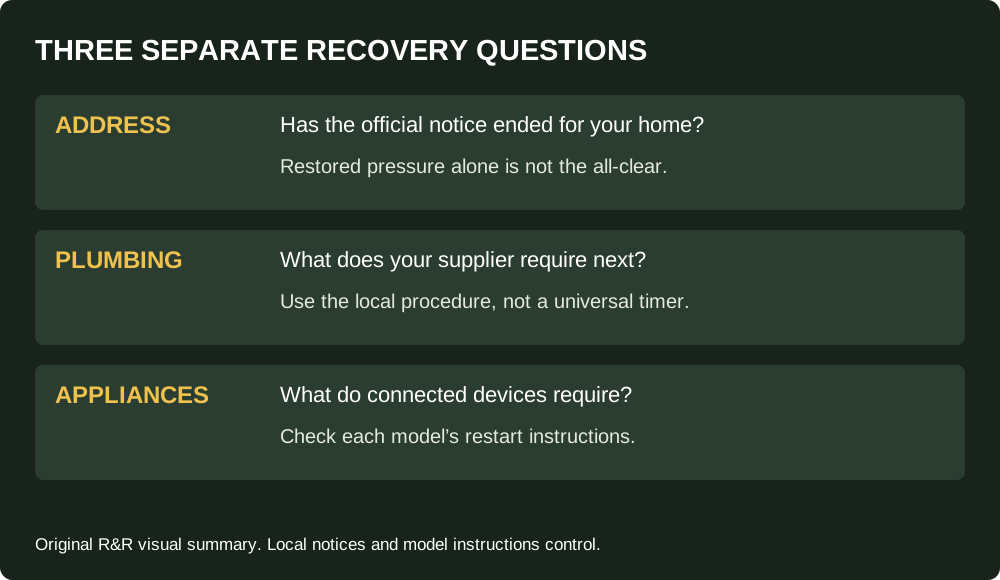
Confirm the all-clear for your actual address
Open the utility’s current notice from its official website, notification service or another channel it identifies. Check the affected area, the publication time and any instructions that remain in place. Save the notice or its link so the other people in your household can read the same information.
Look for an explicit statement that the advisory has been lifted. A message about a repair, restored pressure or crews completing work is not necessarily that statement. If the boundary description is unclear, ask the supplier whether your service address is included rather than making the decision from a nearby street name.
For an apartment or shared building, identify both the supplier’s notice and any separate instructions from management about the building’s plumbing or equipment. An official system-wide all-clear does not tell you whether an individual appliance has been serviced or whether a separate building fault remains unresolved.
Make the household handover specific. Instead of “the water is back,” communicate “the supplier has lifted the notice for our address; here are the remaining appliance instructions.” That avoids mixing up restoration of service with completion of every task inside the home.
Do you need to flush your pipes after a boil water advisory?
**Follow your utility’s instructions. There is no single flushing time that applies everywhere.** Philadelphia Water Department says most of its boil water advisories do not require household flushing unless the department directs it. WSSC Water publishes cold-water flushing instructions after an advisory ends. Those are local procedures, not interchangeable national rules.
Find the section headed “after the advisory is lifted,” “returning to normal use” or similar wording in your notice. If it tells you to flush, use its sequence and duration. If it does not explain what to do with your particular setup, ask the utility or building manager before copying a procedure from another service area.
Keep household flushing and appliance flushing distinct. A direction about a sink faucet does not automatically explain how to service a refrigerator, water softener or other connected device. Each may have its own instructions. Do not improvise with unfamiliar plumbing valves or equipment.
A useful recovery note records the instruction you actually followed and where it came from. It need not become another large checklist. One line such as “supplier guidance checked; cold-water procedure completed as directed” is enough to prevent a second household member repeating the task unnecessarily.
| Supplier example | Published approach | What it means for you |
|---|---|---|
| Philadelphia Water Department | Routine household flushing is generally unnecessary unless directed | Check whether your supplier specifically requires it |
| WSSC Water | Publishes post-advisory cold-water flushing instructions | Use its procedure only where that guidance applies |
| Your own supplier | Read the current lifting notice and recovery instructions | Resolve unclear steps with the responsible office |
Refrigerator water and ice makers need separate attention
A refrigerator connects the water system to two things you may consume directly: dispenser water and ice. CDC advises against using water or ice from connected appliances while a drinking water advisory is active. The notice ending is the point to check the appliance’s restart instructions, not a reason to assume everything stored inside it is newly cleared.
Discard ice made during the advisory and follow the relevant instructions for the bin and ice maker before making ice for consumption again. ECUA’s post-advisory guidance explicitly addresses this distinction. Consult the model’s manual for the cleaning or flushing process, including any instructions about newly produced ice.
Do not prescribe one batch count for every machine. A number mentioned in another utility’s procedure may be appropriate only when that utility directs the procedure. Record the source for your own steps rather than treating a generic internet number as an appliance specification.
If you are not sure whether the machine made ice during the affected period, do not treat the lack of a timestamp as confirmation that it did not. Ask the supplier or manufacturer how to handle the uncertainty. Keep the ice maker’s status clear to other household members while you resolve it.
Do you have to replace your refrigerator filter?
Check the utility’s direction and the filter or appliance manufacturer’s post-advisory instructions. There is no reliable universal answer based only on the word “filter.” A pitcher cartridge, refrigerator cartridge and whole-house treatment system are different products with different instructions.
ECUA tells customers to follow manufacturer directions for cleaning, flushing or replacing their filters after a precautionary notice. That is a useful decision principle: identify the exact model and the applicable instruction before buying a replacement. Do not assume an ordinary scheduled replacement interval answers an incident-specific question.
When a replacement is required, use a compatible cartridge and complete its specified installation and flushing procedure. Whirlpool, for example, explains that its refrigerator water system should be flushed after filter replacement to prepare the filter and remove trapped air and excess carbon. That is manufacturer guidance for its equipment, not a universal instruction for every brand.
Avoid judging filter performance from appearance alone. A cartridge fitting into a housing does not establish which contaminants it is designed to reduce. CDC also says ordinary home filtering does not remove the need to boil water during a boil water advisory. The all-clear must come from the responsible authority, not from installing a new cartridge.
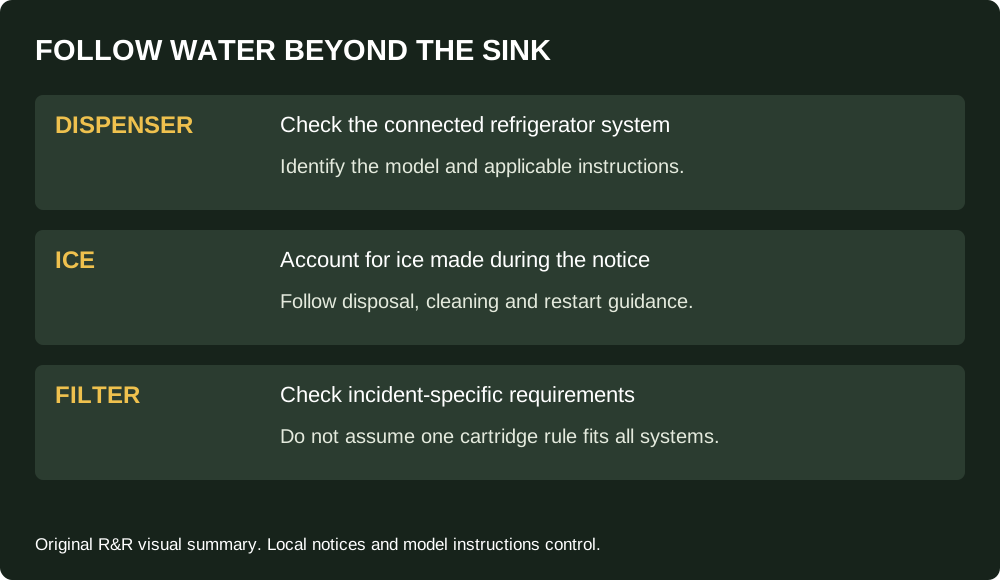
Coffee makers, dishwashers and other connected equipment
Walk through the kitchen and identify which appliances use supply water automatically. This is an equipment-identification exercise, not a direction to disassemble them. A manually filled kettle and a plumbed-in coffee machine have different connections and may require different attention.
For each connected appliance, locate its model information and the relevant instructions. Ask a focused question if the manual is unclear: “This appliance was connected during a boil water advisory; what restart, cleaning or filter steps apply?” A model number and the notice details are more useful than asking whether all coffee makers need the same treatment.
Do not assume that a normal operating cycle is a manufacturer-approved sanitizing procedure. Equally, do not run repeated empty cycles or add cleaning chemicals without a reason supported by the instructions. Recovery should be deliberate rather than a collection of unrelated household hacks.
Follow any separate rules that apply to a business or specialized equipment. A household article cannot establish the reopening requirements for a food-service operation or the water requirements of medical equipment. Those questions belong with the responsible regulator, care team or equipment provider.
What if the water is still brown, cloudy or unusual?
Contact the water supplier when a persistent appearance, odor or pressure problem remains after its prescribed recovery steps. Explain what you are observing, when it began and whether it affects one fixture or several. Do not use taste as a test of safety.
ECUA advises customers with continuing discoloration or pressure concerns after restoration to contact customer service. A local explanation for discoloration should not be generalized into a claim that every unusual color in every home is harmless. Likewise, clear-looking water is not an official all-clear when a notice remains active.
Give the utility observations rather than a guessed diagnosis. “The cold tap at two sinks remains discolored after the instructed procedure” is more actionable than “the water must be contaminated.” Keep any photographs and the time of the observation available if the supplier requests them.
If you receive a new warning, follow the new instructions. Do not rely on an older screenshot that has been superseded. Keep an appropriate alternative water supply available while an unresolved question is being addressed, using it in line with the current official advice.
Boil water, do not drink and do not use mean different things
Read the notice’s actual category. CDC distinguishes boil water advisories from do-not-drink and do-not-use advisories. Boiling addresses germs; it does not make water contaminated with harmful chemicals or toxins safe. A rule appropriate to a boil notice must not be reused automatically for another kind of warning.
This matters when search results mix different incidents. A page about a pressure-loss precaution, a chemical spill and a private-well flood can all mention “unsafe water,” yet require different actions. Start with the warning that applies to your home, not the first broadly relevant article.
If you are searching because water service has just returned but an advisory is still active, you are still in the advisory phase. Use the supplier’s current instructions rather than the post-advisory parts of this guide. For broader planning, our emergency water storage guide for small apartments helps separate stored drinking water from assumptions about tap availability.
| Notice wording | Key distinction | Where to get the applicable action |
|---|---|---|
| Boil water | Addresses a germ-related risk through the specified precautions | Current utility or public-health notice |
| Do not drink | Boiling does not remove harmful chemical or toxin contamination | The notice’s permitted and prohibited uses |
| Do not use | May restrict contact as well as consumption | The responsible authority’s explicit instructions |
Renters and shared buildings should identify who handles each task
Ask management whether the building has shared water equipment or separate restoration instructions. You do not need to become the building’s plumber. You need to know which tasks belong to your household and which require management or a service professional.
A focused message might read: “The supplier’s lifting notice includes our address. Are there any separate building instructions, and who is handling shared equipment? I will follow the manual for appliances inside my unit.” This is an example communication, not a statement about legal responsibility in every jurisdiction.
Do not enter restricted plant rooms or adjust shared valves to complete a procedure copied from another building. Record an unresolved management question separately from a task you can complete inside your apartment. That keeps a household plan from implying authority over systems you do not control.
If the disruption also affects wastewater service, consult our guide to toilets during a power outage and follow the sewer utility’s instructions. Drinking-water clearance is not an announcement that a separate wastewater problem has been repaired.
Why the October 2026 recovery guidance matters
ECUA published its post-Isaias questions and answers on October 13, 2026. It illustrates why a useful recovery article must address ordinary household questions rather than simply repeating that service has resumed. Readers need a route from the official notice to their own kitchen and equipment.
The lesson is not that ECUA’s procedure should be applied nationwide. Its value here is a concrete example of the questions to resolve: address coverage, appliance restart, ice, filters and continuing problems. We distinguish that local example from the instructions published by other suppliers.
Our Hurricane Isaias flooding and power-outage coverage provides the event context. This guide is the lasting household resource, intended to remain useful when a future pressure loss or water-main incident creates the same practical questions. It does not provide a live address-clearance map.
Return to normal use without losing the next disruption plan
Once you have completed the applicable steps, tell the other household members what has changed. Note any appliance still awaiting service and remove outdated instructions that could cause confusion. Keep the official notice link available until any remaining questions are resolved.
Replenish supplies that were used, but buy for an identified need. A different filter model or an extra gadget does not replace understanding the advisory. Our water shut-off planning guide covers the interruption phase, while the emergency-kit maintenance guide explains how to keep an existing reserve organized afterward.
If the same incident caused an electrical outage, address refrigerated food separately using our power-outage food-safety guide. The end of a water notice does not answer how long food was outside its required temperature conditions.
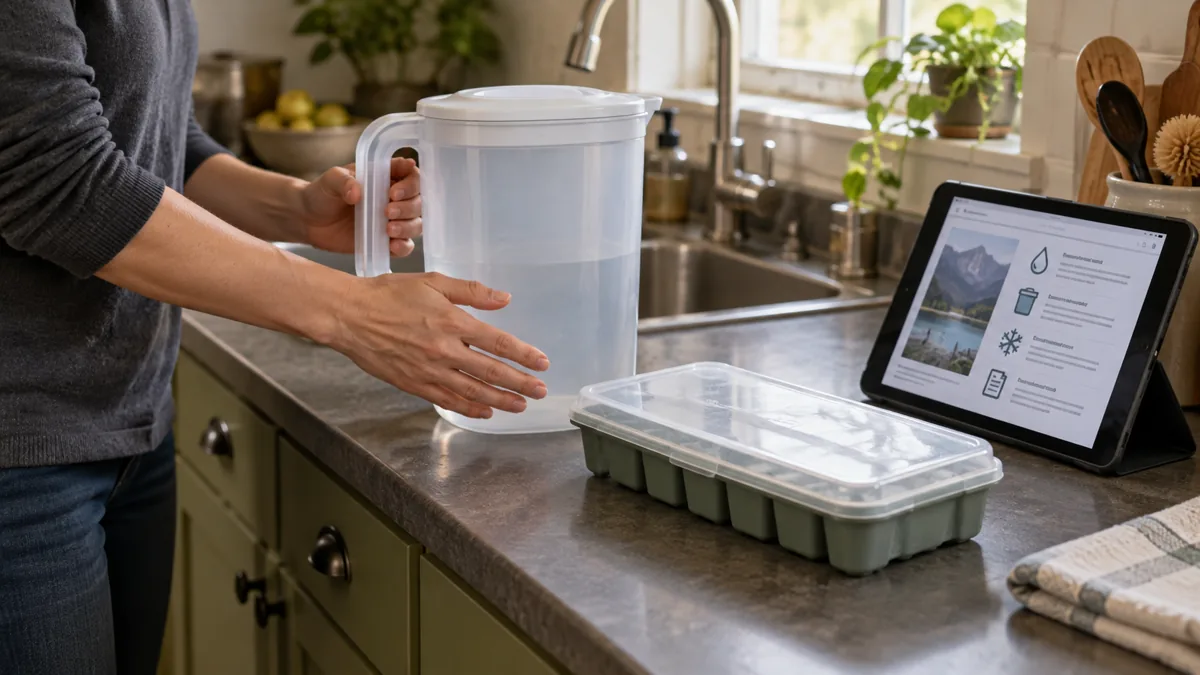
A simple household handover prevents crossed instructions
Picture a household where one person receives the lifting notice while another is shopping for bottled water and a third has already switched the refrigerator ice maker back on. Everyone is trying to help, but they are working from different information. The fix is a shared message that separates the official status from unfinished household tasks.
Use three short statements. First, identify the source and the address covered by the all-clear. Second, say which utility-directed steps have been completed. Third, name anything still awaiting the appliance manual or a service response. This is an original communication method, not a water-quality assessment.
For example, a fictional household might write: “Our utility has lifted the notice for our address. We have completed the steps in its notice. Please leave the refrigerator dispenser unused until we finish the model-specific restart instructions.” That is clearer than a large green check mark beside the word water.
Include anyone who relies on the household supply, including a visiting caregiver or a relative who does not follow the same notification channel. Keep the message readable without requiring someone to open several attachments. If the utility changes its advice, update that message rather than leaving two competing versions visible.
What to ask when the notice leaves a question unanswered
Have the service address, notice date and a description of the unresolved question ready before contacting the supplier. Avoid sending sensitive account information through an unverified social-media account. Use the contact route on the utility's own site or your established account records.
A useful question is specific enough to answer. Ask whether the lifting notice includes your address, whether its recovery procedure applies to your building, or which office should address persistent discoloration. Do not ask an appliance manufacturer to clear the public supply, and do not assume the utility can identify a cartridge from a vague description.
For equipment questions, record the manufacturer, model number and the instruction you cannot interpret. You can say that the appliance remained connected during the advisory without asserting that it was definitely contaminated. A factual description gives the support team something it can work with.
Keep the answer with its date and source. If you receive conflicting instructions, identify the conflict explicitly and ask the responsible parties to resolve it. Repeating a procedure from a forum does not reconcile a difference between an official notice and a model-specific manual.
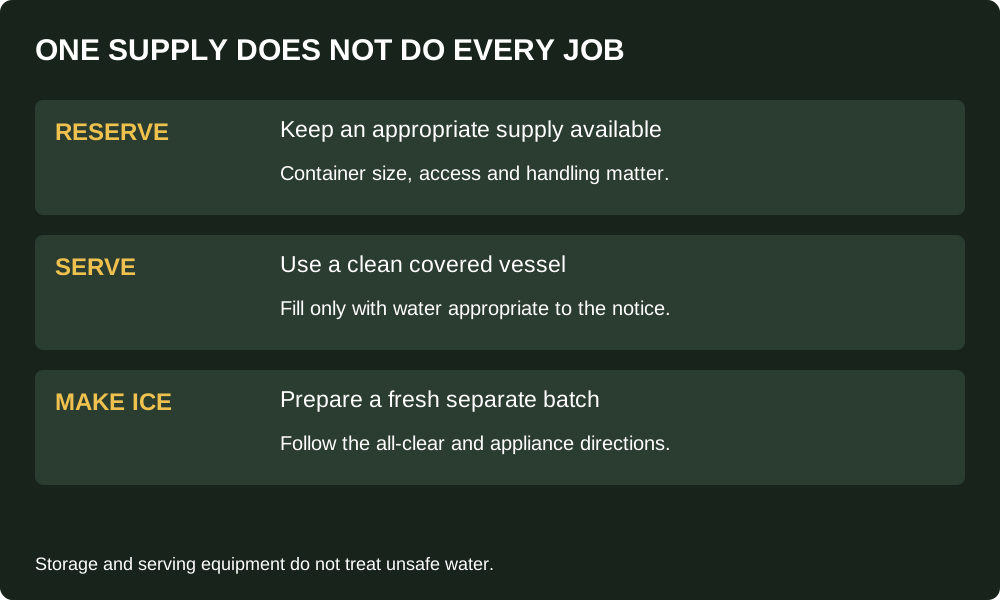
Choose supplies for a defined task
The most useful purchase is the one that solves an identified gap. A covered pitcher can organize water already safe to use. A separate ice tray can make a fresh batch using an appropriate water source. A larger storage container can support a future reserve. These are different jobs, and none of them declares an advisory over.
Look at the space and handling involved before choosing a container. Check that the intended user can lift or dispense from it, that it fits the storage location and that its cleaning instructions are manageable. A large capacity is not automatically an advantage in a small apartment or for someone who needs assistance.
For a connected filter, establish compatibility and the incident-specific replacement requirement before shopping. Match the exact product information rather than buying the first cartridge with a similar shape. Keep the manual available for installation and any required preparation steps.
Reuse suitable equipment you already own when it meets the applicable instructions. This article's product selections are optional examples of household organization and storage tools. They are not an equipment requirement issued by your utility, a treatment recommendation or evidence that your tap water has been tested.
Worked example of a household returning to normal use
Consider a fictional renter whose water pressure returns in the morning. The tenant first checks the supplier's current notice and finds that the boil water instruction is still active. The tap running normally changes convenience, but it does not change the instruction. The tenant continues following the active notice.
Later, the official lifting notice includes the building's address. The renter reads the recovery instructions, asks management whether there is a separate building task and locates the refrigerator manual. The household handles the ice made during the affected period using the applicable advice, then follows the appliance restart directions.
The final handover records what is complete and leaves any unresolved equipment question visible. If a persistent water-quality concern remains, the tenant reports observations to the supplier instead of relying on a taste test or assuming a new filter resolves the issue. This example demonstrates the order of decisions; it does not prescribe a universal plumbing procedure.
Common questions after a boil water notice ends
Can I drink tap water immediately after the advisory is lifted?
Use the official lifting notice for your address and complete any required steps it specifies. Do not treat the return of pressure or a neighboring area’s clearance as confirmation for your home. Appliance instructions may still apply to dispensers and ice makers.
How long should I run the taps?
Use your supplier’s duration and sequence if it requires flushing. Some utilities do not routinely require it after every boil notice. A five-minute instruction from another service area is not automatically the rule for yours.
Does a new filter make water safe during an active advisory?
Do not substitute a household filter for the advisory’s directions. Check the current notice and follow the appropriate water-use instructions until the responsible authority lifts it for your address.
Must I discard all food in the refrigerator?
A boil water notice and a refrigeration failure are different issues. Identify items affected by advisory-period tap water using the official guidance, and assess a separate power interruption with the relevant food-safety instructions. Do not infer that the entire refrigerator is cleared or condemned from the water notice alone.
Does this guide apply to a flooded private well?
No. A private well affected by flooding needs its own assessment and instructions from the appropriate health authority or qualified well professional. A municipal supplier’s lifting notice does not certify a private water source.
Sources and editorial method
We compared utility instructions rather than inventing a national restart procedure. Sources checked October 16, 2026 include ECUA’s October 13 recovery guidance, Philadelphia Water Department’s advisory FAQs, WSSC Water’s during-and-after guidance, CDC’s drinking-water advisory overview and Whirlpool’s filter support guidance. Examples of household communication and task organization are original editorial guidance. We have not tested your water, inspected your plumbing or verified a live advisory for your address.