
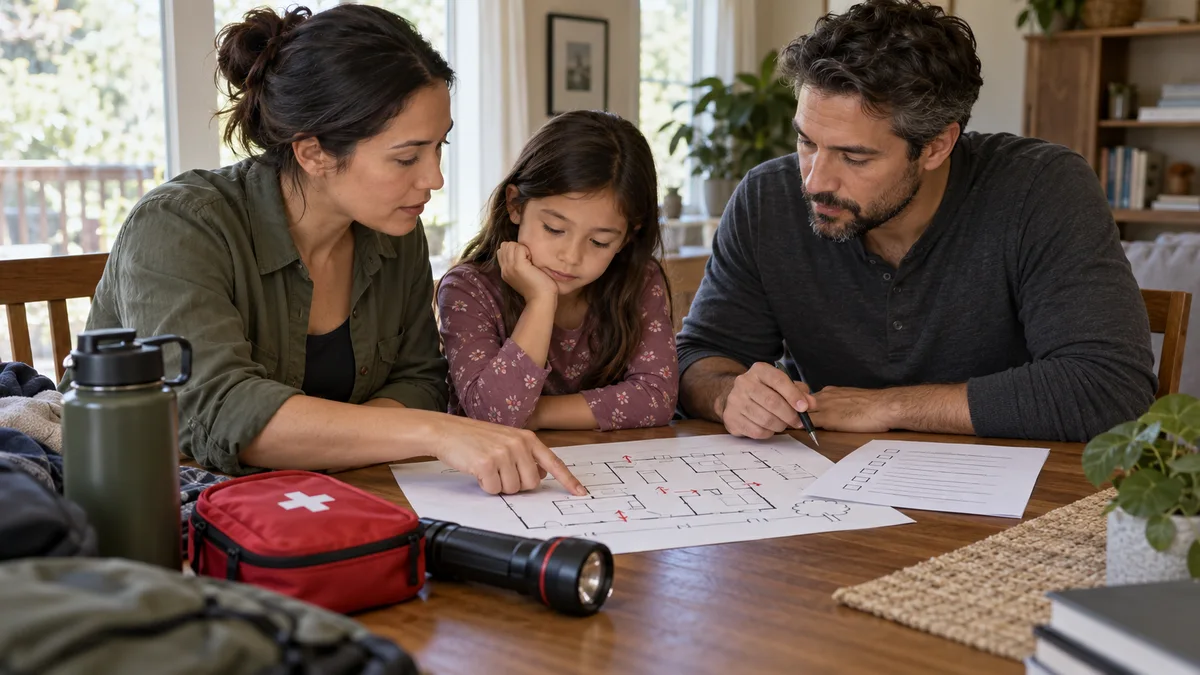
An earthquake plan becomes useful when it answers ordinary questions before anything moves. Where would you take cover from the sofa? Which cupboard holds the working flashlight? If the building loses water, does the toilet still have a usable drain? Who collects a child if the usual journey home is interrupted?
I would start with those decisions before buying another emergency bag. Supplies matter, but a well-stocked cupboard cannot choose a meeting place, secure a tall cabinet or explain what to do when the shaking starts. This guide puts those tasks in an order a household can actually finish.
The approach is straightforward. Reduce hazards in the places you use, practise the appropriate protective action, arrange essential supplies and communication, and know which decisions belong to local officials or qualified professionals. The planning worksheets and examples here are original editorial tools. Protective actions are linked to official guidance, without claiming that this publication has tested a home in an earthquake.
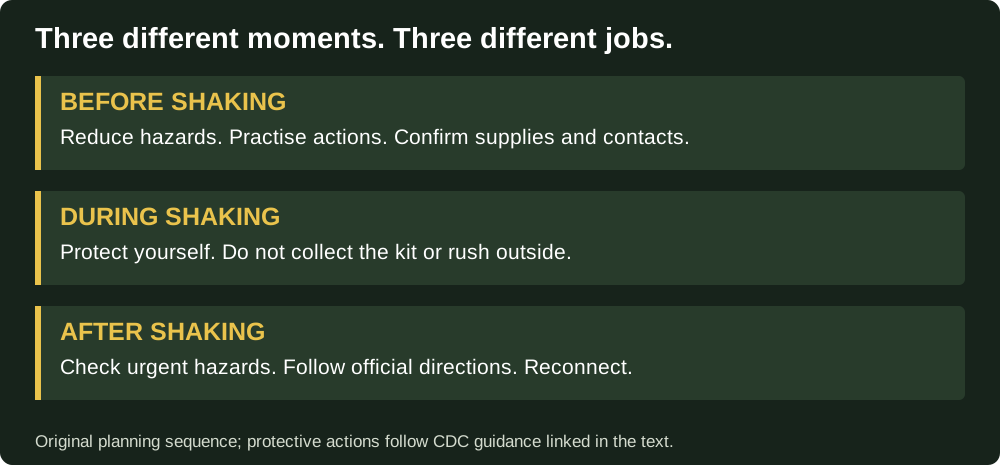
What should you do first to prepare for an earthquake?
Start with one room, one protective action and one person who needs your help. Choose the room where you spend the most time. Identify nearby sturdy cover and objects that could fall into that space. Then discuss how the plan changes for a child, an older relative or someone who cannot comfortably get down to the floor.
Write three unfinished tasks rather than an ambitious shopping list. Your first task might be moving a heavy decorative object away from a bed. Another might be asking building management about emergency communications. A third could be checking whether the flashlight actually has the right batteries. Record an owner for each task and a date that makes sense for your household.
This is our suggested way to make a large job manageable, not an official readiness score. Completing three tasks does not make a building earthquake-proof. It gives you a concrete beginning and exposes questions you might otherwise keep postponing.
The USGS preparation overview brings together earthquake safety resources. Use it with your state, county or city emergency-management information. A national guide cannot establish your building's condition, local evacuation routes or a household member's individual support needs.
| Task | Confirm before marking complete | Who owns the next action? |
|---|---|---|
| Protective action | An appropriate action is understood for each person | Household member / support contact |
| Falling hazards | Safe reorganization or suitable installation completed | Occupant / owner / qualified installer |
| Building questions | Actual management response recorded | Named resident and management |
| Water and supplies | Usable quantity and location checked | Supply owner |
| Communication | Contacts and arrangements agreed | People involved |
Make your home safer room by room
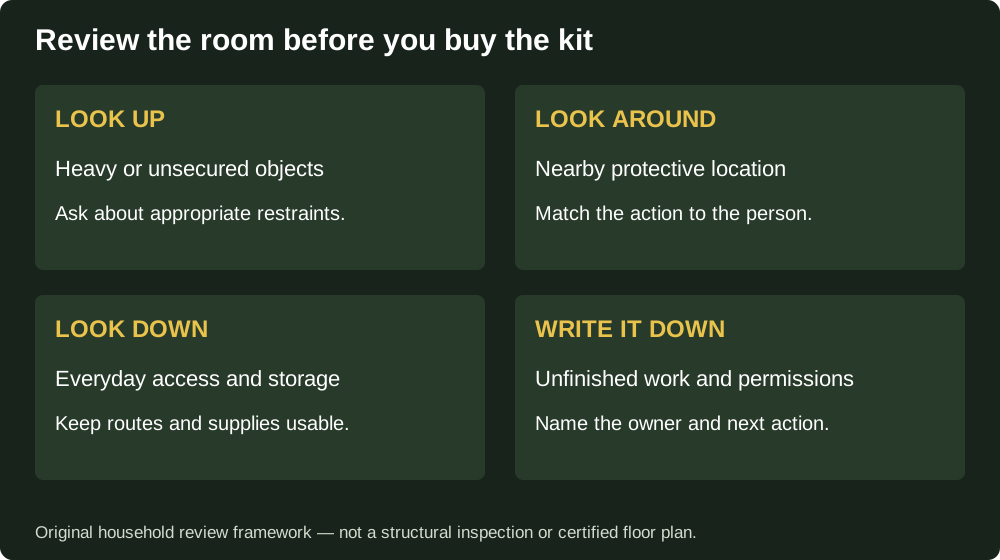
Walk through the rooms in daylight when there is no emergency. Look up as well as down. A clear floor can sit beneath an unsecured bookcase, a heavy mirror or a cabinet full of breakable objects. The useful question is what might move toward a person, block access or make essential supplies difficult to reach.
The Earthquake Country Alliance's Secure Your Space guidance emphasizes securing furnishings and other movable hazards. Identify tall furniture, appliances and wall-mounted objects that need appropriate restraints. Use hardware and attachment methods suited to the item and the supporting structure, following manufacturer instructions and applicable local requirements. An adhesive product advertised for small ornaments is not automatically a restraint for a loaded wardrobe.
I would separate the walk-through into things you can safely reorganize now and work that requires permission or expertise. Moving a heavy object to a lower shelf is different from drilling into an unknown wall or changing a water-heater installation. Keep those jobs on separate lines so a simple checklist does not quietly turn into an unqualified retrofit project.
Bedroom and overnight access
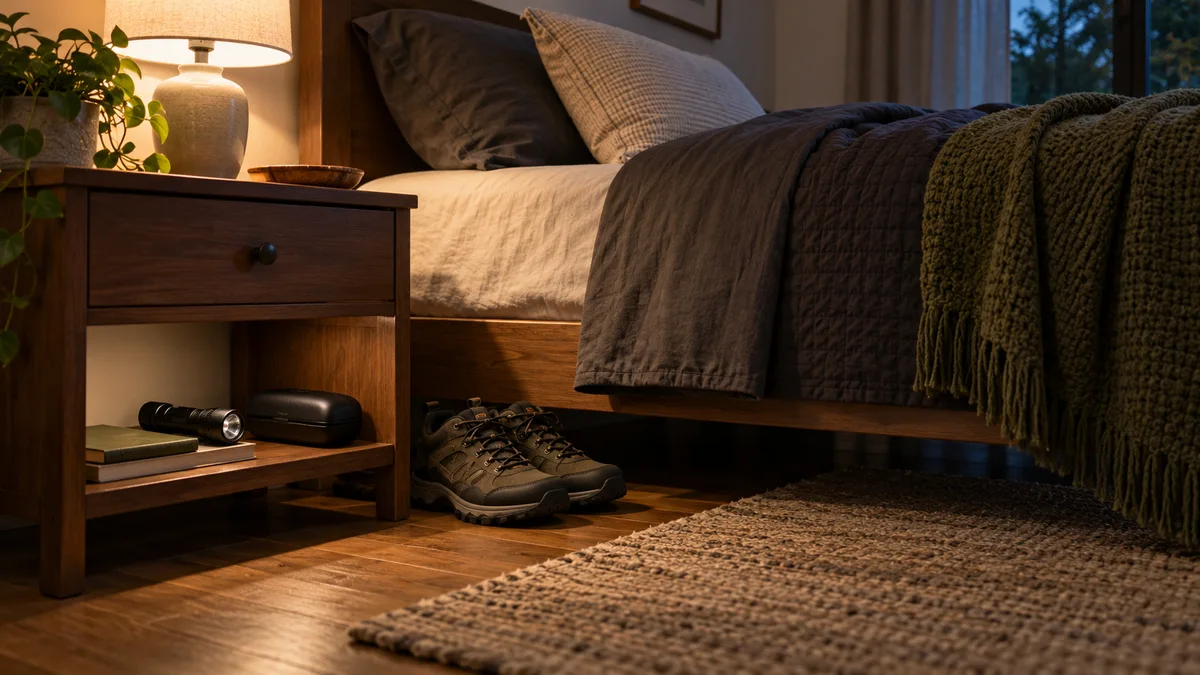
Review the space above the bed and the route beside it. Arrange everyday items so you can locate footwear, glasses and a light after shaking without first searching a distant room. Keep the walking route usable during normal life, including when chargers, laundry or bags accumulate beside the bed.
Choose a storage position the actual user can reach. A bedside kit on the floor may work for one person and be inaccessible to another. Our recommendation is to test retrieval calmly, with normal lighting, rather than simulate hazardous darkness or deliberately create obstacles.
Living room, kitchen and storage
Review where people sit relative to windows, tall furnishings and hanging objects. In the kitchen, distinguish stored food from the fragile containers around it. A reserve that requires sorting broken glass is a poor arrangement even if the original purchase list looked complete.
Keep heavy supplies low and accessible without obstructing an exit. Divide supplies between sensible locations if one cupboard would become a single point of access. Do not put everything into a crowded hallway merely because the front door feels like a convenient emergency location.
For a more detailed organization method, use our emergency supply storage guide for small spaces. Its purpose is to improve everyday access, not certify an installation against seismic forces.
Structure, chimneys and major equipment
A household walk-through cannot clear a building's structure. If you own the property, ask the appropriate qualified professional about the building's construction, local retrofit requirements and any known vulnerabilities. Keep inspection records and completed-work documentation where you can retrieve copies.
Renters should ask management which responsibilities belong to the owner, how repair concerns are reported and how residents receive instructions after a damaging event. Record the answer, not an assumption that somebody must have checked already. Do not copy an online retrofit detail into a different building and call the problem solved.
What to do during an earthquake
The central protective action is Drop, Cover and Hold On. Get down, protect your head and neck under nearby sturdy shelter when available, and hold on until shaking stops. If you are indoors, do not run outside or rush through other rooms. Doorways are not the recommended shelter. These are the CDC's protective-action instructions.
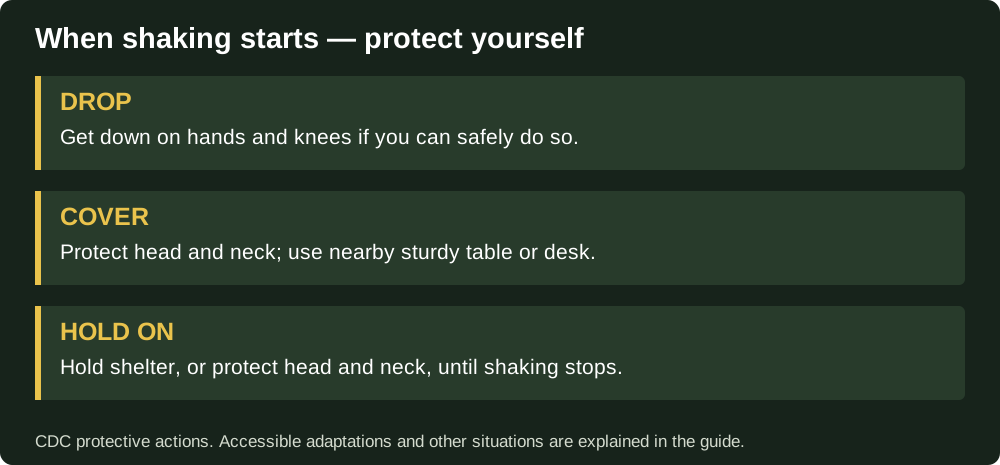
Keep the action separate from the preparation list. During shaking is not the time to collect a bag, retrieve identification or make a tour of the utility valves. Practise recognizing the immediate action before discussing the longer sequence that follows.
Bed, wheelchair and other access needs
If you are in bed, remain there and protect your head with a pillow. For people who cannot drop safely, plan an appropriate seated action in advance. Wheelchair users should lock the wheels where applicable and protect the head and neck. Consult the Earthquake Country Alliance's accessible protective actions for the person's situation.
The FEMA earthquake instructor guide cautions against transferring from a wheelchair, recliner or bed while shaking is happening. Do not build a household plan around a rushed transfer that someone cannot safely perform. Discuss individual arrangements with the person and relevant support providers during normal conditions.
Outside or driving
Outside, move away from buildings, overhead lines and other falling hazards toward open space; stay low until shaking stops. If driving, stop where safe away from bridges, overhead structures and utility hazards, set the parking brake and remain in the vehicle during shaking. Follow official instructions for any subsequent route restrictions. A familiar road is not proof that its condition is unchanged. The American Red Cross earthquake guide covers protective actions for drivers, outdoor settings and people using mobility equipment.
Build an earthquake emergency kit around household functions
An earthquake kit should support what people need to do after an interruption. Start with water, suitable food, individual health needs, lighting, communication, hygiene, clothing and essential records. Then consider the differences between remaining at home and leaving under official instructions or because the immediate location is unsafe.
The CDC's earthquake preparation guidance recommends organizing supplies and planning before an event. Its three-day baseline is a starting point, not a promise that services or assistance will resume in 72 hours. Follow longer reserve recommendations issued for your region where applicable.
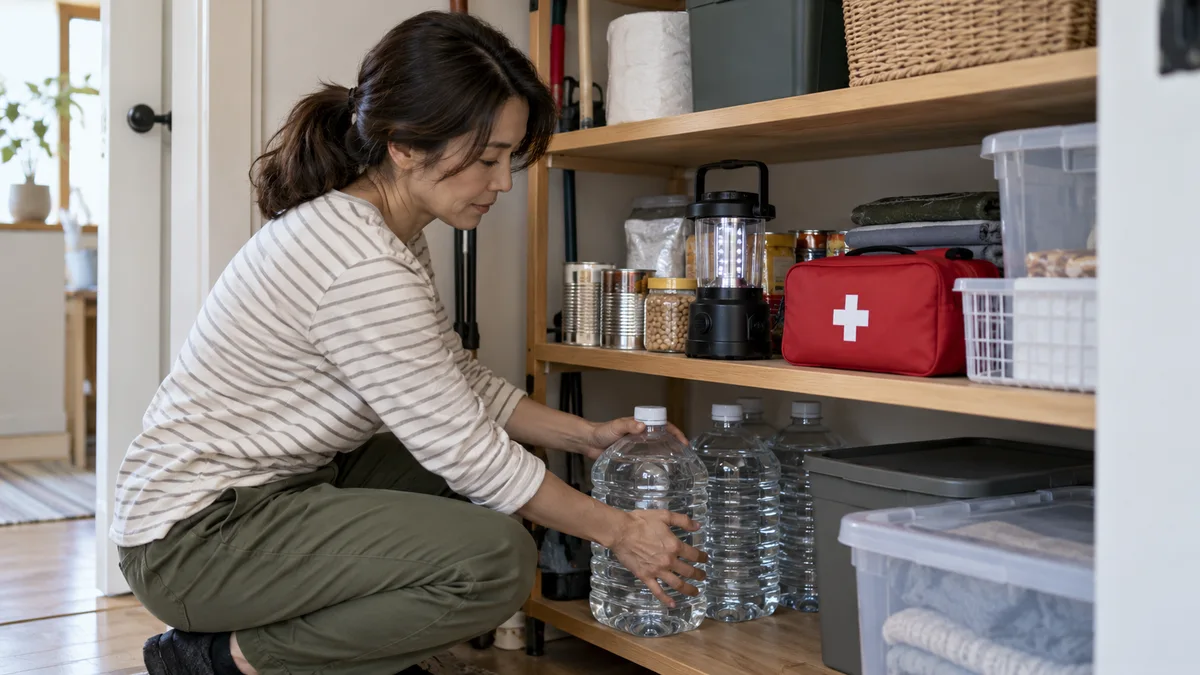
I would count complete working arrangements rather than objects. A power bank without a compatible cable is an unresolved charging task. A radio nobody can operate is an unfinished communication plan. A bag that the intended person cannot carry needs a different arrangement, even if every box on the retailer's checklist is ticked.
| Household function | Record what makes it usable | Common gap |
|---|---|---|
| Water | Actual quantity, storage place and review date | Empty containers counted as a reserve |
| Food | Familiar shelf-stable food and preparation needs | No opener or unsuitable dietary options |
| Lighting | Working light and the correct batteries | Batteries missing or stored elsewhere |
| Communication | Phone power, cables, official alert sources | A power bank with the wrong connection |
| Individual health | Care-provider arrangements and equipment plan | Assuming a generic first-aid kit covers all needs |
| Hygiene and sanitation | Handwashing and a suitable toilet contingency | Assuming a damaged sewer can accept flushing |
| Clothing and records | Accessible suitable layers and secure copies | Everything kept in one inaccessible room |
Home reserve and departure bag are different jobs
Keep a home reserve where it is accessible and stored appropriately. Make the portable bag realistic for the individual, the transport plan and the household's needs. Do not assume that a large water reserve, several people's bedding and all daily medical equipment can be carried in a single backpack.
Our bug out bag checklist includes an editable workbook for recording actual quantities and loads. Use it to distinguish what is packed from what you intend to buy. If another person provides transport or carries an item, confirm that arrangement rather than silently assigning the job.
Equipment worth checking before you shop
The most useful purchase is the one that closes a documented gap. Check what you already own, confirm required specifications and keep the parts together. The options below are category comparisons for planning; they are not products we have tested in an earthquake.
CLOSE A REAL SUPPLY GAP
Compare equipment for the job you identified
As an Amazon Associate I earn from qualifying purchases.
Hands-free lighting
Check battery requirements, accessible controls and compatibility with the user.
Compare options on Amazon →Home water storage
Choose suitable food-grade containers and a size you can store and handle.
Compare options on Amazon →Phone charging backup
Check the actual phone, cable and supported charging specifications.
Compare options on Amazon →Category searches; no prices, availability or hands-on testing claimed. Existing suitable equipment can fill the same role.
How much emergency water should you store?
CDC recommends at least one U.S. gallon per person per day for three days and suggests trying for a two-week supply where possible. Additional needs include pets, pregnancy, illness and hot conditions. Unopened commercially bottled water is the most reliable emergency source. See the CDC emergency water storage guidance.
The table below simply multiplies that three-day baseline by household size. It does not include every individual additional need, and it is not a recommended backpack load. U.S. gallons are used because this guide primarily serves U.S. readers; metric equivalents are rounded.
| People | Three-day baseline in U.S. gallons | Approximate liters |
|---|---|---|
| 1 | 3 | 11.4 |
| 2 | 6 | 22.7 |
| 4 | 12 | 45.4 |
| 6 | 18 | 68.1 |
Keep a record of the quantity actually present and usable. Observe packaged-water expiry guidance; replace water you fill into storage containers every six months. Use appropriate closed containers and keep stored water away from toxic substances. Do not repurpose a container that previously held hazardous chemicals.
For a small home, our apartment emergency water storage guide works through placement and rotation. Buying a filter does not replace a stored supply, and a camping filter should not be assumed to handle chemical contamination after damaged infrastructure. During an incident, follow the relevant water authority's current instructions about supply and water quality.
Water supply, drinking-water safety and toilet drainage are separate checks
This is where I would slow down a household plan. “The tap works” answers only one question. It does not establish that water is safe to drink or that wastewater has a functioning route out of the building. An earthquake can leave those questions with different answers.
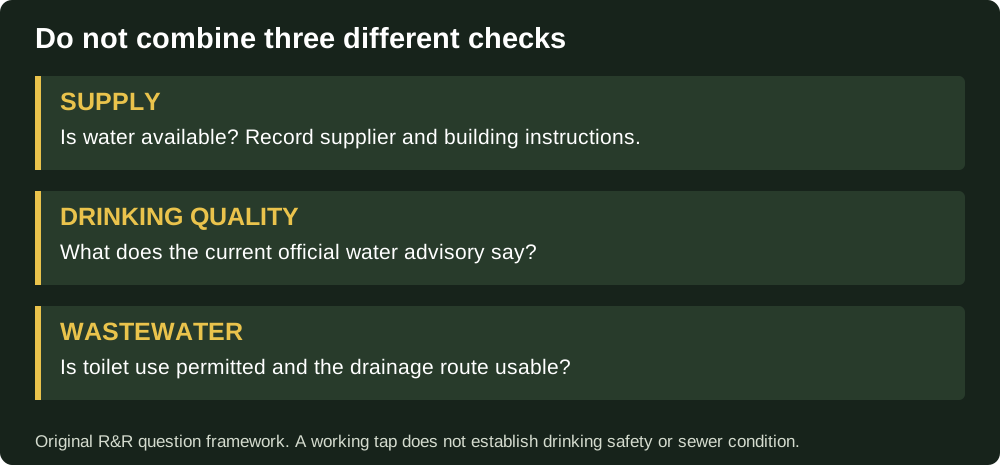
Our planning method uses three entries. First record whether water is available. Next record the latest drinking-water instructions from the supplier or public-health authority. Finally record the building or wastewater authority's instructions about drainage and toilet use. Mark an unanswered question as unconfirmed instead of treating silence as permission.
Read whether toilets work during a power outage alongside the emergency apartment toilet guide. A gravity toilet does not establish that the downstream sewer is undamaged. Do not manually flush into a suspected blocked, damaged or restricted wastewater system.
The water shutoff checklist helps organize supplier contacts and practical interruption planning. Keep that separate from the guide to flushing without running water, which applies only when the drainage route remains suitable and no restriction rules it out. The existence of an available bucket is not enough to settle the decision.
If sewage is backing up, stop treating the problem as a normal shortage. Our sewage backup guide explains why restricting exposure and obtaining appropriate help takes priority over improvised cleanup. A household checklist should make it easier to stop an unsuitable action, not give it a reassuring label.
Make an apartment earthquake plan with management
Apartment residents need an individual plan and verified building information. Ask how management communicates when ordinary systems are unavailable, how residents report damage and what arrangements exist for people needing assistance. Confirm the procedure for your building rather than copying instructions from a different property.
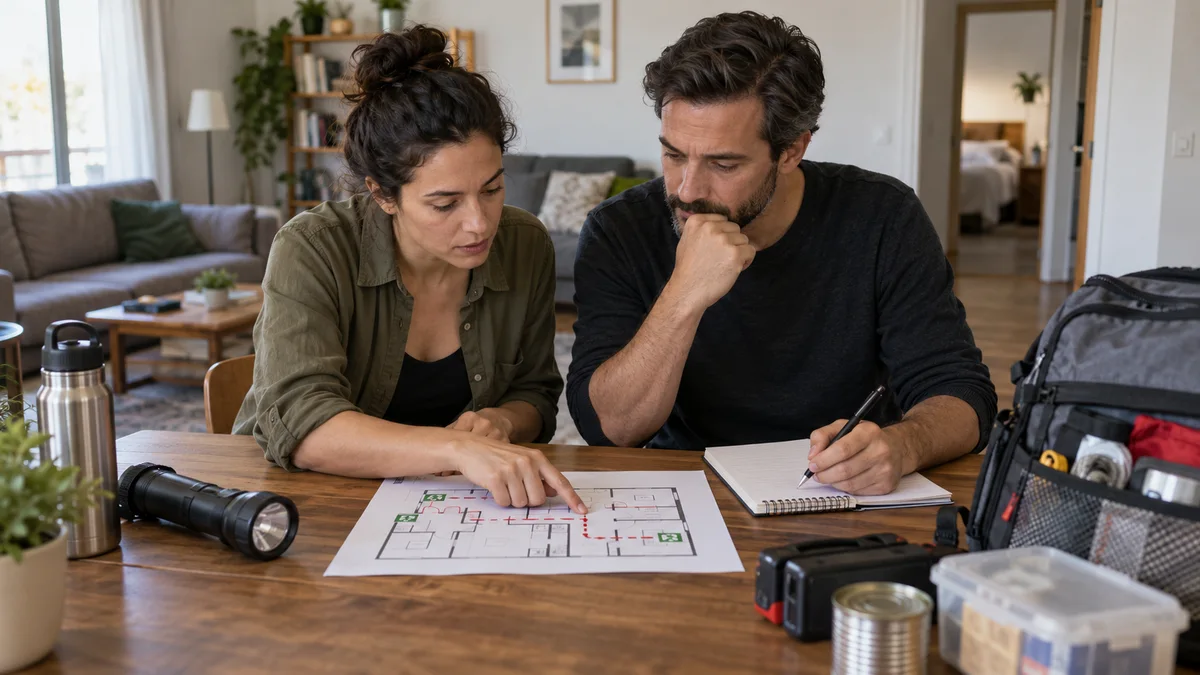
Record who can answer questions about water pumps, common-area access and utility responsibilities. Ask about stairs and assistance arrangements before an event; do not promise that elevators will remain usable. Keep the contact method somewhere other than a phone that may be uncharged or inaccessible.
Questions worth putting in writing
- Which official building contacts should residents use for an urgent problem?
- How will management communicate instructions if power or normal access systems fail?
- Who is responsible for shared utilities and who is authorized to operate them?
- What process exists for arranging individual assistance needs?
- Where can residents find current instructions about leaving or re-entering?
- How should residents report damage without entering a restricted area?
The answer “we need to confirm that” is useful. It tells you which assumption should not be embedded in the family plan. Keep a dated record of the response and the next action, without turning the worksheet into a public list of residents' medical details.
Use our apartment power outage checklist for the related loss-of-power questions. An earthquake plan should link these tasks together while preserving the difference between a routine outage and possible physical damage.
Agree how your household will reconnect
Think about a weekday when everyone is already apart. One adult may be at work, a child at school and another person at a medical appointment. A plan that assumes everyone is standing beside the emergency cupboard misses the more complicated version of the problem.
Choose a contact arrangement people understand, write down key numbers and agree what information a short check-in should contain. Our suggested message records who is checking in, their location, immediate needs and the agreed next check-in. Share only appropriate information and do not put sensitive access codes or identity numbers on a visible household sheet.
School and care-provider procedures matter. Confirm authorized pickup arrangements and how an institution communicates during disruptions. A meeting place is helpful only if people can reach it safely and it remains consistent with official instructions. Name an alternative and identify who can decide that the first location is unsuitable.
For a person living alone, ask a willing contact what they can actually do. Agree how an unsuccessful check-in will be handled using appropriate local services. Do not casually promise that an untrained neighbor can enter damaged premises or carry out a rescue.
Pets need their own part of the plan. Record transport arrangements, necessary supplies and which potential destination accepts them. Keep identification and care information accessible to the responsible person. The plan should describe the animal you have, not the average pet imagined by a generic kit list.
| Situation | Agree in advance | Keep private |
|---|---|---|
| Household apart | Check-in contact, message and alternative meeting place | Sensitive location / access information |
| School or care | Authorized collection and institution instructions | Personal care records |
| Assistance needed | Willing helper, limits and alternative support | Medical details not needed on public sheet |
| Pets | Transport, destination acceptance and care contact | Unnecessary identity information |
What to do after the shaking stops
The first question is whether you or someone nearby needs immediate help and whether the present location has an urgent hazard. Follow emergency-service directions. Keep clear of damaged areas, fallen lines and unstable objects. Do not enter a damaged building until authorities say it is safe. The CDC's post-earthquake guidance also emphasizes aftershocks and communication difficulties.
Aftershocks are a reason to retain the protective action you practised, not proof that one particular room or street is safe. If shaking resumes, protect yourself again. Do not use the apparent quiet between events to make an unsupported structural assessment.
Where possible, use short text messages for routine check-ins rather than repeated calls. Keep emergency lines available for urgent needs. Save battery by keeping the message useful and following the communication arrangement already agreed, rather than repeatedly refreshing uncertain social posts.
Gas and electricity need the correct authority
Learn your actual utility's emergency procedure before an incident. PG&E's gas safety information says to leave immediately and call 911 if you suspect a gas emergency. Do not delay leaving to find a tool or investigate the source yourself. Follow your own supplier's directions and call from a safe location.
If gas has been shut off, do not restore it yourself; PG&E specifies professional restoration. A landlord's shared meter is not an invitation for every resident to operate it. Keep utility contacts with the building plan so the household can distinguish reporting a hazard from taking on a specialist job.
For power loss, work through the food safety during a power outage guide. Do not decide food is safe because the refrigerator light has come back on. If considering fuel-powered equipment, follow the applicable outdoor operating clearances and carbon-monoxide precautions; do not improvise an indoor or garage setup.
Document damage without creating another hazard
Keep insurance and important-record copies accessible in advance. Afterward, record losses only where it is safe and permitted to do so. A photograph is not worth entering a restricted structure or approaching an unstable object. Follow insurer and local-authority instructions about documentation and repairs.
We recommend a simple recovery record with the date, issue, responsible organization, contact reference and next action. Keep urgent hazards separate from reimbursement questions. That makes it easier to prioritize without treating the whole recovery as one unstructured to-do list.
Coastal earthquake preparedness includes tsunami evacuation
If you live, work or travel in a tsunami hazard zone, learn the local evacuation routes before a warning. During shaking, protect yourself. When it is safe to move, natural warnings such as strong or long coastal shaking, unusual ocean behavior or a loud ocean roar may require immediate movement toward high ground or inland; do not wait for an official alert. Follow the National Weather Service tsunami instructions.
NWS also advises people on a beach or near the water who feel an earthquake to move off the beach toward high ground or inland as soon as safely possible. Do not turn a generalized shaking-duration rule into a reason to remain by the water. The correct route depends on local geography and the marked hazard zone.
Keep away until the official all-clear. The first wave is not necessarily the largest. Do not travel into the coastal zone to watch, collect photographs or meet somebody when doing so conflicts with evacuation instructions. Arrange an inland alternative meeting location during normal planning.
Earthquake alerts are not earthquake predictions
Early warning and prediction are different ideas. A warning system detects an earthquake that has already begun and can alert some locations before strong shaking reaches them. Time available varies, and a warning is not guaranteed at every location. Use the USGS ShakeAlert public-safety information to check official alert options in California, Oregon and Washington.
Do not make the household plan dependent on receiving a phone notification first. Recognizing shaking and knowing the protective action remain essential. Check device and service instructions during ordinary conditions, including accessibility arrangements and any available official test procedure.
USGS explains that precise earthquake prediction is not currently possible in its earthquake facts and misconceptions guidance. A viral post naming a date does not become reliable because it includes a map or technical vocabulary. Aftershock forecasts describe probabilities; they do not identify the exact next event.
For current events, use the USGS earthquake map and relevant local emergency authorities. This article is a household preparedness guide, not an earthquake-near-me tracker, live warning service or prediction tool.
Practise once, then fix what you discover
The Great ShakeOut lists October 15, 2026 as the main drill date, with regional exceptions. Check your region's details rather than assuming every participant uses the same local time. A drill is a scheduled practice, not a prediction of an earthquake that day.
Begin with a calm discussion of the action appropriate to each person. Do not switch off utilities, block exits or create a hazardous simulation. Review what was confusing afterward. Someone may not remember the contact number; another may discover that their everyday seat is far from usable cover. Those findings belong on the next-action list.
I would repeat the review after moving furniture, changing household members or altering a care arrangement. Equipment and contact changes can quietly make a written plan inaccurate. A short update connected to a real change is more useful than a perfect-looking document nobody has opened since moving in.
Your printable earthquake preparedness checklist
Use the checklist to record confirmed arrangements and unfinished tasks. Checking a box means you have reviewed that item for your circumstances; it is not a structural clearance, individual medical assessment or emergency-service certification. Download the PDF for a record you can keep offline.
Make the plan specific to your household
On-page ticks are temporary. Save the PDF to keep your record.
Common earthquake preparedness questions
Should you run outside during an earthquake?
If you are indoors, stay indoors during shaking and take the appropriate protective action. Running outside can expose you to falling objects. After shaking, leaving may be necessary because of damage, another immediate hazard or official directions; that is a separate decision from running during the event.
Is a doorway the safest place?
No. Use Drop, Cover and Hold On with nearby sturdy shelter where available. The doorway advice is not the CDC's recommended action for modern buildings. Plan a protective location in the room you are using rather than relying on a doorway elsewhere.
Is an emergency kit enough for earthquake preparedness?
No. A kit supports the plan. Reducing household hazards, practising protective actions, arranging assistance, communicating and following official post-event instructions are separate jobs. Buying equipment does not complete them automatically.
Can renters prepare without making structural changes?
Yes. Renters can organize supplies, improve access, practise appropriate actions and agree contact arrangements. Work requiring permission, structural assessment or changes to shared equipment should go through the owner, management or relevant qualified professional. Record outstanding questions instead of treating them as resolved.
How often should you update an earthquake plan?
Use changes in your real household as triggers: a move, different furniture, new equipment, changed contacts or individual support needs. Also follow applicable supplier inspection schedules and official regional recommendations. There is no universal review interval that guarantees readiness.
Where should a beginner continue?
Start with the beginner preparedness guide and the 72-hour household supply guide. Then use the water, sanitation and outage guides linked above for the specific gaps you identified. Our free resource library brings the printable worksheets together without requiring an account.
Sources and editorial method
Researched October 15, 2026 by Ready & Resourceful. This independent household guide combines linked official safety guidance with our original organization framework, tables, diagrams and worksheet. It is not firsthand disaster reporting, professional structural advice or a tested emergency intervention. Local instructions and individual care arrangements take priority.
The household scenes are illustrative planning visuals, not photographs documenting a real earthquake. No expert inspection, clinical review, institutional endorsement or product testing is claimed.