
NEWS / EUROPE & AVIATION SECURITY
Bomb Threats Disrupt European Flights as Searches Find No Explosives
Seven identified services, four destination countries and no explosives found. The confirmed routes, Modlin’s reopening timeline and the questions travelers should ask after a security disruption.
THE ESSENTIAL FACTS
European flight bomb threats on November 3
Bomb threats triggered searches of passenger aircraft across Poland, Spain, Italy and Bulgaria on Tuesday, November 3. No explosives were found in the reported searches. A London–Warsaw flight diverted to Modlin, where the airport temporarily closed. Other affected aircraft landed at their scheduled destinations before checks.
The publicly identified services do not establish who sent the threats or whether they were coordinated. A threat, an actual explosive device and a confirmed attack are different findings.
WATCH / ORIGINAL R&R VIDEO
The flight alerts explained in under a minute
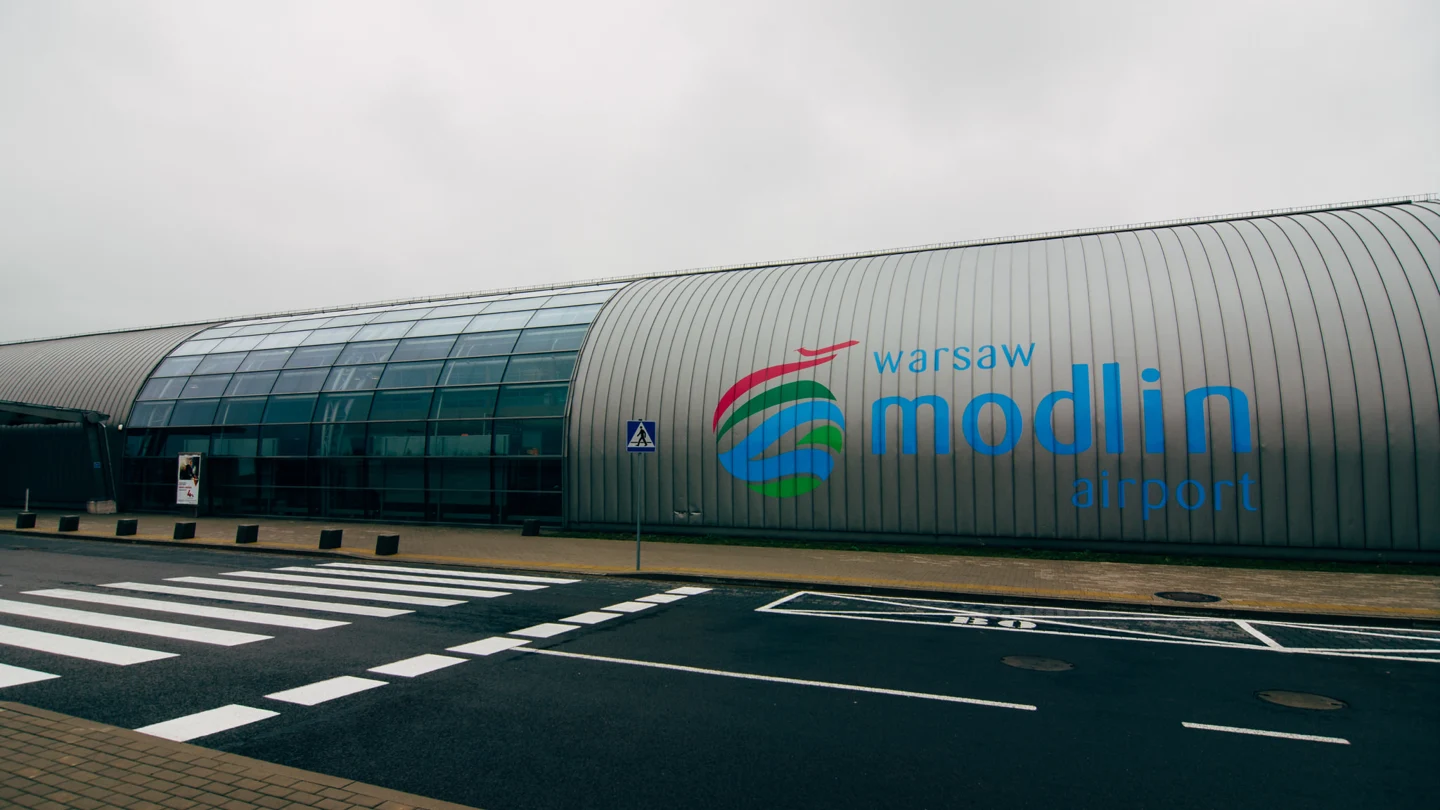
A narrated briefing with original route animation and the Modlin timeline. The airport photograph is archival, not footage of the security response.
Video transcript and credits
Bomb threats disrupted European flights on November third. Searches found no explosives. Here are the confirmed facts. Seven identified services involved Warsaw, Murcia, Rome and Sofia. A flight from London Heathrow diverted to Modlin. Other aircraft were searched after arrival. Modlin recorded the landing at ten oh one, local time. The alert was lifted at twelve twenty one, and normal airport operations resumed. The reviewed accounts did not establish who sent the threats, or whether they were coordinated. A security response is not proof that a bomb was aboard. If your flight is affected, follow crew instructions. During an emergency evacuation, leave all bags behind. Once safe, confirm onward travel and baggage arrangements. Read the full report at Ready Resourceful dot com.
Original R&R animation, edit and synthetic English narration. Airport photograph: Markus Winkler, markuswinkler.de, CC BY 4.0; cropped and animated from a 2011 photograph. No incident footage is implied.
Security alerts disrupted European air travel on Tuesday without the discovery of an explosive device, leaving passengers facing inspections, a diversion and a temporary airport closure. The practical effect was real even where the reported threats proved unfounded: an aircraft at a different airport, passengers waiting in a terminal and other flights operating behind schedule.
Reuters identified at least seven affected flights and a separate threat involving the cruise ship Crown Iris in Greece. That is a documented minimum, not a definitive count of every warning received. AFP reporting carried by CNA described about ten flights and additional UK police notifications. The different totals should not be added together because reports may overlap.
Which flights were affected?
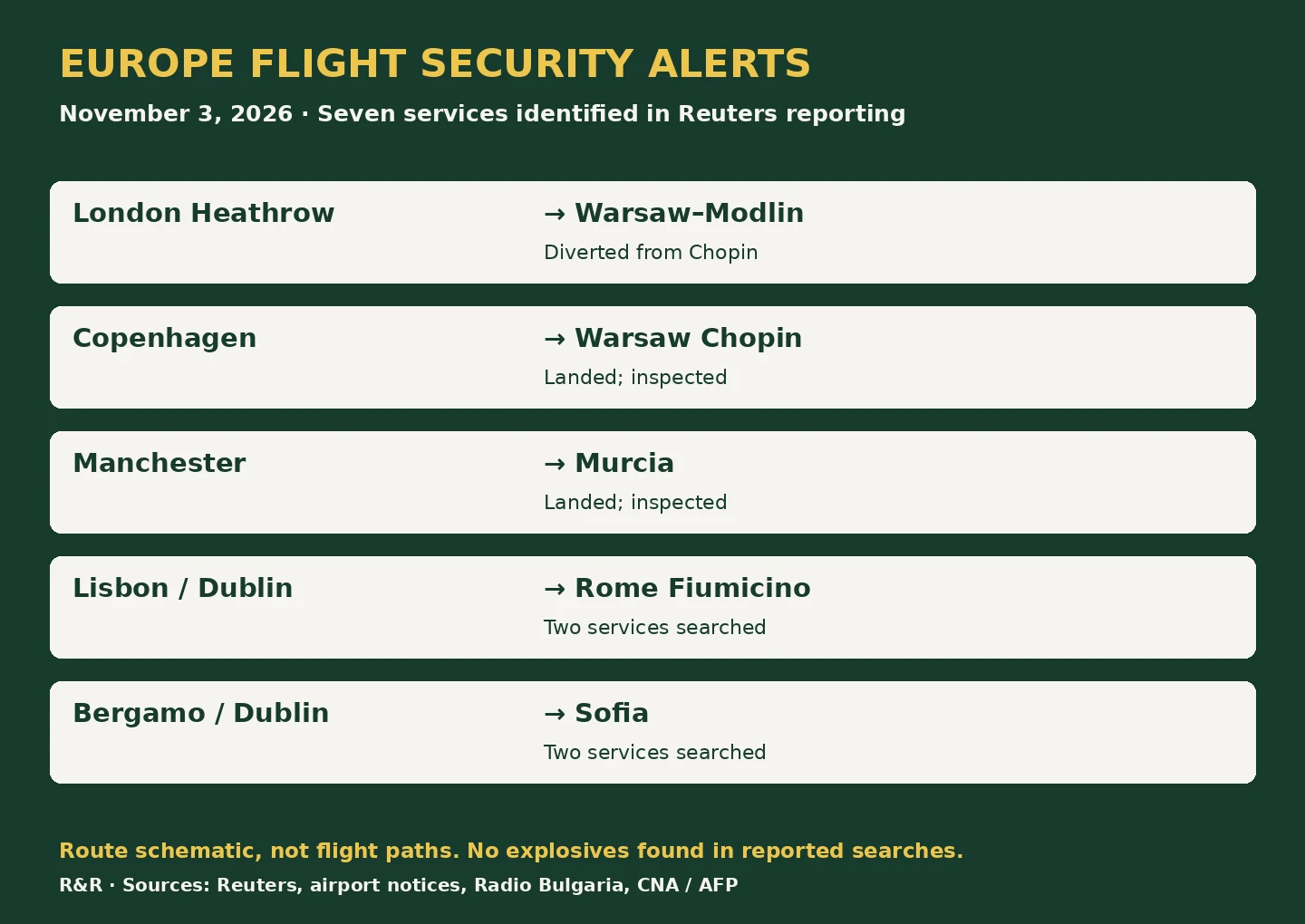
The table separates an actual diversion from an inspection after arrival. It describes the November 3 incidents, not a live airport-status service. A security check on one aircraft did not mean every flight at that airport was cancelled.
| Route | What happened | Reported outcome |
|---|---|---|
| London Heathrow → Warsaw Chopin, LOT | Diverted to Warsaw–Modlin; passengers moved into arrivals. | Modlin subsequently lifted the alert and restored normal operations. |
| Copenhagen → Warsaw Chopin, SAS | Aircraft landed at Chopin and underwent checks. | No explosives found; this was not the Modlin diversion. |
| Manchester → Murcia, Ryanair | Security protocol activated after arrival. | Searches found no explosives. |
| Lisbon → Rome and Dublin → Rome, Ryanair | Two services underwent security checks. | Rome airport said checks were negative and the alert cleared. |
| Bergamo → Sofia and Dublin → Sofia | Aircraft searched after landing. | Bulgaria’s transport minister said nothing suspicious was found. |
Sources: Reuters, Modlin’s final notice, Radio Bulgaria’s corrected account and CNA / AFP.
Modlin’s own notices show how the disruption unfolded
The clearest public chronology comes from the airport that received the diverted Heathrow service. Modlin’s first notice records an alert at 09:54 and a Boeing 737 MAX landing at 10:01, with 181 people aboard. The flight had been bound for Warsaw Chopin.
The second notice said passengers were leaving the aircraft and would wait in the arrivals hall. The airport remained closed while the security response continued. This matters because passengers could leave an aircraft while the wider airport disruption was still unresolved.
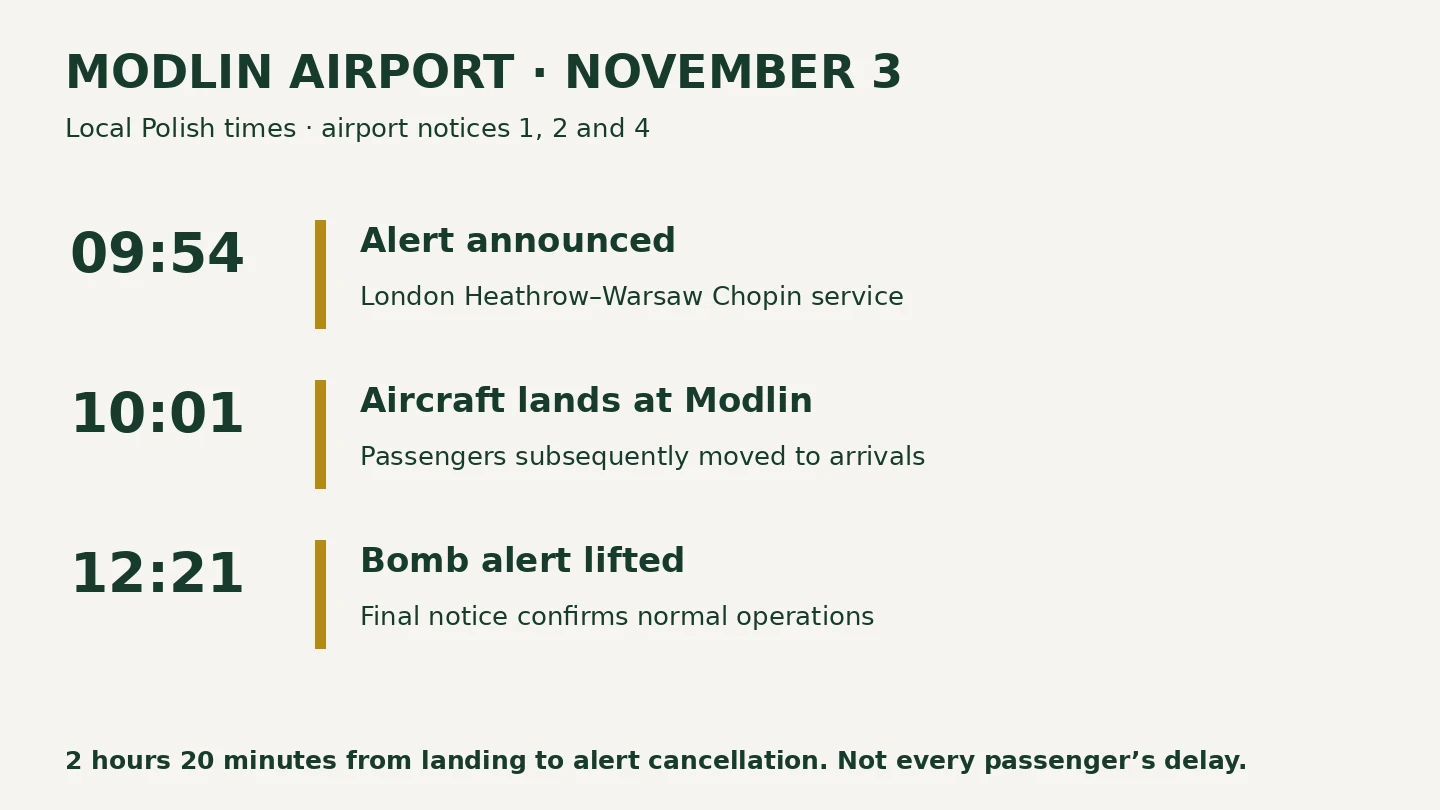
In its final notice, issued at 13:00, Modlin said the alert had been cancelled at 12:21 and normal operations restored. That is two hours and 20 minutes after the diverted aircraft landed; it does not measure each passenger’s total delay.
The closure also affected people on unrelated services. An Edinburgh arrival scheduled for 11:30 reached Modlin at 12:49 after an intermediate landing in Poznań. A Tenerife departure scheduled for 11:45 left at 12:37. Those examples show how a security response can interrupt surrounding flights even without an explosive being found.
Separate checks in Rome, Sofia and Murcia
In Rome, the airport operator’s account carried by RTÉ said passengers, baggage and two aircraft were checked, with the alert subsequently cleared. Other airport services were not affected in that account. Published reports differed over which Rome-bound service received a military escort, so we do not attach that detail to a specific route.
In Bulgaria, Radio Bulgaria’s updated report identified the affected origins as Bergamo and Dublin. This corrects an early account naming Israel. It also said the previous day’s London Luton–Sofia service had diverted to Budapest, undergone checks and continued to Sofia. The November 2 diversion is a separate incident, not an eighth November 3 flight.
At Murcia, AFP’s account said airport operator Aena activated a security protocol for the Manchester arrival. The reported searches did not establish the presence of explosives. We omit disputed minute-by-minute arrival times and passenger totals where they do not change the established account.
No public attribution establishes who was responsible
Reuters reported no claim of responsibility and no official attribution in its account. The occurrence of similar threats in several countries is a reason for investigation; it is not enough on its own to establish a single perpetrator or a state-directed operation.
| Supported by reviewed accounts | Not established |
|---|---|
| Multiple aircraft required security checks. | That the incidents shared one sender. |
| Modlin temporarily closed and later reopened. | That European airspace was generally closed. |
| No explosives were found in the reported searches. | That every threat received by every authority has been publicly documented. |
| Some reports describe military escorts. | That an escort proves an explosive device was aboard. |
For readers, the useful distinction is between a precautionary response and the result of the checks. A serious response can be necessary before authorities know whether a threat is credible. Its scale should not be presented as proof that the threatened event occurred.
What Americans and other travelers should check next
For the complete passenger response, read what to do if there is a bomb threat on your flight, including reporting, disembarkation and evacuation instructions.
For an upcoming journey, check the operating airline’s flight status, the departure airport and the intended arrival airport. Use the flight number and travel date, rather than assuming a November 3 headline describes today’s service. A reopened airport is a historical outcome, not a promise that a later flight will run on time.
- During the response, follow crew and security instructions. Do not leave an aircraft, approach a restricted area or retrieve belongings contrary to directions.
- After a diversion, confirm the new airport. Ask what onward transport the airline is arranging and where instructions will be issued. Do not assume an unfamiliar airport uses the same ground connections.
- Ask separately about checked baggage. Aircraft checks, passenger processing and baggage release may follow different arrangements. Wait for specific instructions.
- Record the disruption. Save airline notifications, booking details and receipts. Ask for a written explanation before assuming an expense will be reimbursed.
- Send one concise family update when permitted. State your location, that you are following instructions and when you expect to check in again.
Before future travel, keeping essential documents, prescribed medication and charging supplies accessible can reduce difficulties during an extended wait, subject to airport rules and safety instructions. The FAA requires spare lithium batteries and power banks in cabin baggage; remove them if your carry-on is checked at the gate. Check your airline’s current quantity, capacity and onboard-use restrictions as well.
Do not assume every diversion creates the same compensation rights
EU passenger-rights guidance distinguishes diversions according to whether the alternative airport serves the same town, city or region. Eligibility for assistance, rerouting, refunds or compensation depends on the applicable rules and circumstances. A security-related interruption is not a basis for promising every traveler a fixed payout.
For practical planning, our guides explain communication options when normal connections fail and budgeting emergency cash. These are supporting resources, not evidence that the flight threats caused a communications or banking outage.
Sources and reporting method
Published November 4, 2026. This original desk report reconciles airport notices, corrected regional reporting and international coverage. R&R did not witness the incidents or contact the airlines. Historical outcomes are dated; this page is not a live departure board. No perpetrator, coordination or wider attack is asserted without evidence.
- Reuters, November 3 — seven flights and a cruise ship; no devices found
- Warsaw–Modlin Airport, notice 1 — alert and landing times
- Warsaw–Modlin Airport, notice 2 — passengers moved to arrivals
- Warsaw–Modlin Airport, final notice — alert lifted and operations restored
- Radio Bulgaria, corrected November 3 account — Bergamo and Dublin flights
- CNA / AFP, November 3 — UK, Spanish, Italian and Polish responses
- RTÉ, November 3 — Dublin services and Rome airport statement
- FAA — passenger evacuation guidance
- FAA PackSafe — lithium batteries and power banks
- EU Your Europe — passenger rights and diverted flights
The route schematic and timeline are original R&R visuals. The lead image is a credited archive photograph of Modlin, not a photograph of the November 3 response. See our editorial standards.