
PREPAREDNESS / AIR TRAVEL SAFETY
What to Do If There’s a Bomb Threat on Flight
Report the concern. Listen to the crew. Know the difference between waiting, disembarking and evacuating—and what to leave behind.
THE SHORT ANSWER
What should you do if there is a bomb threat on your flight?
Tell a flight attendant promptly if you receive a threat or notice a specific concern. Follow the crew’s directions, do not touch or investigate a suspicious item, and keep the aisle clear. If an emergency evacuation is ordered, leave every bag behind and follow instructions to a usable exit.
If this is happening now, stop reading and alert the crew or airport police. This guide cannot assess a threat or replace instructions from the people responsible for the aircraft.
A security announcement changes a journey in a second. You may have little information, a child beside you and a bag above your seat. The most useful preparation is knowing which decision belongs to you and which belongs to the crew: report what you know, listen for directions and avoid creating a second problem.
This passenger guide brings together published guidance from U.S., UK, European and Australian aviation and security authorities. It does not explain how to search an aircraft, identify an explosive device or judge whether a threat is genuine. Those decisions require trained personnel and information passengers do not have.
ON THE AIRCRAFT
Start with the crew, not the rumor
If you directly hear a threat, receive a threatening message or see something that causes a specific security concern, tell a flight attendant. Use the call button if appropriate and follow their direction about speaking further. The FBI’s aircraft-crime guidance identifies the flight crew and airport police as reporting contacts.
Describe the observation rather than announcing a conclusion to the whole cabin. “Someone said these words” is more useful than “There is definitely a bomb.” Report behavior and facts, not assumptions based on a passenger’s nationality, appearance, language or religion.
If the announcement comes from the captain or cabin crew, listen to the complete instruction. You may be told to remain seated, move only when directed, stop using a device or leave the aircraft. Avoid guessing the next step from what another passenger is doing.
There is no passenger checklist that can certify an item as harmless. Do not use this article, a social-media post or an image search to make that decision.
Match your next step to the instruction you receive
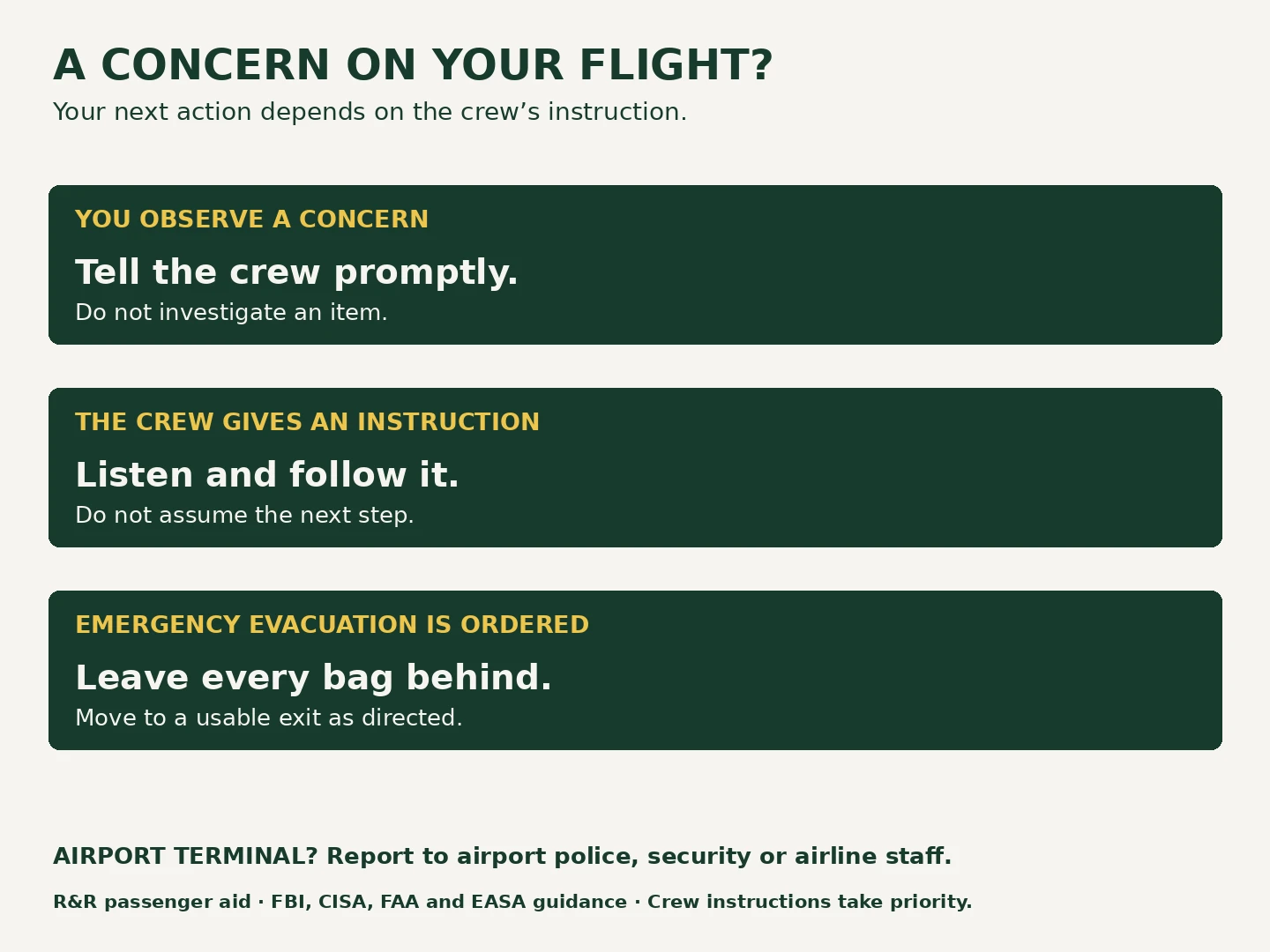
| Situation | Your useful action | Avoid |
|---|---|---|
| You notice a concern before an announcement. | Report it promptly and accurately to the crew. | Examining an item or confronting a person. |
| The crew announces a security-related change. | Listen for the specific instruction and comply. | Assuming a diversion means immediate evacuation. |
| The crew orders emergency evacuation. | Move as directed and leave all belongings. | Collecting luggage or stopping to film. |
The diagram is intentionally about passenger choices. It does not prescribe where the aircraft should land, where people should sit or how security personnel should respond.
WATCH / ORIGINAL R&R EXPLAINER
The passenger response, explained clearly
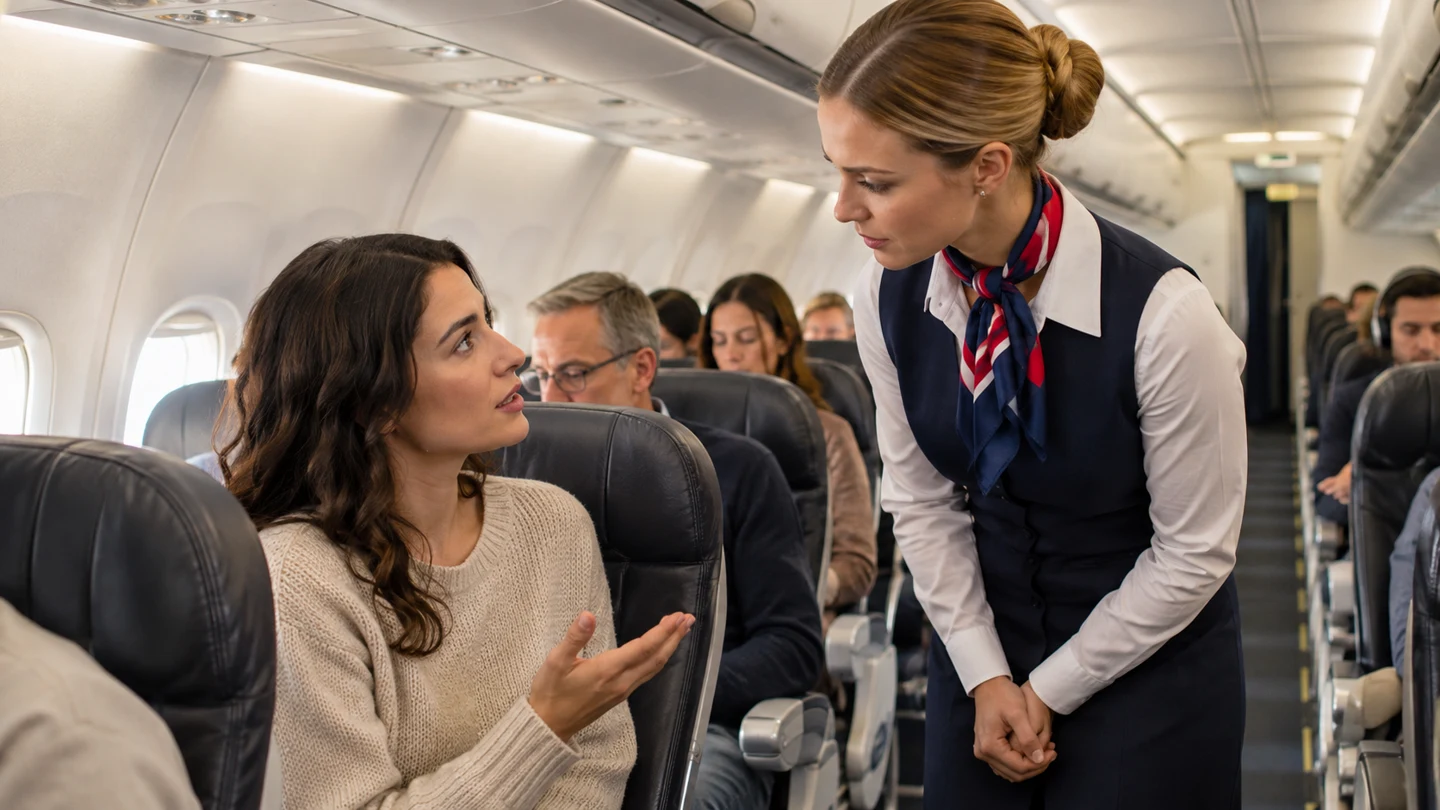
A narrated video combining original graphics, a licensed cabin photograph and an illustrative passenger–crew scene.
Transcript and visual credits
If there is a bomb threat on your flight, your job is to report what you know and follow the crew. Do not investigate a suspicious item. Tell a flight attendant what you saw or heard, where it happened, and when. Separate your own observation from a rumor. Do not confront another passenger. A diversion, a security inspection, and an emergency evacuation are different situations. Listen to the instruction you are actually given. Do not open an exit yourself. If an emergency evacuation is ordered, leave all belongings behind. Do not stop to film. Move to a usable exit as directed, then follow responders away from the aircraft. Before you fly, pay attention to the safety briefing and read the card for your aircraft. Tell the airline and cabin crew if you need assistance. Once safe and permitted, confirm your airport, onward travel, and baggage arrangements. Send a brief family update. Read the passenger guide and its official sources at Ready Resourceful dot com.
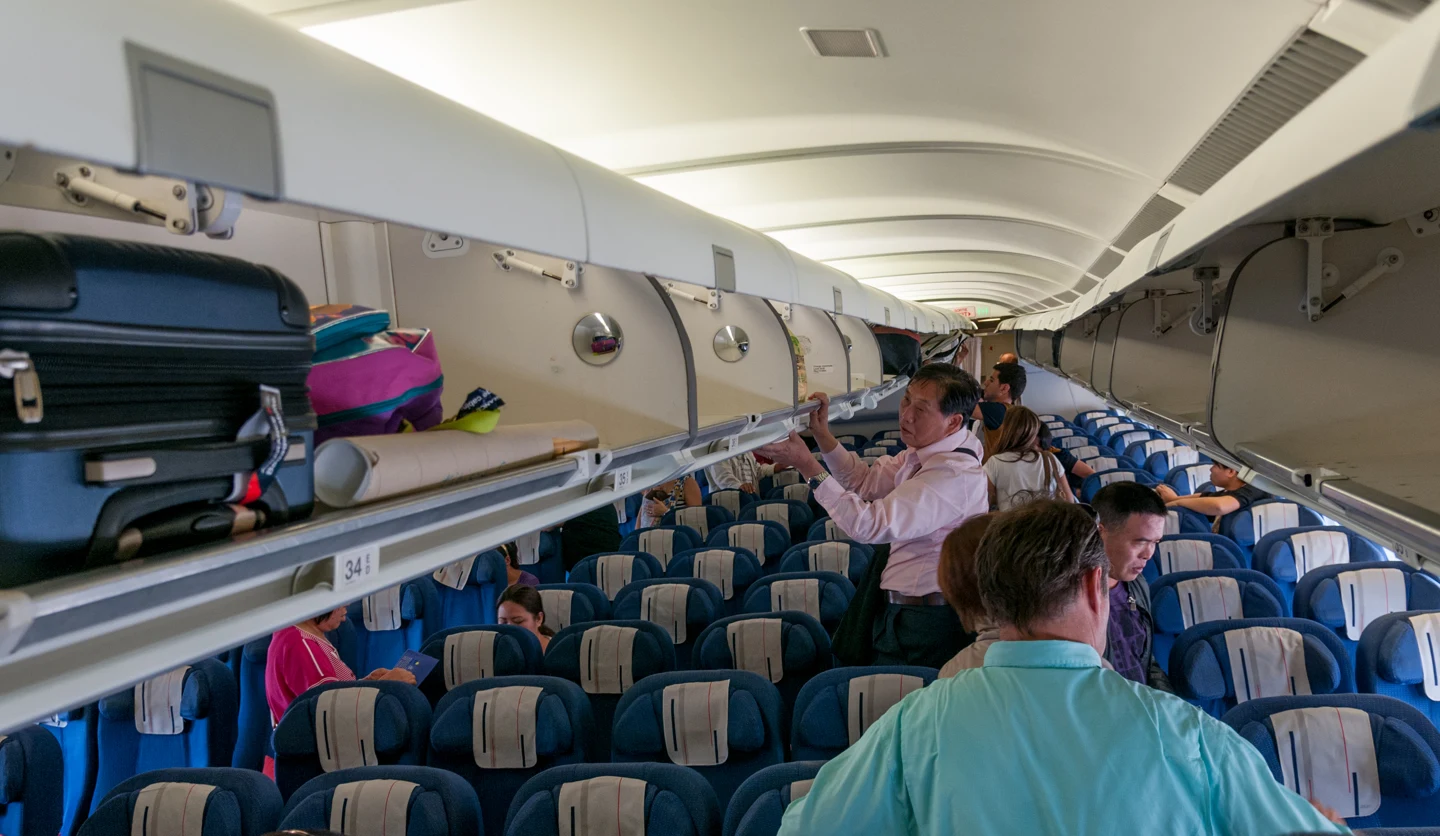
Original R&R edit, animation and synthetic English narration. Passenger–crew scene: generated editorial illustration. Cabin photograph: Wilfredor, 2013, Wikimedia Commons, CC0. These are explanatory visuals, not footage of a bomb-threat incident.

What to tell a flight attendant
Give the information you actually have. A useful report can be brief:
Example, not a real incident: “I’m in seat 18C. At about 2:15, I heard a person in the next row say [the exact words]. I have not touched anything. Can I speak with you?”
The seat and time help locate the concern; the exact words distinguish a direct observation from a rumor. Say whether you heard it yourself, read it on your own device or were told by someone else. If you are uncertain about a detail, say so instead of filling it in.
If the threat arrives on your phone
Notify the crew immediately and follow their instructions. When safe and permitted, keep the original message available rather than deleting it or forwarding it widely. CISA’s guidance on electronic threats emphasizes retaining the message and noting the time. Evidence preservation must not delay evacuation or override crew restrictions on device use.
A message naming your flight should not be posted as a live public accusation before the crew has assessed it. Your role is to pass the information to the people who can act, not to investigate a sender or broadcast another passenger’s identity.
If you only heard another passenger discussing the news
Ask yourself what you actually observed. A conversation about a previous incident is different from a current threat. If the words or circumstances still concern you, describe them to the crew without changing the account into something more definite.
What if you are at the gate or inside the terminal?
Tell airport police, security or airline staff about a threat or a suspicious item. Give its location as clearly as you can without approaching it. Follow the instructions about leaving an area, staying out of restricted space and where to wait.
Do not pick up an unattended bag to carry it to a service desk. Do not walk closer to get a better photograph. CISA advises against gathering near the incident scene, where people can obstruct responders. A nearby coffee shop, queue or exit is not automatically a safe waiting point just because other travelers have chosen it.
If there is immediate danger on the ground, contact the local emergency service when safe; the appropriate number depends on the country. In the cabin, report to the crew first rather than relying on an online tip form for urgent help.
When airline messages and airport signs disagree, ask staff to confirm the instruction for your flight number. Save a screenshot for later reference only when doing so is safe; do not remain in a cleared area to finish documenting it.
Disembarkation and evacuation are not the same thing
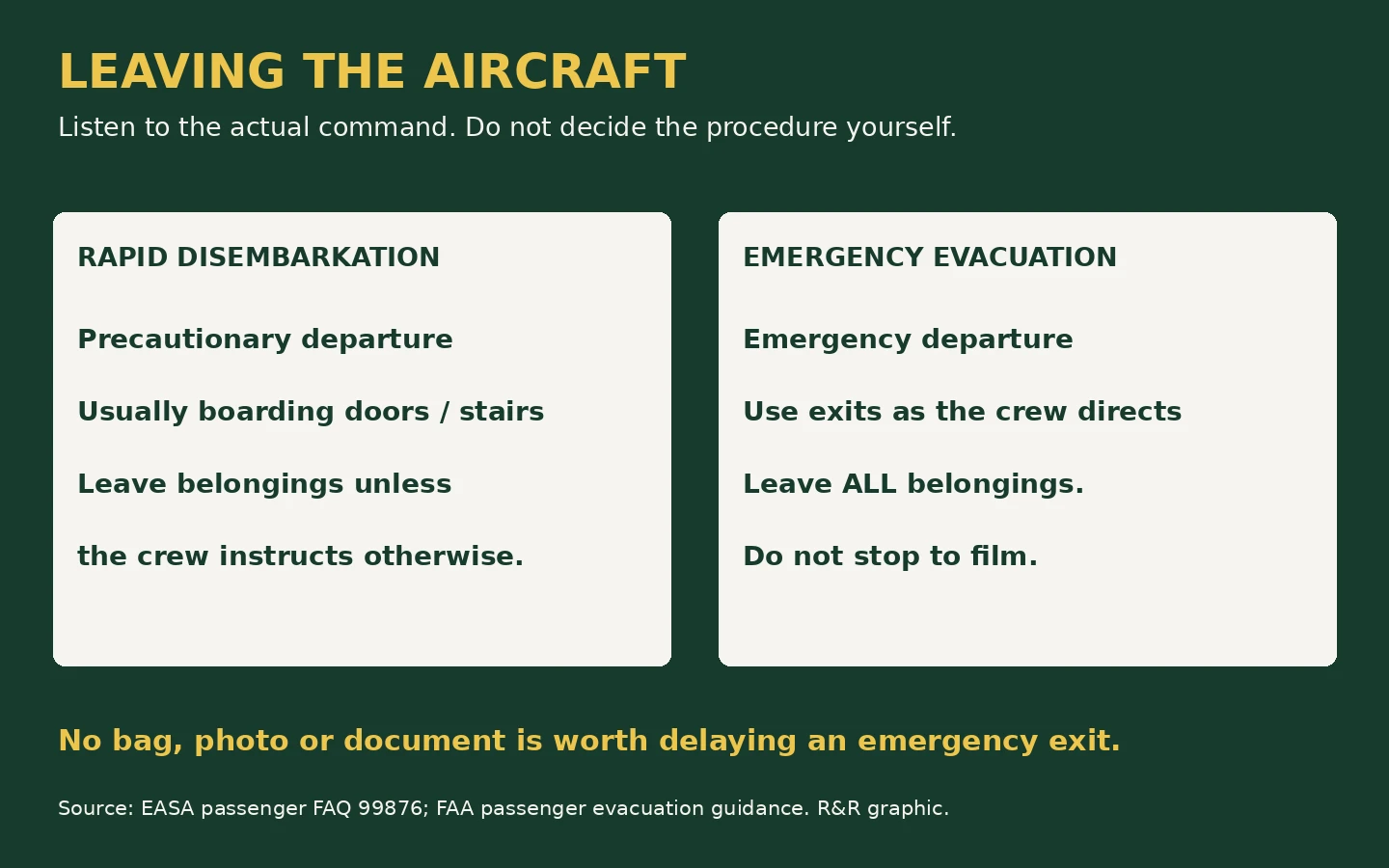
EASA distinguishes precautionary rapid disembarkation from emergency evacuation. Rapid disembarkation commonly uses boarding doors, stairs or an airbridge. Evacuation is an emergency departure using the usable exits and equipment as directed by the crew.
The distinction does not mean “take your bag unless you see a slide.” EASA says passengers rapidly disembarking leave belongings unless instructed otherwise; in an evacuation, belongings stay aboard. Listen to the actual command.
If emergency evacuation is ordered
The FAA’s passenger evacuation guidance is direct: follow crew commands, use a safe exit and leave carry-on baggage behind. Do not stop to record video. An exit you used to board may not be the usable one during the emergency.
Once outside, move to the place responders direct. Australia’s CASA highlights tarmac hazards, including moving service vehicles and operating aircraft. Stay with the directed route; do not wander back toward the aircraft for a bag or a photograph.
Traveling with children or needing assistance
Prepare a short explanation of the help you need before the flight. “I cannot stand without assistance” or “I may not hear an announcement” gives staff something specific to plan around. Arrange assisted travel with the airline in advance, and confirm relevant needs with cabin crew rather than assuming every staff member has seen the booking notes.
The UK CAA provides a separate assisted-travel resource. Individual arrangements depend on the airline, airport and traveler; this guide cannot specify how someone should be moved in an aircraft emergency.
A simple family briefing before boarding
Agree that everyone will listen to the crew, leave toys and bags if told to evacuate, and go where staff direct. Avoid a separate family plan that tells a child to wait aboard or return to a seat. If family members are seated apart, make the crew aware of assistance concerns before departure.
During a disruption, use one clear sentence at a time with a child. “We are listening for the next instruction” is more useful than speculating about what could happen. After reaching a safe waiting area, tell staff if someone in your group is missing or needs help.
After a diversion or security inspection
Safety instructions come first. When staff say it is appropriate to organize the rest of your journey, separate the problem into transport, baggage, assistance and expenses.
| Ask the airline | Why it matters |
|---|---|
| Which airport am I at, and what onward transport is arranged? | A nearby airport can have different rail, bus and entry arrangements. |
| Where and when will checked baggage be released? | Passenger processing does not guarantee immediate baggage access. |
| What happens to my connection? | Keep the booking reference and identify the operating carrier. |
| What support is available for my medical or accessibility needs? | State an urgent need rather than waiting for general announcements. |
| Which expenses are authorized, and can I have confirmation? | Keep receipts; do not assume every private booking will be reimbursed. |
EU passenger-rights guidance treats some diversions differently according to the airports involved. Applicable rights also depend on the journey and circumstances. Do not assume a security incident automatically entitles every traveler to a fixed compensation payment.
A practical message once safe: “I am at [airport], following airline instructions. My next update will be at [time and time zone].” Avoid announcing a cause that authorities have not confirmed. Our backup-communications guide explains alternatives if ordinary connectivity is also unavailable.
Prepare for disruption without overpacking
Before takeoff, give the safety briefing your attention and read the card for that aircraft. The UK CAA’s cabin-safety advice also covers seat-belt and device instructions. Follow the carrier’s rules rather than assuming they match your previous flight.
For an ordinary extended wait, have your itinerary, emergency contact details and medication information accessible. Charge devices before leaving home and carry the correct cable. If you compare backup power banks, check the exact model against current airline rules; a household recommendation is not automatic approval for air travel.
FAA PackSafe requires spare lithium batteries and power banks in carry-on baggage, not checked luggage. Airline-specific limits and onboard-use policies may be stricter. If a bag is checked at the gate, follow the applicable instructions for removing these items.
Small-bill cash may help with an unplanned ground journey, but it is only one payment option. Our emergency-cash planner is a budgeting aid, not a recommended universal amount for flying.
For broader household planning after your trip, use the 72-hour emergency-kit guide. Its home-reserve list is not an airline packing list; some household supplies are unsuitable or prohibited aboard aircraft.
Common questions about bomb threats on flights
Should I call the police from my seat?
For an immediate onboard concern, notify the flight crew promptly and follow instructions. On the ground, airport police can respond locally. The FBI also accepts reports concerning aircraft crimes, but an online tip is not a substitute for urgent onboard notification.
Does a diversion mean a bomb was found?
No. A diversion and an explosive-device finding are separate facts. Read the airline or authority’s actual statement rather than treating a precautionary landing as proof of an attack.
Can I take my passport or medication during evacuation?
Do not stop to collect anything. Before travel, keep necessary small items on your person where practical. If they are already in a bag when an emergency evacuation is ordered, leave the bag behind and tell responders about urgent medication needs once safe.
Can I film what is happening?
Do not film during evacuation or let a device delay movement. At other times, follow crew, airport and police instructions. Documentation of expenses can wait until you are safely outside the response area.
What if the threat turns out to be false?
A negative search does not mean it was appropriate to ignore the report. Passengers should report genuine concerns accurately and let authorized personnel assess them. Do not make threats or jokes to test the response.
Sources and editorial method
Checked November 4, 2026. This is an original passenger guide based on public authority guidance, not a crew operating manual or a claim of aviation-security credentials. Examples and decision graphics are R&R’s editorial explanations. Live crew and emergency-service instructions take priority.
- FBI — crimes aboard aircraft and reporting concerns
- FAA — passenger evacuation and before-flight preparation
- UK CAA — cabin safety, devices and crew instructions
- EASA — rapid disembarkation versus evacuation
- CISA TRIPwire — public bombing-prevention advice
- CISA — handling received bomb threats and preserving messages
- CASA — passenger behavior and tarmac safety
- IATA — Save a Life, Not a Bag campaign
- UK CAA — assisted travel
- FAA PackSafe — lithium batteries
- EU Your Europe — diverted-flight passenger rights
The lead scene is a generated editorial illustration of a conversation with cabin crew, not a photograph of a real incident. The cabin photograph is a credited public-domain image. Original diagrams explain passenger decisions without depicting a device or revealing operational security procedures. See our editorial standards.