
The most useful question after France’s October 17 protests is not whether the country looks frightening on a phone screen. It is whether public institutions can protect people, hear legitimate grievances and explain what they will do next. Those are separate obligations. A government does not satisfy all three by condemning a burning building, and a movement does not satisfy them by pointing to the size of a peaceful march.
Our view is straightforward. Violence against people and destruction of public services deserve investigation and accountability. Peaceful protest deserves protection. The demands that brought people into the streets deserve a substantive response. A serious account of the France protests in October 2026 must hold those positions together, rather than make readers choose between concern for public order and concern for public trust.
This editorial argues for a practical response on two levels: public institutions should publish specific commitments and evidence, while households should prepare for defined interruptions without treating political unrest as proof of imminent national collapse. Preparedness should make ordinary life more resilient, not make fear more profitable.
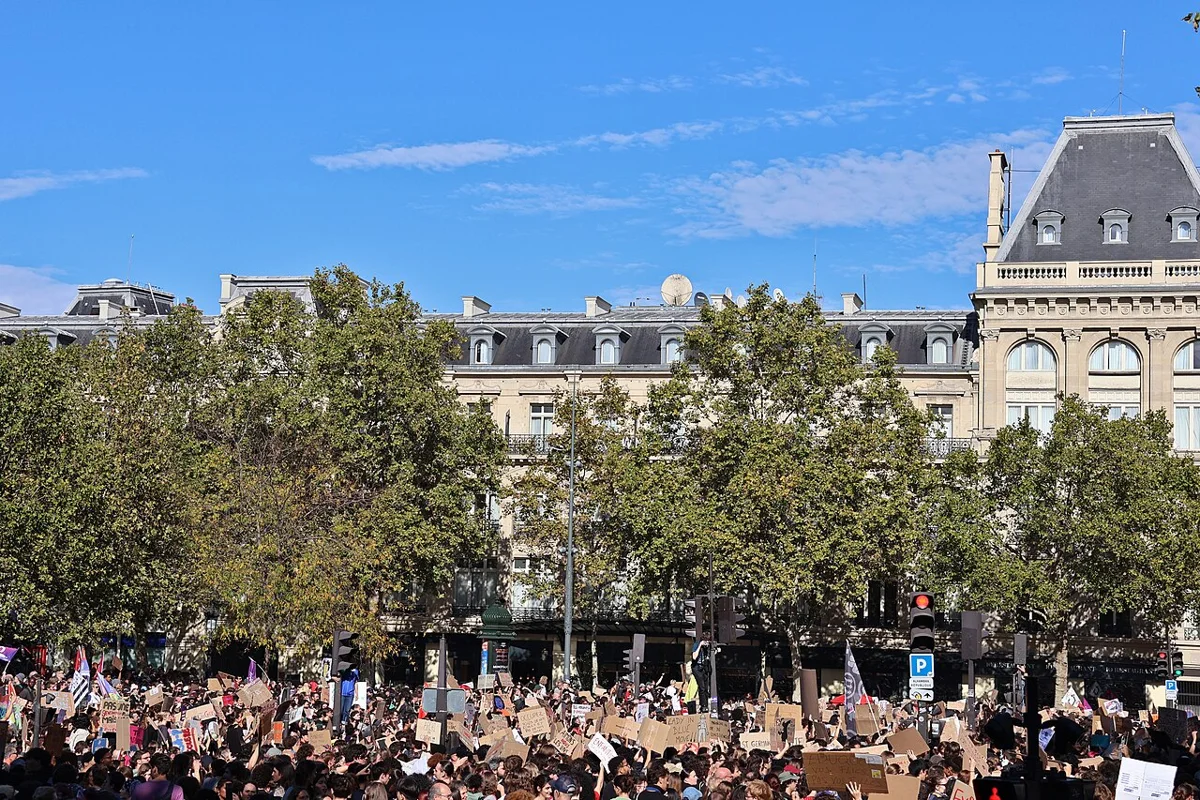
What the France protests establish and what they do not
The October 17 demonstrations brought together school-related grievances and wider frustration about living costs. The Interior Ministry estimated turnout at approximately 550,000; organizers gave a figure of 800,000. Fires, looting and clashes occurred in several cities. Our France protests news report separates the dated figures and affected locations from this editorial’s judgments.
AP’s October 17 coverage records the competing turnout estimates. The difference is worth preserving, but neither number answers the question that follows: how many participants engaged in particular offenses, and on what evidence? The size of a demonstration cannot establish the guilt of an individual. Nor can the existence of peaceful marchers erase a specific act of arson.
A widely shared image has a different limitation. It can show what was visible at one place and moment. It cannot tell us how every neighborhood functioned, whether a railway line remains open, or what an entire generation believes. Treating an image as a complete national diagnosis produces certainty faster than it produces understanding.
That distinction matters for readers outside France. American, British, Canadian and other Western audiences may encounter the unrest through short clips stripped of dates and locations. Before treating a scene as a warning about their own community, they should ask what the scene actually establishes. A powerful photograph can be authentic and still support a much narrower conclusion than its accompanying caption suggests.
Public order and the right to protest are simultaneous responsibilities
The argument that authorities must choose between listening and maintaining order is inadequate. Preventing attacks on people, protecting emergency access and investigating destruction are basic responsibilities. So is preserving space for people to voice grievances peacefully. Neither obligation should become an excuse for abandoning the other.
When a shop is damaged, the consequences do not stop with the owner. Staff may lose work, customers may lose access and nearby residents may inherit disruption. Damage to a public building can interrupt services used by people who played no role in the confrontation. Calling such destruction a political message does not explain why those people should bear its cost.
At the same time, an offense committed near a demonstration does not automatically describe everyone at the demonstration. Public authorities should be precise about the conduct they are investigating. Political labels are not a substitute for identifying an act, an alleged perpetrator and the evidence connecting the two.
The same evidentiary standard should apply to complaints about police conduct. A credible review must be capable of finding wrongdoing where it exists and rejecting unsupported accusations where it does not. Our position is not that every allegation is true. It is that scrutiny should turn on evidence rather than on whether the person making the allegation belongs to a favored political group.
This is a demanding standard because it resists the easiest reactions. It does not permit dismissing destruction as understandable background noise. It also does not permit using destruction to make legitimate grievances disappear. Public confidence is better served by investigations that can distinguish people and actions than by rhetoric that merges them.
The real test is whether grievances become measurable decisions
The deeper issue is what happens after leaders acknowledge that people are angry. Recognition can open a conversation; it cannot be the final product. Citizens need to know which problems a government accepts, which claims it disputes and what evidence will determine the next decision.
Reuters’s account of Macron’s October 18 address describes an announced review of preparedness and proposed talks involving students, teachers, lawmakers, unions and business representatives. The editorial question is what such a process should deliver. A meeting is an action, but an invitation is not an outcome.
For a school-related demand, a useful commitment would identify the problem being addressed, the responsible authority, the resources available and a date for reporting progress. For a disputed claim, it would identify the data needed to resolve the disagreement. For a rejected proposal, it would explain the reason and any workable alternative. These are proposed accountability standards, not claims that those commitments have already been made.
An announcement that promises improvement without defining a result gives everyone permission to declare success later. A published commitment makes that harder. It also allows progress to be recognized when it occurs. Accountability should be capable of recording improvement as well as failure.
There is a corresponding responsibility for organizers. A movement seeking decisions should explain which demands are immediate, which require negotiation and who can speak to a proposed agreement. Broad frustration may unite a crowd, but it does not by itself specify a policy. Clear priorities help people judge whether a response addresses the issue or merely changes the subject.
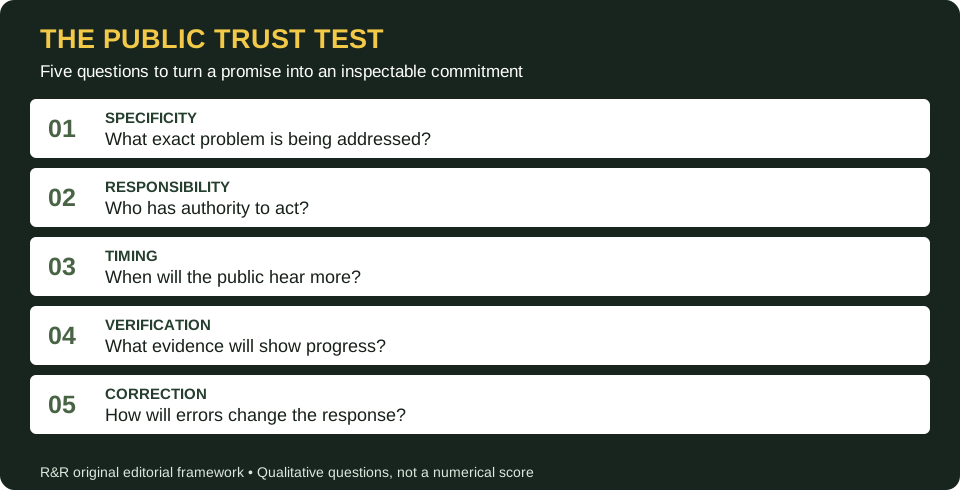
A public trust test readers can reuse
The following framework is our proposed way to evaluate a response to disruption. It is not a statistical index or a prediction model. Its purpose is to turn broad promises into questions that residents, journalists and community organizations can ask consistently.
| Test | Question to ask | Evidence that would answer it |
|---|---|---|
| Specificity | What exactly is being addressed? | A defined service failure, grievance or incident |
| Responsibility | Who has authority to act? | A named institution or accountable office |
| Timing | When will the public hear more? | A dated decision, review or progress update |
| Verification | How will progress be checked? | Published records, methods or independently reviewable evidence |
| Correction | What happens if the account is wrong? | A visible correction and an explained change in action |
The framework deliberately avoids assigning points. A numerical score could imply a level of measurement we have not established. Instead, a reader can record whether each answer is available, missing or contested. The distinction between missing information and unfavorable information is essential: an unanswered question should remain a question.
The test also applies to our own coverage. We should date figures, distinguish analysis from reporting, identify what we have not independently established and correct mistakes visibly. Authority is more convincing when a publication makes its reasoning inspectable than when it repeatedly describes itself as authoritative.
Preparedness should begin with dependencies rather than predictions
A household does not need to predict the next confrontation to make a useful plan. It needs to identify what would become difficult if a normal service were temporarily unavailable. That shifts the task from interpreting political drama to understanding daily needs.
Consider an ordinary dependency chain. A person needs medication, collection depends on reaching a pharmacy, and the journey depends on a particular route. A relevant preparation is to understand legitimate refill arrangements and an alternative journey. Buying unrelated equipment because a dramatic clip appeared in a feed does not solve that problem.
The same reasoning applies to communication. If household members travel separately, they need an agreed way to check in and a fallback meeting arrangement appropriate to them. A plan that everyone understands can be more useful than a large stock of equipment that only one person knows how to use.
Our 72-hour household preparedness guide provides a starting point for reviewing water, food, medication arrangements, lighting and communication. The reserve period is a planning reference, not a forecast that unrest will interrupt services for three days. Readers should follow local instructions and adapt supplies to actual needs.
For readers in smaller homes, the small-space emergency supply storage guide addresses organization. The important question is whether the right person can find a needed item at the right time. A crowded cupboard is not automatically a usable emergency system.
An interruption ladder is more useful than a collapse narrative
We propose a simple interruption ladder. Start with the smallest confirmed disruption and add a response only when the evidence justifies it. The ladder is a decision aid, not a description of what is currently happening throughout France.
| Confirmed condition | Proportionate household response | What it does not establish |
|---|---|---|
| A street or station is temporarily inaccessible | Verify another route and update anyone expecting you | That the entire city is inaccessible |
| An operator confirms a service interruption | Check its scope, expected duration and alternatives | That unrelated utilities have failed |
| A utility announces a water or power problem | Use the relevant household plan and official instructions | That a protest caused the problem |
| Authorities issue a protective instruction | Follow the specific instruction and assistance arrangements | That social-media advice overrides the authority |
This approach helps prevent a common reasoning error: moving from one visible failure to a collection of imagined failures. A route problem is initially a route problem. If power also fails, that requires its own verification and response. The household gains nothing by confusing those categories.
Our apartment power-outage guide and water shutoff guide are relevant when those particular interruptions occur. They are linked here because they explain dependencies, not because we have evidence that the French protests caused widespread water or electricity outages.
There is also an affordability argument. A modest plan built around existing supplies, accessible contacts and realistic alternatives avoids turning every headline into a shopping assignment. We are not attaching an emergency purchase list to this editorial. Readers deserve a reason for a recommendation that is stronger than the availability of an affiliate link.
Watch the earlier student-protest context
France 24 English, October 13, 2026. Earlier student-protest coverage, not footage of the October 17 events. Watch on the publisher’s YouTube channel. Contains scenes of confrontation.
Residents and travelers need operational information
For a traveler, the important question is often narrower than whether France is safe. Can the planned journey proceed? Is the accommodation reachable? Has the operator issued a notice? Is there a local restriction that affects the route? Those questions require current operational sources rather than an editorial’s national mood assessment.
The RATP traffic service is an appropriate place to check Paris public-transport information. U.S. readers can consult the State Department’s France advisory, and UK readers the FCDO’s France advice. A dated news report can explain an event; it cannot replace a current operator notice.
Residents have a related but different need. They may know their usual routes well while lacking an alternative for a specific interruption. The useful preparation is to keep essential contacts available, make assistance needs explicit and establish where verified local updates will come from. The free resource collection can support household planning without requiring readers to treat this event as a national supply emergency.
Neither residents nor visitors should be encouraged to approach a confrontation to verify it personally. Checking an operator or authority notice is a different activity from entering an affected street to record video. Our preparedness position prioritizes continued access to ordinary needs over collecting dramatic evidence for social media.

What coverage should stop rewarding
A news environment built around the most alarming fragment can obscure both the original grievances and the people harmed by violence. It rewards the image that travels fastest, even when the image is accompanied by a location error, an old date or a sweeping interpretation it cannot support.
Editors should resist three shortcuts. First, do not use one participant as a representative of everyone in a crowd. Second, do not attach an old image to a new event without a conspicuous date. Third, do not present an accusation about political responsibility as if an investigation had already established it.
The photographs and video accompanying this editorial have explicit dates and credits. Earlier student demonstrations provide context, not substitute footage for October 17. The distinction is part of the information, rather than an inconvenience to hide beneath a more compelling presentation.
A publication can be clear without pretending to have been present. We have not conducted interviews at these demonstrations or inspected the damaged buildings. Our contribution is an original argument and a reusable evaluation framework, grounded in linked reporting. Readers should be able to separate that contribution from the eyewitness work of the journalists and photographers credited here.
The response should be judged after the cameras move on
The immediate images will eventually be replaced by another story. That is when a useful assessment becomes more difficult and more important. Were damaged services restored? Were allegations investigated? Did announced talks produce specific decisions? Were people told when an initial account changed?
Our editorial judgment is that public trust requires answers to those questions, alongside protection of peaceful protest and accountability for violence. None of those aims needs to be sacrificed to make the others sound stronger. A functioning response should make room for all of them.
For households, the corresponding task is smaller and achievable: identify one important dependency, verify the information source and make one workable alternative. For institutions, it is larger: turn public commitments into records that people can inspect. That is a more constructive lesson from France’s unrest than either dismissing the grievances or selling the expectation of collapse.
Reporting and source record
Reporting checked October 19, 2026. The October 17 CNN reference was not directly retrievable; the story was cross-checked against the sources below. No on-scene interviews were conducted by R&R.
- AP, October 17: turnout, marches and initial events
- AFP, October 17: demonstrations and damage
- Reuters, October 17: origins and provisional figures
- AP, October 18: later arrests and government response
- Reuters, October 18: Macron’s announced review and talks
- Le Monde, October 18: policing reconstruction
- The Guardian: later arrest update