
NEWS / RUSSIA & SECURITY
Russia Releases Bulava Missile Test Video: What the Launch Shows
A submarine launch, a Russian test range and an alarming viral headline. Here is what the October 28 release establishes, what remains attributed, and how to read it in context.
WHAT THE REPORTING ESTABLISHES
Russia’s Bulava missile test: the essential facts
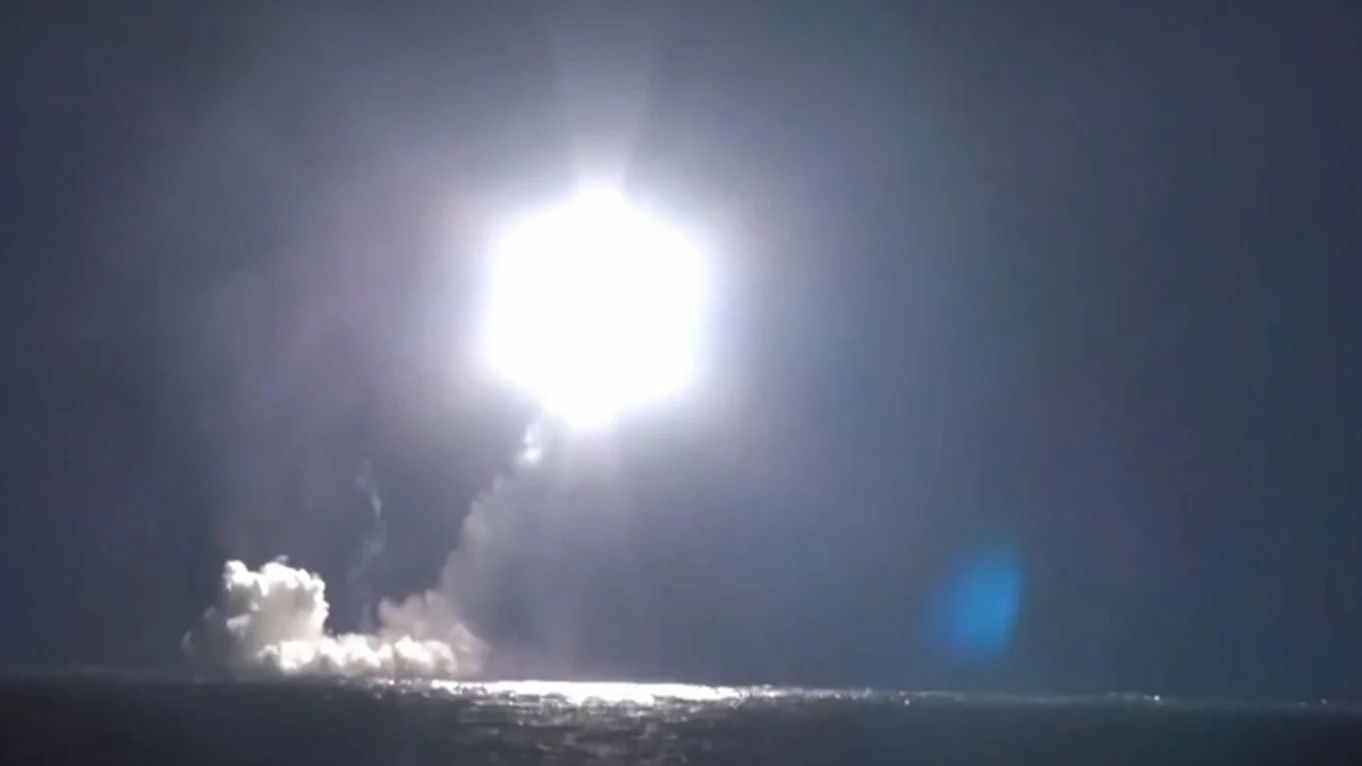
Russia’s Defence Ministry announced a submerged Bulava ballistic-missile launch from the Pacific Fleet submarine Generalissimus Suvorov in reporting published on October 28, 2026. The stated destination was the Chizha test range in Russia’s Arkhangelsk region. The ministry described the firing as planned combat training.
The material reviewed for this report describes a missile test, not an attack on Europe or a nuclear detonation. Claims about its success come from Russian authorities; the footage alone cannot independently establish the complete flight or its results.
WATCH / ORIGINAL R&R EDIT
Watch the launch excerpt in our original news video
A 40-second visual explainer with a short excerpt of the actual test footage and original animated context. Narrated with an original R&R voiceover.
Open the dedicated video page · Original Times of India reel
Footage and image credits
Launch excerpt: Russian Defence Ministry footage, released October 28, 2026, as presented by CCTV+. Ten seconds from the published 68-second source are integrated into original R&R editorial graphics. Source watermarks remain visible. The excerpt is shortened and its audio removed; it is not the complete Times of India reel. No endorsement is implied.
Header image: Amic.ru’s October 28 report, which credits the image as a screenshot from TASS video. Underlying launch footage is attributed to Russia’s Defence Ministry.
Russia has released video of a Bulava missile test from a submerged strategic submarine, drawing renewed attention to its sea-based nuclear forces. The release is significant military news, but the distinction between a nuclear-capable missile launch and a nuclear explosion is essential to understanding it.
TASS’s October 28 report, attributing the information to Russia’s Defence Ministry, identifies the launch area as the Sea of Okhotsk in the Russian Far East. It names the destination as a Russian test range rather than a foreign target.
What Russia said happened
Sea of Okhotsk
Chizha test range, Russia
Planned combat training
Reporting carried by Interfax also attributes the exercise account to the ministry. Russian officials said tracking information indicated that the missile’s warheads arrived in the designated area at the expected time. That remains an attributed official statement, not a result independently measured by Ready & Resourceful.
The footage’s release date should also be distinguished from the moment it was recorded. Material supplied by Anadolu Agency through Reuters Connect labels the video as released on October 28. Its shot list describes the submarine at sea, crew preparations and a missile launch.
What is the Bulava missile?
The RSM-56 Bulava, also designated SS-N-32, is a Russian submarine-launched ballistic missile. The Center for Strategic and International Studies’ Missile Threat profile describes a solid-propellant, nuclear-armed system with an estimated range of 8,300 kilometres, or about 5,160 miles.
The submarine’s role matters because the launch platform can operate underwater. However, identifying a missile as nuclear-capable tells readers about the weapon system’s potential use. It does not establish that a particular test involved a live nuclear explosion.
Generalissimus Suvorov is a Borei-A strategic submarine. TASS reports that it entered the Russian Navy in 2022 and transferred to the Pacific Fleet in 2023. Those service-history details provide context for the vessel shown; they are not evidence of a new operational deployment announced by this video.
Does “6,000-kilometre range” describe this test or the missile?
The Facebook reel’s headline emphasizes a 6,000-kilometre figure. Readers should separate two different measurements: how far a missile is assessed to be capable of flying, and how far it travelled on one particular test.
The CSIS figure above is a published system-range estimate. It is not an independently verified measurement of this flight. We have not established the reel’s roughly 5,500–6,000-kilometre flight-distance claim from independently reviewed tracking data, and do not present it as a measured result.
A test-range destination and a launch area can help explain the reported geography. They do not justify drawing an exact flight track on a map without additional data. For that reason, this report does not show a speculative missile trajectory or a graphic suggesting European cities were targeted.
What the video shows—and what remains an interpretation
| Point | What the available material supports | What should not be inferred |
|---|---|---|
| A missile launch | The published footage depicts a launch attributed to Russia’s Defence Ministry. | A short edited clip does not independently prove the complete flight or impact results. |
| Training purpose | Russian authorities described a planned exercise. | An official description is a source claim, not a complete account of strategic intentions. |
| Nuclear capability | The Bulava system is designed to deliver nuclear warheads. | Nuclear capability does not establish a nuclear detonation during this test. |
| “Message to Europe” | This is the reel publisher’s headline framing. | The reviewed launch material does not establish a specific attack order or a new public emergency warning for European households. |
Military footage can demonstrate a capability and attract attention without providing enough evidence to determine every political intention behind its release. Describing the launch accurately leaves room to discuss its significance without treating a dramatic headline as a confirmed threat assessment.
This submarine has conducted a Bulava test before
The specialist Russian Strategic Nuclear Forces research project places the new report alongside an earlier launch from this submarine in November 2022, during its acceptance trials. It also notes previous Pacific-based Bulava launches in 2020 and 2024. That history helps explain why a newly released clip should not automatically be described as a first-ever capability.
Does this explain the recent household preparedness campaigns?
The sources reviewed do not establish that connection. Events happening in the same month are not sufficient evidence that one caused the other, or that governments are privately signalling a specific attack through routine household advice.
For example, the UK Cabinet Office’s October 22 Be Ready announcement describes a three-year campaign focused on disruption to everyday services, including from severe weather. It also explains that much of the guidance continues advice published since 2024. That stated purpose should not be replaced with an unsupported explanation linking it to this missile footage.
Our comparison of preparedness guidance across countries separates publication dates, different reserve targets and official explanations. It is a better starting point for assessing the broader trend than assuming that several recent headlines amount to one coordinated warning.
Useful action for readers
A proportionate household plan remains useful across many kinds of disruption. The UK’s Be Ready guidance includes written contact information, meeting arrangements and support for people who may need additional help.
- Know where local instructions come from. Keep the official sources relevant to your location accessible, alongside a way to receive updates if normal internet access fails.
- Make a family communication plan. Our guide to communicating when cell towers are down explains the different backup routes and their limitations.
- Price practical gaps. If payment access is a concern, use the emergency cash calculator to budget essential purchases rather than withdrawing a large arbitrary amount.
These are general preparedness steps. They are not instructions issued because of this launch. If authorities responsible for your location issue an actual warning, follow that warning’s specific directions.
Before sharing a missile-test video, check four things
- Date: Is the date the filming date, release date or date of a later repost?
- Source: Is the uploader the camera operator, a government source or an outlet re-editing supplied footage?
- Claim: Does the caption describe a test, an operational strike or a nuclear detonation? Those are different events.
- Evidence: Which parts are visible, which come from an official statement, and which are the publisher’s interpretation?
In this case, the clearest account is a reported submarine-launched missile test, accompanied by official footage released on October 28. We will revise this report if credible new evidence materially changes that account.
Sources and reporting method
Checked October 29, 2026. This is an original desk report based on the sources below. Russian official claims are attributed; technical background and editorial interpretation are distinguished. R&R did not witness the launch, inspect the missile or independently verify its trajectory, payload or impact. The original R&R video uses a brief attributed launch excerpt with original explanations. The source audio is removed and source watermarks are preserved.
- TASS, October 28: Russian Defence Ministry account of the launch
- Interfax, October 28: ministry statements about the launch and test results (Russian)
- Anadolu Agency material on Reuters Connect: handout shot list, release date and verification disclaimer
- CSIS Missile Threat: RSM-56 Bulava system profile
- Russian Strategic Nuclear Forces research project, October 28: launch context and history
- UK Cabinet Office, October 22: stated purpose of the Be Ready campaign
- UK Be Ready: household planning guidance
- The Times of India | World: original Facebook reel supplied by the reader
- CCTV+, October 28: published video and shot list for the launch excerpt
- Amic.ru, October 28: actual launch frame credited to TASS video
See our editorial standards. The article does not claim that the release predicts an imminent nuclear attack or establishes a direct link to household preparedness campaigns.