
Ukrainian drone strikes set oil facilities in St. Petersburg ablaze on October 18, while Russian attacks continued to damage Ukraine’s energy system, placing civilian power supplies and a worsening dispute between Kyiv and Washington at the center of the war’s latest escalation.
Russia’s Defense Ministry said it destroyed 1,015 Ukrainian drones across a broad area. That is a Russian military claim about interceptions, not an independently verified count of successful Ukrainian strikes. St. Petersburg officials separately reported fires at oil facilities and casualties. The distinction matters because the number of drones, the number of impact sites and the damage to operating capacity measure different things.
The attacks unfolded as U.S. President Donald Trump defended delaying new pressure on Moscow and criticized Ukrainian strikes on Russian oil infrastructure. Ukrainian President Volodymyr Zelenskyy argued that sanctions relief would strengthen Russia while its forces continued attacking Ukraine. The immediate story therefore has three connected parts: damage on the ground, pressure on energy networks and a diplomatic disagreement over how to end the war.
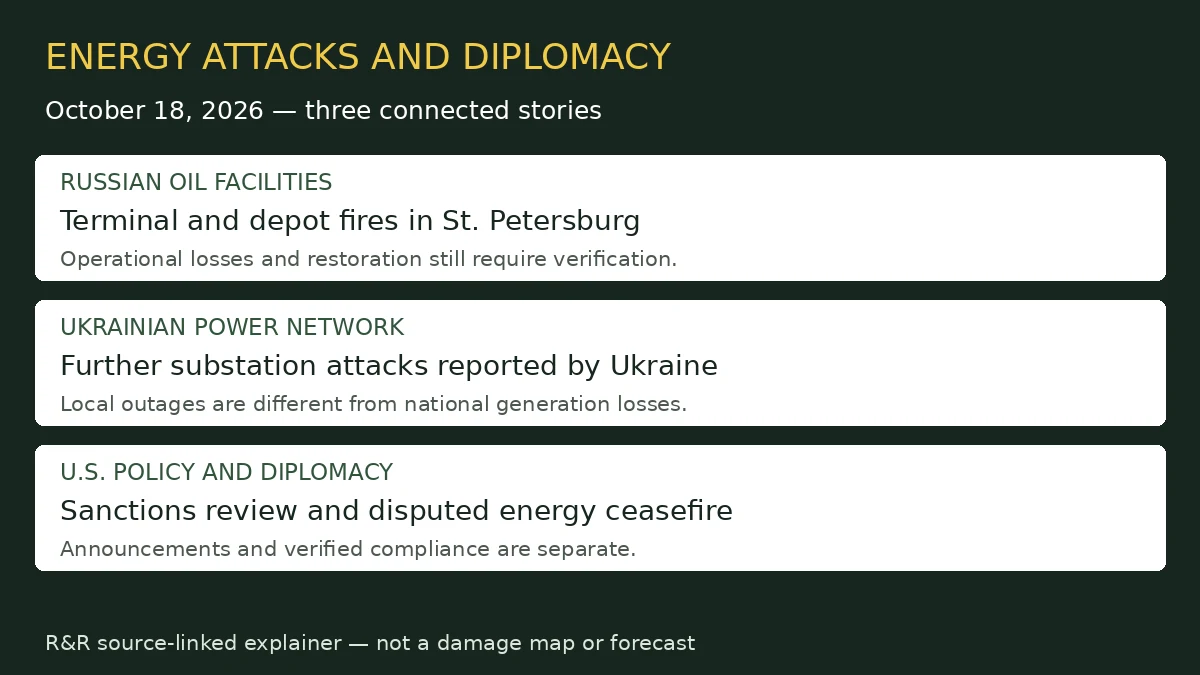
What happened in the October 18 drone attacks?
Associated Press coverage identified fires at the Petersburg Oil Terminal and the Ruchi oil depot. Governor Alexander Beglov said one person was killed and five were injured in the St. Petersburg attack. Those casualty figures remain attributed to the local authorities.
Euronews’s dated event footage showed smoke and fires associated with the industrial attacks. Its account also described temporary restrictions at Pulkovo Airport and damage reported at logistics facilities. The video documents visible conditions, rather than establishing the full duration of an outage or the amount of fuel lost.
An export terminal, a storage depot and a refinery are not interchangeable descriptions. A terminal handles movement and loading; a depot stores fuel; a refinery processes crude into products. An attack at one type of site can affect a different part of the supply chain from an attack at another. This report uses the facility descriptions supported by the linked accounts rather than calling every oil-site fire a refinery shutdown.
The key figures and their limits
| Figure | What it describes | Source and limit |
|---|---|---|
| 1,015 drones | Drones Russia said its forces destroyed | Russian Defense Ministry claim carried by AP; not independently verified here |
| One killed and five injured | St. Petersburg casualties reported by the governor | Local-authority account; provisional |
| 76 attacks | Attacks on Ukraine’s energy, oil and gas sectors in the preceding week | Zelenskyy’s October 18 statement, reported by Reuters |
| Four regions | Substation locations identified in the latest Ukrainian account | Vinnytsia, Zhytomyr, Khmelnytskyi and Odesa; not a national damage inventory |
| Up to 60 days | U.S. review period described by Marco Rubio | A policy-review period, not an agreed ceasefire duration |
These figures should not be combined into a single attack total. The Russian drone claim and Ukrainian energy-sector count concern different operations, geographical areas and reporting periods. Neither is a direct measure of how many households lost electricity.
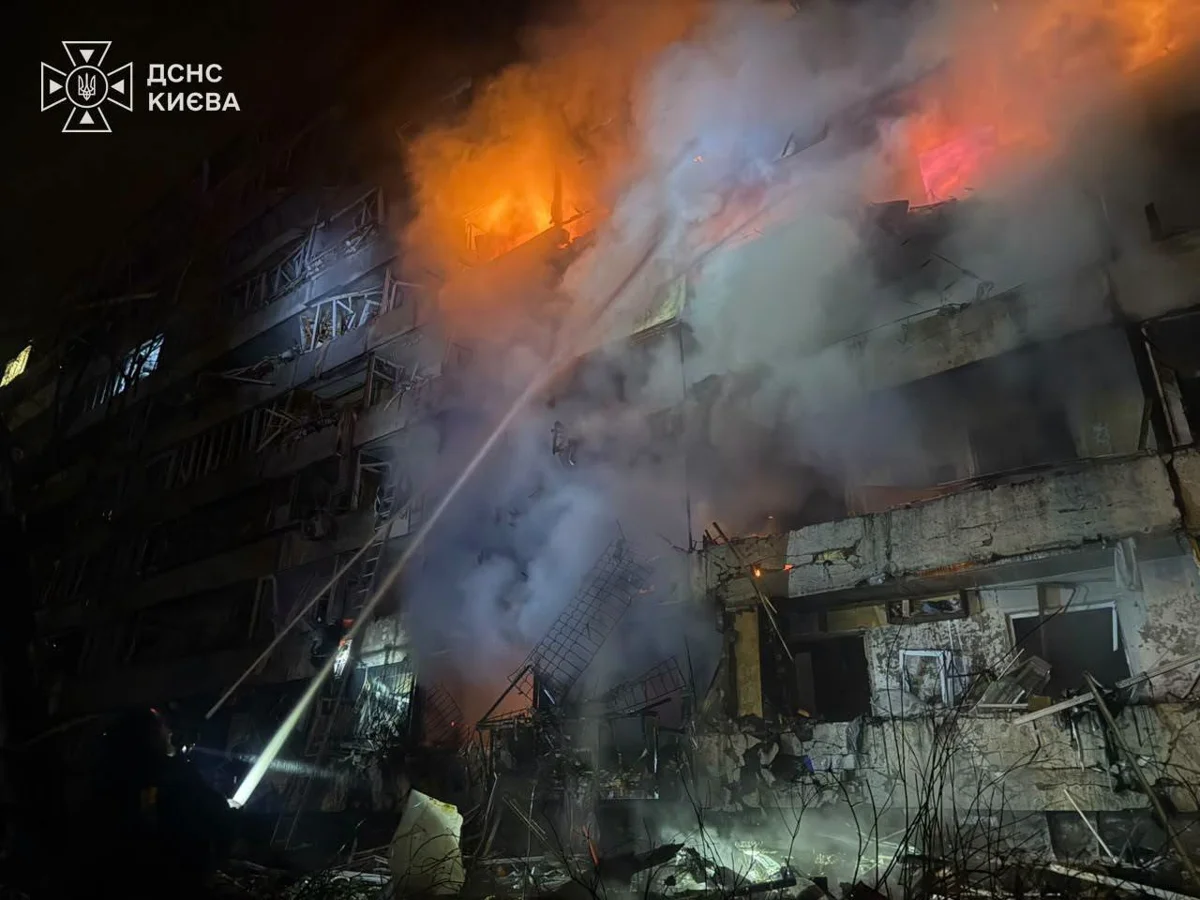
Ukraine reports further attacks on substations
Zelenskyy said Russia had struck Ukraine’s energy, oil and gas sectors 76 times during the week after Trump announced an energy ceasefire. A Reuters dispatch identified the four regions where the latest attacks targeted substations: Vinnytsia, Zhytomyr, Khmelnytskyi and Odesa.
ABC News’s October 18 report carried Zelenskyy’s account that the recent strikes had left tens of thousands of families without power. It also described his criticism of the sanctions decision. Those are Ukrainian statements about the effects and political significance of the attacks, rather than a damage survey conducted by this publication.
A substation’s role helps explain why attention extends beyond the generating plant itself. Electricity must be transmitted, transformed and distributed before it reaches a building. Damage along that path can interrupt delivery even when generation elsewhere continues. Conversely, an interruption does not by itself establish that an entire plant has been destroyed.
The civilian significance depends on where the damaged equipment sits within the network, available alternatives and the repairs required. A photograph of smoke cannot answer those engineering questions. Confirmed restoration information from the responsible operator is therefore different from an initial account of a strike.
Watch the St. Petersburg fires
Euronews, October 18, 2026. Event footage, not a live feed. Watch on the publisher’s page if the player is unavailable.
Why the energy ceasefire is disputed
Trump announced an energy ceasefire on October 11. Subsequent strikes and competing accounts have left the scope and implementation of that announcement in dispute. Kyiv said it resumed attacks on Russian oil facilities after a pause, while accusing Russia of continuing attacks on Ukrainian energy infrastructure.
The Financial Times’s October 18 account places the St. Petersburg attack within this disagreement over energy targets and U.S. support. The central unresolved issue is not simply whether leaders used the word ceasefire. It is what each side accepted, which facilities were covered, when restrictions applied and how compliance would be assessed.
A political announcement, an operational instruction and a verified halt to attacks are separate stages. Without an agreed public account of those stages, a subsequent explosion can generate incompatible claims about whether an arrangement was breached or never became effective. This report does not treat the announcement as proof that a monitored, enforceable agreement was operating.
That distinction also prevents a misleading timeline. A strike reported after an announcement does not automatically establish when it was authorized, what it targeted or which side’s interpretation governed it. Those details require evidence specific to the operation.
Trump’s Russia sanctions decision adds to the dispute
Reuters reported that Secretary of State Marco Rubio described a review of up to 60 days following Trump’s waiver of key Russia-related sanctions and tariffs. The administration linked its approach to economic effects and diplomacy. Zelenskyy warned that easing pressure could prolong the war.
The administration also defended a separate Russian diesel-supply arrangement. Its stated rationale was to improve supply and encourage a reduction in hostilities. That is the administration’s policy argument, not evidence that either result has already occurred.
For U.S. and European readers, the distinction between an oil-facility attack and a retail fuel-price effect is important. The first concerns a particular site and event. The second depends on broader supplies, product availability, transport, commercial decisions and other market conditions. This article does not assign a pump-price increase to the St. Petersburg attack without evidence establishing that connection.
Our earlier Gulf refinery and fuel-supply report examines a different disruption. It is relevant background for understanding why infrastructure damage, restart timing and delivered supply should be assessed separately; it is not evidence that the two events have identical market effects.
Intelligence sharing and Starlink claims remain contested
The disagreement also extends to support systems used by Ukraine. In an October 18 television interview, Zelenskyy said intelligence sharing had resumed after a temporary interruption. He also alleged that Washington had intentionally limited the speed of Starlink access, a claim U.S. officials disputed.
The Washington Post’s account of the dispute describes the allegation and the U.S. denial. A reported interruption, an asserted technical cause and an allegation about political intent should not be collapsed into one established fact.
The Institute for the Study of War assessment published by Critical Threats likewise identified uncertainty about Ukraine’s ability to use satellite communication systems for some interception tasks. Its assessment is an analytical source, separate from a technical investigation by a service operator.
For readers trying to understand what changed, the outstanding evidence would include a documented service incident, its technical scope, the period affected and an attributable explanation. Statements from political figures establish what those figures allege or deny; they do not substitute for all of that technical evidence.
Lithuania raises a separate cross-border concern
Ukraine’s foreign ministry expressed regret over the possible diversion of its drones into Lithuanian airspace. Spokesperson Heorhii Tykhyi suggested Russian electronic warfare may have been involved and said Ukraine would share information with Lithuania to establish the circumstances, according to Reuters.
The explanation about electronic warfare remains an attributed possibility, not an independently established cause. The incident is relevant to neighboring countries because it involves airspace and public warnings. It does not, by itself, establish a deliberate attack on Lithuania or an automatic alliance-wide military response.
Readers seeking the distinction between consultation and collective defense can use our Article 4 and Article 5 explainer. Applying those concepts to a particular incident requires verified facts and the decisions of the relevant governments; a map or a drone video cannot make that determination.
A timeline of the energy and diplomatic dispute
| Date | Development | What remains separate |
|---|---|---|
| October 11 | Trump announced an energy ceasefire | An announcement is not proof of verified compliance |
| October 16 | Trump signed the Russia sanctions waiver described in Reuters reporting | The waiver and the separate diesel arrangement are different measures |
| October 18 | St. Petersburg oil-site fires and further Ukrainian energy attacks were reported | Drone claims, visible damage and operational losses require separate evidence |
| October 18 | Ukraine addressed the Lithuania airspace incident | Its proposed explanation is subject to investigation |
| October 18 | Rubio described a review period of up to 60 days | That period does not define the duration of any ceasefire |
The sequence is a reference for the cited reporting, not a live incident tracker. Later official updates may revise casualties, damage assessments or the status of particular facilities.
What the energy attacks mean for civilian preparedness
The immediate civilian concern in an affected area is the actual interruption and the instructions issued locally. Military developments should not be translated into unsupported claims that Western households face an imminent blackout or shortage. This article makes no such forecast.
For households already planning for outages, our apartment power-outage guide, emergency water-storage guide and 72-hour household preparedness guide address ordinary service dependencies. They are background planning resources, not instructions for surviving an active attack. Local protective instructions and evacuation notices take precedence.
A useful household review separates electricity, communications, water and access to assistance. Some needs overlap, but they should not be assumed to fail together. Likewise, an update about one damaged facility does not establish the status of an entire city’s services. The responsible local operator or authority is the source for operational instructions.
The relevant preparation for a reader far from the affected area is to understand their own dependencies and trusted information channels. An overseas strike is not, on its own, a reason to buy equipment. No event-specific Amazon product recommendations have been attached to this news report.
What to watch next
The most consequential updates will be verified restoration information, the duration of disruption at the affected oil facilities, any revised casualty figures, and documentary evidence clarifying the diplomatic arrangements. The outcome of Lithuania’s investigation is a separate development to follow.
A further headline drone count would not answer all of those questions. Establishing the scale of an operation is different from determining its military effect, economic effect or civilian consequences. The evidence for each should be identified rather than inferred from the most dramatic number available.
This article was independently written from the linked reporting and assessment material. R&R did not conduct interviews at the attack sites or independently inspect the facilities. The original explanatory graphic organizes the reporting; it is not a damage map, an intelligence assessment or a forecast. The accompanying photograph is dated October 13 and is presented only as earlier context for attacks on Ukraine.
Reporting and source record
Reporting checked October 19, 2026. The October 18 CNN reference was not directly retrievable; the story was cross-checked against the sources below. No on-scene interviews were conducted by R&R.