
NEWS ANALYSIS / MEDIA & PREPAREDNESS
The Economist 2027 Cover: Warning, Forecast—or a Hidden Blueprint?
A genuine cover, earlier fabrications and a familiar suspicion: are powerful institutions forecasting tomorrow or shaping it? An evidence-led examination of the conspiracy interpretations.
THE SHORT ANSWER
What does the 2027 cover actually establish?
The official artwork is authentic. Earlier fake versions also circulated. A forecasting cover does not establish a hidden operational plan: this feature separates documented facts, visual interpretation and speculation.
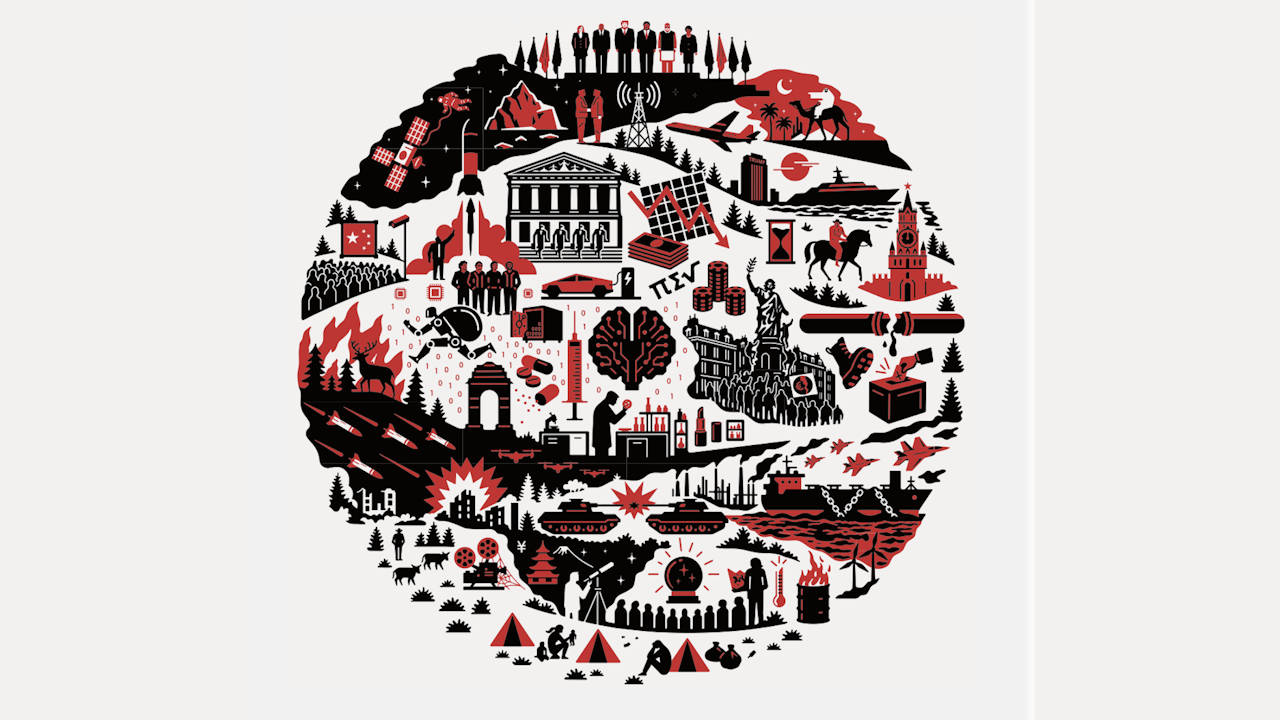
EXPLORE THE FOUR THEORIESThe unsettling thing about The Economist’s 2027 cover is not any single missile, machine or political face. It is that they all belong to the same crowded world. Conflict sits beside technology; medicine beside money; the future is presented as a system whose pressures cannot be neatly separated.
That is also where the suspicion begins. If the people explaining tomorrow move in the same circles as the people shaping it, how much of a forecast is observation—and how much is a statement of priorities? It is a fair question. Calling the illustration a secret timetable is a different claim, and a much harder one to prove.
THE CENTRAL QUESTION
Is the cover predicting a crisis—or teaching us which crises to expect?
The official artwork is authentic. Earlier fake 2027 images also circulated. This feature examines the real cover, the interpretations it invites and the evidence missing from claims of a hidden blueprint. The distinction matters: an image can reveal an editorial worldview without revealing a covert operation.
First, which Economist 2027 cover are you looking at?
Fabricated versions circulated before the official release. On September 10, AAP FactCheck examined a purported 2027 cover featuring a cake marked with the year and other ominous objects. AAP reported that a spokesperson for The Economist confirmed the image was fake. Its finding concerned that particular circulating illustration—not every subsequent cover carrying the year 2027. Read AAP’s dated examination.
That distinction prevents two opposite mistakes. An old fabrication does not become authentic because the real annual edition now exists. Equally, an earlier fact-check does not prove the newly released official image is fabricated. Authenticity belongs to the specific image, not simply the year printed on it.
Find the original before interpreting a symbol. Locate the actual passage before repeating a prediction. A real cover can be paired with an invented caption, and an accurate screenshot can circulate with a misleading explanation.
| What you have | What it supports | What remains unproved |
|---|---|---|
| Publisher-linked image | Official identification of the cover | Future accuracy or concealed intent |
| Unattributed screenshot | Someone circulated an image | Authenticity and context |
| Genuine image plus added predictions | The artwork may be authentic | That the publisher wrote the added list |
| Earlier fake-cover fact-check | A specific image was challenged | That a later release is also fake |
What the publisher actually says about 2027
The publisher describes an annual forecasting edition whose subjects include American politics, Iran’s consequences, heat, AI, European populism, debt markets, Taiwan, medicines, space and entertainment. It says the edition accompanies the weekly print issue dated November 21, with the standalone newsstand edition from November 26. Those are publication dates, not deadlines for events. These are editorial forecasts and judgments, not confirmations of future outcomes. See the official announcement and cover.
This is where interpretations often change category unnoticed. A risk becomes a prediction, a prediction becomes certainty, and certainty is presented as proof of advance knowledge. Those are four distinct propositions. A scenario can be plausible without being inevitable. Someone can anticipate a danger without intending to cause it.
Read the artwork without inventing a code
The official image uses a crowded red, black and white globe-like composition. Its visual compression makes separate developments appear to occupy one unstable system. That description concerns the artwork’s effect; it is not a verified statement about the artist’s intentions.
A machine-like shape could suggest technology, automation or conflict. A financial motif cannot independently identify a bank, amount or collapse date. The question “what could this mean?” is too permissive on its own. With enough imagination, almost anything can resemble something that happens later.
A stronger question is: what evidence makes this reading more convincing than another? Keep two columns in your notes: what is visible, and what is inferred. When those columns merge, an interpretation starts impersonating a discovery.
CLOSE READING / OBSERVATION VS INTERPRETATION
Six details that make the cover feel like a warning
Keep the full cover open while reading. The observations below describe the artwork; the interpretations are R&R’s analysis, not an artist-approved decoding key. No placement is treated as a date or instruction.
1. The globe: connection becomes confinement
A globe normally promises a complete picture. Here, the crowding makes completeness feel oppressive: there is little visual escape from the collection of forces. That construction encourages the viewer to search for one explanation connecting them all.
The darker reading: a managed world in which apparently separate crises form a single program. The competing reading: editorial compression. An annual cover has to bring many stories into one frame. The evidence needed to move from compression to coordination is not inside the circle; it would have to come from records connecting the actors and decisions.
2. Missiles and military machinery: a future narrated through force
Military imagery makes risk physical. Unlike an abstract policy dispute, a weapon implies immediate consequences. Its presence creates tension even before the viewer assigns a country or target.
The conspiracy interpretation turns preparedness into foreknowledge: why show war unless somebody knows it is coming? That inference overlooks the difference between recognizing an existing danger and possessing a specific operational plan. A weapon-shaped symbol cannot establish a target, launch order or date. The more useful criticism is editorial: why does force occupy so much of the picture of tomorrow, and which non-military possibilities become less visible as a result?
3. Machines and AI: who remains in control?
Machine imagery beside human figures creates an immediate contest of agency. Are people directing technology, being displaced by it or becoming dependent on systems they cannot inspect? Those questions give the cover its technological anxiety.
A hidden-control interpretation goes further, treating the image as a confession that human choice will be removed. To investigate that concern seriously, follow actual control: who owns a system, who can switch it off, what decisions it makes and whether people can appeal. The illustration can identify a question; a contract, technical design or policy can help answer it.
4. The financial motif: a crisis without an address
A market-like chart gives uncertainty a recognizable visual shorthand. But a chart used as an illustration is not a forecast dataset. Without labeled axes, an identified instrument and a dated methodology, it does not tell a reader what to buy, sell or withdraw.
That missing specificity is important because a market-crash narrative can acquire false precision through narration. Someone adds a bank name or a month; the image then appears to support a statement it never made. Keep the original artwork separate from the added claim. For households, a payment-access backup is a more defensible response than a major financial decision based on symbolic interpretation.
5. Medical imagery: treatment, commerce and bodily autonomy
A syringe-like form can feel threatening when placed among weapons and machines. The surrounding composition changes its emotional meaning. It can suggest treatment, pharmaceutical power, dependence or intervention without resolving which interpretation is intended.
That ambiguity is not evidence of an undisclosed medical operation. A claim about compulsory treatment or a planned outbreak needs its own evidence. The stronger line of scrutiny concerns identifiable incentives: what is marketed, how claims are supported, what consent is required and whose interests determine access. Visual unease should lead to better questions, not invented medical facts.
6. Satellites and space: infrastructure above, dependence below
Space hardware can mean expansion and ingenuity. In an anxious reading it becomes a symbol of surveillance or remote control. Neither meaning can simply be assigned to every object that resembles a satellite.
Follow the function instead. Communications, observation and computing infrastructure raise different ownership, privacy and resilience questions. The practical preparedness issue is dependence: what happens to your household when a service is unavailable? That can be investigated without alleging that every disruption was deliberately engineered.
The strongest angle is influence—not clairvoyance
The cover is worth scrutinizing precisely because it is a public editorial choice. It tells readers which developments deserve their attention and places those developments inside a shared emotional frame. That is influence we can examine directly.
The hidden-blueprint interpretation is more dramatic, but it also risks distracting from decisions that leave a paper trail. The useful investigation asks who proposes a policy, who finances the proposed answer, who bears the cost and what alternatives were excluded. Those questions remain valid even if every supposed secret symbol turns out to be ordinary illustration.
Theory one: “They are telling us before they do it”
The dramatic interpretation is that powerful actors disclose intentions symbolically before carrying them out. It explains why the alleged plan can be public and secret at the same time: the cover becomes concealment and confession.
But who is “they”? What decision was made? Who authorized it? How does the artwork communicate an actionable instruction? Which independently authenticated record connects the image to the alleged operation?
Without answers, the theory can absorb every outcome. An event proves the warning; a non-event means postponement; ambiguity proves concealment. A claim that cannot encounter a contrary result is difficult to investigate honestly. The cover can prompt a question, but it cannot supply the missing operational evidence.
Theory two: predictive programming
A subtler argument says disturbing imagery prepares audiences to accept disruption. Two different claims hide inside that phrase. One concerns whether prominent stories shape attention and expectations. The other alleges a coordinated campaign conditioning audiences for a particular planned event.
The second requires evidence of coordination, intention and effect. Repetition or an unsettling illustration alone does not establish those elements. Nevertheless, readers can examine framing: which dangers receive emphasis, which solutions appear inevitable, whose interests are assumed and which uncertainties become less visible?
That is a meaningful critique of influence. It does not require treating every influential publication as the mouthpiece of a single command structure.
Theory three: elite signaling
Perhaps, the theory goes, the intended audience is not ordinary readers but influential people communicating priorities among themselves. Shared networks and interests deserve scrutiny. Yet similar professional incentives can produce similar views without a secret central instruction.
The investigation should follow identifiable relationships. Examine named contributors, affiliations, ownership, contracts, public statements and decisions. Ask whether the proposed interpretation predicts something specific or merely redescribes the influence already visible in public.
Concentrated influence can be important even when there is no code. Replacing actual relationships with an all-purpose invisible actor makes accountability harder, not easier.
Theory four: the forecast helps create the future
This may be the most useful angle. Forecasts can become inputs into decisions. In a hypothetical case, a warning about a sector could lead readers to delay spending or buy alternatives. Companies might respond to those expectations. The forecast would then participate in the environment it described.
That possibility does not prove that this cover caused any event. It suggests a better question: when is a forecast an observation, and when does its circulation become an intervention? To answer, an investigator would need a timeline, evidence of decisions and plausible alternative explanations.
The same scrutiny belongs in preparedness publishing. An urgent headline can encourage sensible planning, but it can also turn a remote possibility into an immediate shopping impulse. A recommendation should identify an actual vulnerability and a proportionate response.
Why apparent predictions look stronger afterward
A fair record includes misses. Suppose an annual forecast discusses ten broad risks and one develops dramatically. A later montage showing only that one is not a balanced evaluation. Preserve the original wording, date, time horizon, uncertainty and outcome criteria before deciding whether a prediction succeeded.
“Instability may increase” is not equivalent to naming an institution, mechanism and date. Broad language is easier to match to later events. That does not make forecasting worthless; it makes specificity and complete records important.
What would change this assessment?
Authenticated communications connecting imagery to an operation would matter. Corroborated testimony or records demonstrating coordination around a specific event would also matter. An annotation on a screenshot or a retrospective symbol montage is not equivalent evidence.
The sources reviewed establish an official forecasting publication and earlier fabricated cover imagery. They do not establish a coded confession or an engineered-disaster timetable. Speculation in this feature is identified as a theory or hypothetical mechanism, not reported as a discovered plan.
Who profits from the fear?
Scrutiny should reach the people selling certainty about the cover, too. Does a purported exposé lead immediately to a course, investment, subscription or emergency shopping list? Does the presenter show the original? Would the recommendation still make sense if this magazine cover had never existed?
These questions apply to R&R as well. Preparedness advice should earn its place through usefulness, not an implication that a purchase offers protection from a decoded prophecy. This feature contains no product recommendations or affiliate shopping links.
Prepare for dependencies, not a magazine’s symbols
A household cannot usefully act on “everything may collapse.” It can identify a specific dependency and a fallback. Review accessible offline contacts, essential medication arrangements, a reasonable water reserve and the actual devices that need charging. Use local official alerts for immediate threats.
Our 72-hour preparedness explainer gives policy context, and the free household checklist provides a starting inventory. For specific gaps, read how to plan emergency cash, communication when cell towers are unavailable and the refrigerator backup-power calculator.
Do not make major financial decisions because a social post claims a deadline is hidden in artwork. Test the household need independently. A useful backup remains useful even if a forecast is wrong.
Questions readers are asking
Is The Economist 2027 cover real?
The publisher has released an official cover. Earlier fabricated versions also circulated. Compare the specific image with the publisher-linked original.
Does it prove a planned collapse?
No such conclusion is established by the sources reviewed. A forecast, an illustration and evidence of an operation are different things.
Should preppers ignore the discussion?
Use it as a prompt for a proportionate dependency review, not an emergency alert or guaranteed schedule.
Sources and editorial method
Prepared November 18, 2026. R&R examined the publisher’s announcement and linked cover, and https://aap.com.au/factcheck/fake-economist-cover-spreads-on-social-media/’s September 10 fake-cover report. Visual observations are separated from interpretation. No interviews, access to private records or advance knowledge are claimed. The official cover is displayed from the publisher’s image host as the subject of critical commentary, with attribution and a full-image link. This does not establish a blanket reproduction license. The close reading is editorial interpretation; no private records or artist interview were obtained.
Share this page
Help someone take their next practical step.