EDITORIAL / DIGITAL RESILIENCE
The Microsoft Outage Is a Warning About Dependence, Not Proof of a “Black Sky” Event

An unavailable inbox can interrupt far more than office conversation. It can block the information people need to get ordinary things done. That deserves serious preparation. It does not justify turning a technical failure into a prediction of societal collapse.
OUR VIEW
Prepare for lost access. Do not manufacture a bigger emergency.
The useful lesson from the Microsoft 365 outage is that a backup must remain accessible when the primary service fails. Households and institutions should check that independence now, without treating “Black Sky” speculation as an official warning.
Reporting cutoff: November 13, 2026, 23:35 UTC / November 14, 7:35 a.m. Philippine time. This is an editorial, not a live service-status feed. Check Microsoft service status and your organization’s administrator for current conditions.
What the Microsoft outage record actually establishes
The University of Pennsylvania’s extract of Microsoft incident notices records incident MO1550821 beginning November 12 at 18:26 UTC. Microsoft attributes the disruption to an earlier network-capacity upgrade whose problem surfaced after a subsequent network change, and says it was unrelated to cyberattack or AI agents.
The November 13, 22:00 UTC update reports sustained recovery, continued monitoring and an email backlog still being processed. It does not mark the incident ended. Its service details also matter: Exchange-dependent Teams features were affected, while most core calling, meetings and chat functions were described as unaffected. “Everything Microsoft stopped” would be an inaccurate summary.
These are Microsoft’s explanations, reproduced by a university, rather than an independent technical investigation. A final post-incident account remains important. We should assess the eventual findings, not substitute an imagined cause for the remaining questions.
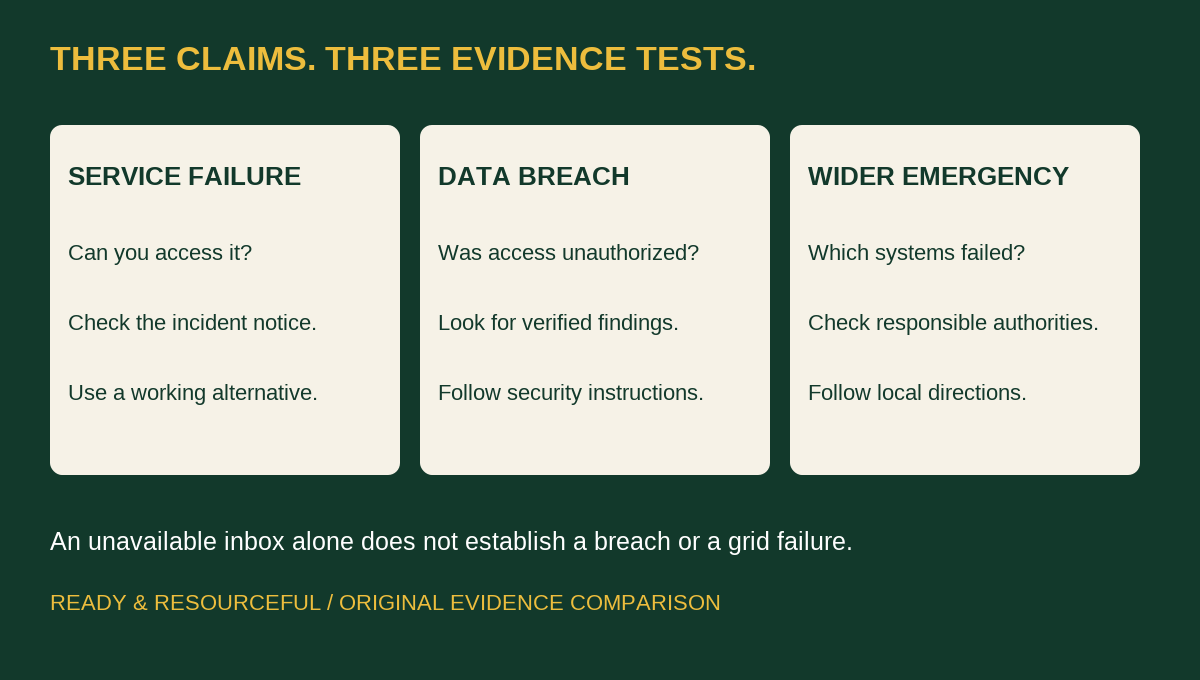
| Claim | What establishes it? | What does not establish it? |
|---|---|---|
| A service is unavailable | A relevant incident notice and the actual access problem | A screenshot about an unrelated app |
| Data was stolen | Evidence of unauthorized access or a verified breach finding | Being unable to open an inbox |
| A wider infrastructure emergency is unfolding | Verified failures and instructions from the responsible operators or authorities | A trending phrase or a contingency plan’s existence |
This distinction is not an attempt to minimize inconvenience. Someone who cannot retrieve an essential message may face a real, immediate problem. But the practical response depends on identifying that problem correctly. Missing access calls for a working alternative. A confirmed security compromise calls for the organization’s security response. A local emergency calls for appropriate emergency assistance. Treating them as interchangeable makes decisions worse.
What is a Black Sky event—and why the label needs care
The Electric Infrastructure Security Council uses “Black Sky” for catastrophic, prolonged disruption across critical infrastructure in multiple regions. Its concern is cascading dependence: damage to one major system can undermine others. The organization considers severe natural and human-caused hazards, including extreme weather and cyberattacks.
That is a resilience-planning concept, not evidence that a particular catastrophe is approaching. It is also not a three-day countdown. An emergency broadcaster’s arrangements, a household supply recommendation and an infrastructure-risk scenario answer different questions. Combining them into one ominous timetable creates a story the evidence has not established.
November 13 reporting documents social-media posts linking the outage to Black Sky fears. Those posts explain why the phrase is circulating; they do not validate the connection. An editorial should examine the concern without laundering it into a fact through repetition.
The real concern is what depends on the unavailable service
Imagine a parent who needs a school pickup instruction stored in an email. The phone has power. The mobile network works. The problem is narrower: the message cannot be retrieved. A power station would not restore the mailbox. A written pickup arrangement or an accessible local copy could answer the immediate need.
Now imagine a small business with a supplier’s telephone number in a cloud contact list and its outage procedure in a shared online folder. It may have purchased a second communication app, yet still need the failed account to find the right person or sign in. That is a second interface, not necessarily an independent route.
These are hypothetical examples, not reported casualties of this incident. Their purpose is to expose an ordinary design weakness: we can count devices and subscriptions while overlooking the steps required to use them. The useful unit of preparation is a task someone can complete, not an app someone has installed.
This is why the outage belongs in a preparedness publication. The connection is not that every cloud failure threatens the power grid. It is that essential daily actions can have hidden dependencies. Families cannot redesign a technology provider’s infrastructure, but they can stop making access to every important instruction depend on one login.
A backup should survive the failure you are planning for
“I have another copy” is a good start. The next question is where it is, how it opens and who can reach it. A synchronized folder may still be online-only on a particular device. A saved document may need an unavailable permission check. A contact list may be complete but inaccessible to the person who needs it.
| Primary route | Possible hidden dependence | A useful question |
|---|---|---|
| Email instructions | Working mailbox and account access | Can the intended person find the essential instructions elsewhere? |
| Shared cloud document | Network, sign-in and file permissions | Is the approved local copy complete and actually readable? |
| Alternative messaging app | Same identity provider or unavailable contacts | Can both people use it without the primary account? |
| Battery-powered device | Working service, correct cable and usable information | What task does the charged device still allow? |
| Broadcast radio | Reception, suitable service and power | Which information can it receive locally—and what can it not send? |
There is a security obligation here too. “Offline” does not mean putting passwords, medical records or identity documents where anybody can read them. Keep only what is necessary, protect sensitive copies appropriately and follow workplace rules. Staff should not export customer records or remove document protections simply because an outage is frustrating.
A practical review can be modest: identify one important task, identify the service it depends on, then demonstrate an approved alternative without disabling essential systems. You do not need to stage a household crisis to learn whether a printed number is current or a downloaded file opens.
What a household can usefully do now
Keep a small set of essential information accessible
Choose the contacts and instructions you would genuinely need during disruption. A household check-in contact, a relevant school or care-service telephone number and a safe meeting arrangement may be more useful than a huge archive nobody can navigate. Include the people who will use the plan in deciding what belongs there.
Use our family communication guide to distinguish an unavailable app, a busy network and a network that does not exist at your location. They require different alternatives. Do not describe ordinary messaging as a way to bypass a completely unavailable network.
Prepare for the actual need, not the alarming headline
If a phone has run out of power, a compatible charging arrangement may help. If the server is unavailable, extra battery capacity cannot bring it back. Our power-bank comparison addresses the charging question; it should not be sold as a cure for a cloud outage.
A suitable emergency radio can provide a separate information route, subject to local reception and service. A broadcast receiver does not tell relatives that you are safe. Decide how you will receive instructions and how you will contact people as separate tasks.
Keep broader preparedness proportionate
Water, food, personal care and useful lighting matter for many kinds of disruption. They do not become less sensible because a rumor is false, and they do not need a prediction of collapse to justify them. Our 72-hour household emergency-kit guide separates supplies that stay at home from essentials you can carry, with a transparent water planner and an existing free PDF.
The EU preparedness explainer provides the policy context. Three days is an initial planning window, not a promise that services return at a particular hour. Start with usable supplies you own and unresolved household needs rather than buying a dramatic-looking bundle.
Institutions should explain how people can still reach them
Technology suppliers owe customers a clear account of material failures. But public-facing organizations also have a responsibility that cannot be delegated to a vendor’s status page. If the usual contact route fails, people need a visible, workable alternative and a truthful account of its limits.
An effective public notice should answer practical questions: What is unavailable here? What still works? Which requests can wait? How should someone with an urgent need contact the organization? When will the next update appear? It should avoid making people search through a long technical incident thread to discover a telephone number.
Recovery messaging needs the same precision. Being able to sign in is not the same as knowing that a time-sensitive request has been received and acted on. Institutions should make their acknowledgement process clear and avoid implying that an operational queue has disappeared simply because a portal loads again.
We should also resist an easy political or commercial shortcut: declaring that one outage proves every organization should immediately abandon a provider. Moving systems has costs, constraints and its own dependencies. The more defensible demand is for continuity arrangements that are understood, exercised appropriately and available to the public when needed.
Watch the editorial in one minute
Read the transcript
The Microsoft outage is a warning about dependence, not proof of a Black Sky event. The distinction matters. Microsoft attributes the disruption to a technical network issue, not cyberattack or A I. At our reporting cutoff, recovery and email backlog monitoring were continuing. Black Sky describes severe, prolonged infrastructure disruption. A cloud outage alone does not establish that scenario, or prove that your data was stolen. Our editorial asks a practical question. Can your backup work without the failed service? Keep essential contacts accessible, check approved offline copies, and agree an alternative check in route. Extra phone power cannot restart an unavailable server. A broadcast radio receives information, but cannot tell family you are safe. Match the backup to the task. Read the editorial and household planning guide at Ready Resourceful dot com.
Representative server footage: ALL IZ Well / Pexels. Original R&R script, editing, motion graphics and instrumental bed; synthetic narration. This is not footage of the affected Microsoft infrastructure.
The better test is whether the next necessary action remains possible
The false choice is between laughing off a technology outage and treating it as the beginning of the end. There is a more useful position: take dependence seriously, insist on evidence and fix a specific weakness.
For a household, that might mean an accessible contact card. For a school or service provider, it might mean publishing an alternative route that does not require the failed system. For a technology company, it means explaining the fault and demonstrating the corrective work rather than relying on an apology alone.
“Black Sky” can prompt a worthwhile discussion about interconnected infrastructure. Used loosely, it can also turn understandable concern into confusion. The editorial judgment here is straightforward: we should leave this outage with a better backup arrangement, not a more frightening explanation than the facts support.
Sources and editorial method
This is an original editorial expressing R&R’s analysis, not a claim of on-site reporting or independent forensic investigation. The incident snapshot above uses Microsoft notices reproduced by Penn’s IT service. Status may change after the stated cutoff. We have not independently confirmed detailed BBC emergency-studio arrangements and do not rely on them here. No verified link between this outage and an impending Black Sky event was established in the sources reviewed.
- Penn IT — Microsoft incident notices, including MO1550821
- Microsoft — current public service status
- EIS Council — its Black Sky hazard framework
- LADbible — November 13 coverage of circulating Black Sky speculation
- Pexels — image and footage license
Fictional examples are identified as such. Original diagrams compare evidence and dependencies; they do not show Microsoft’s network topology. Read our editorial standards or send a correction with supporting evidence.