
NEWS / FLORIDA & FLOOD RESILIENCE
St. Petersburg Voters Back $600 Million for Storm Resilience—What Happens Before the Next Flood?
The vote authorizes financing for public infrastructure. The next test is turning that authority into operating projects while residents prepare for storms.
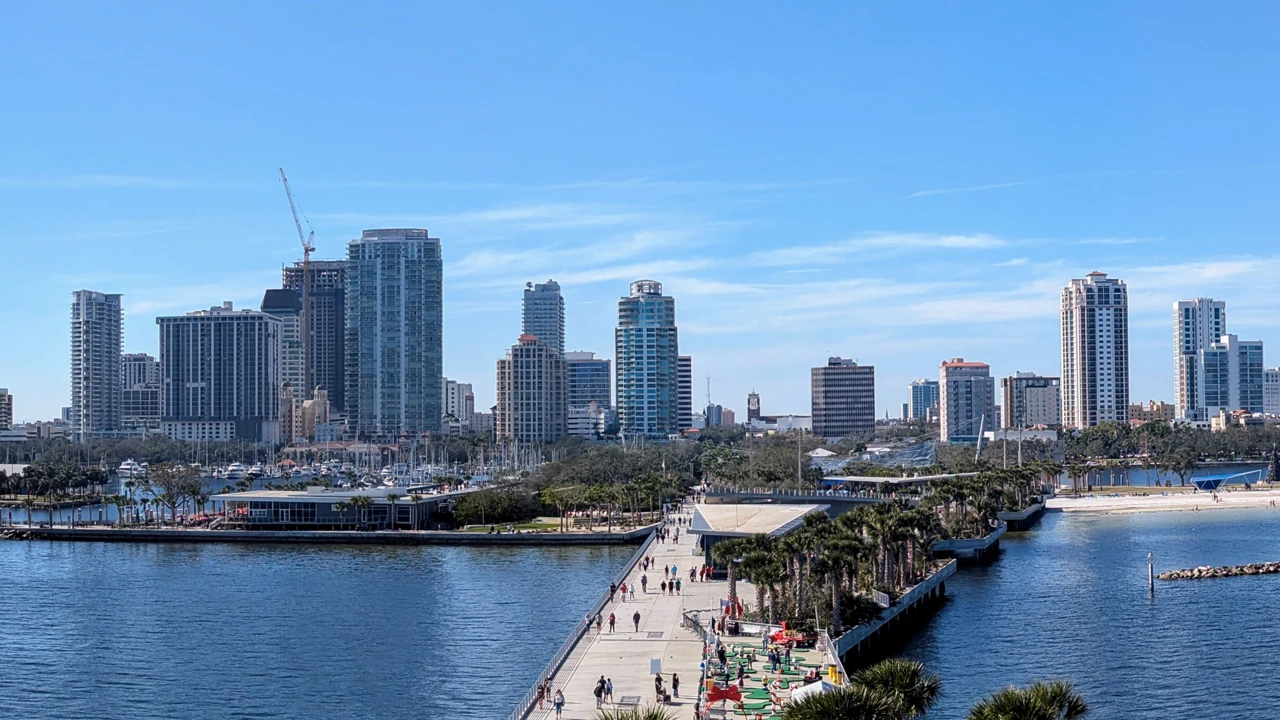
St. Petersburg voters backed up to $600 million in borrowing for storm-resilience improvements on November 3, giving the city a financing tool to accelerate work on drainage, sewer and drinking-water systems. The result moves the infrastructure effort forward. It does not mean the projects are finished—or that a particular neighborhood is protected before the next flood.
Florida Politics reported roughly 74% support with all precincts reporting, based on unofficial county returns. St. Pete Now also reported passage. Their published raw totals differ, so this report uses the rounded share rather than treating either count as final. The Pinellas County election office is the source for updated returns and certification information.
The vote in brief
- Amount: Authorization for up to $600 million in general obligation bonds.
- Purpose: Storm-resilience work involving stormwater, wastewater and drinking-water infrastructure.
- Election: November 3, 2026; reported result remains unofficial.
- Repayment: Backed by the city’s property-taxing power, rather than a grant with no repayment obligation.
- Household implication: Track actual projects and keep an independent storm plan.
Three public systems are covered—not just street drainage
The referendum language includes floodwater protection, stormwater pump stations and drainage infrastructure, along with wastewater collection and treatment and drinking-water distribution and supply facilities. Bonds may be issued in more than one series, with each issuance maturing within 30 years.
Those categories matter because a storm can disrupt a household in different ways. Water standing in a street, sewage backing up and a drinking-water service interruption are not interchangeable problems. A project’s benefit should be described in terms of the system it improves, rather than as a promise to eliminate every consequence of a hurricane.
| System | Its basic job | What a resident should ask |
|---|---|---|
| Stormwater | Manage rainfall runoff through drainage infrastructure. | Which drainage area does the project serve, and what conditions was it designed for? |
| Wastewater | Collect and treat sewage. | Which collection or treatment vulnerability is being addressed, and what service restrictions could still apply? |
| Drinking water | Supply and distribute potable water. | Which facility or service area benefits, and where will customers receive any interruption or water-quality notice? |
For the official program information, start with the city’s St. Pete Agile Resilience, or SPAR, page. When checking a project, use its specific name or identifier: a citywide borrowing ceiling is not a neighborhood construction schedule.
The bond is intended to buy speed—not instant protection
Before the vote, WUSF reported that the city had identified about $2.7 billion in SPAR work that would take roughly 24 years under the utility-funded investment pace then described. Public works administrator Claude Tankersley said the work would continue without the bond, but more slowly. That is the financing rationale: bring eligible construction forward rather than wait for utility revenue to accumulate.
The report is pre-election planning context, not confirmation of a post-election construction calendar. This article has not verified an updated contract-by-contract schedule showing which new works will enter service before the next storm.
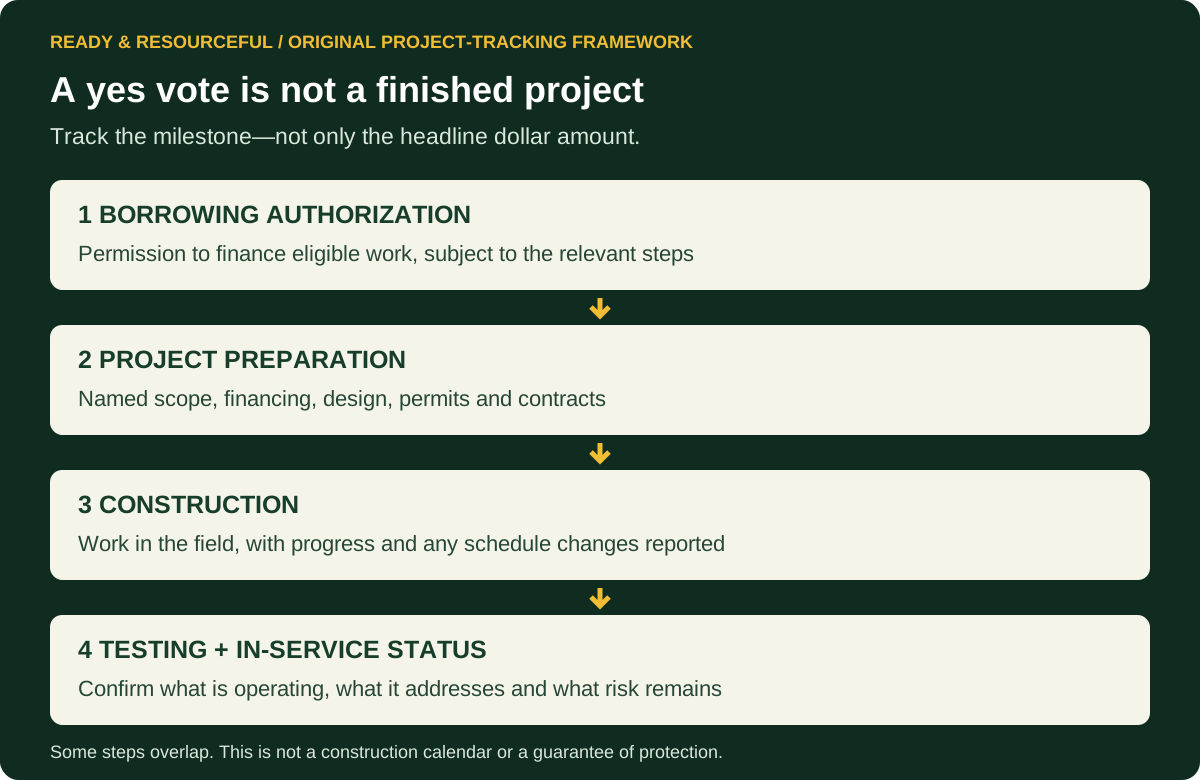
A useful way to read the next announcements is to separate authority to borrow, money committed to a named project and infrastructure operating in the field. Each is a different milestone. A groundbreaking photograph is not the same evidence as completed testing and an in-service date.
The property-tax estimate is not a fixed bill for every homeowner
The St. Petersburg Chamber of Commerce’s voter explanation described the city’s planning estimate as approximately 0.96 mills, or $96 annually for each $100,000 of taxable property value. It emphasized that actual costs depend on borrowing, timing, interest rates and taxable values. Taxable value is not necessarily a home’s sale price.
How to read that estimate
One mill is $1 per $1,000 of taxable value. At the stated planning estimate, the arithmetic is:
- $100,000 taxable value × 0.00096 = $96 a year.
- $250,000 taxable value × 0.00096 = $240 a year.
- $400,000 taxable value × 0.00096 = $384 a year.
These are worked examples of the estimate, not individual tax assessments or a guarantee of the rate ultimately levied.
The distinction between borrowing and a grant also matters. Borrowing moves resources forward while creating repayment obligations. It should be evaluated alongside what is built, how quickly the benefit arrives and how the completed work is maintained.
Better drainage does not make storm surge disappear
The measure’s broad scope should not blur the differences between hazards. Rainfall flooding concerns water falling on land and moving through a drainage area. Storm surge involves coastal water pushed inland by a storm. Sewage backup is another pathway, involving the wastewater system or a property’s plumbing connection. More than one can occur during the same event.
Our storm surge versus flooding explainer shows why that distinction changes the questions residents should ask. A drainage improvement cannot be assumed to provide the same protection as a coastal flood-defense measure or a sewer-system upgrade.
Pinellas County identifies evacuation zones by storm-surge risk. Its flood-map information serves a different purpose. Residents should check both kinds of information rather than treating a single zone label as a complete description of the property’s exposure.
What residents can do before the next flood
Start with the official evacuation-zone lookup and current county instructions. An infrastructure vote does not cancel an evacuation order. The National Weather Service advises obeying evacuation instructions, avoiding flooded roads and staying out of water that could contain electrical hazards.
For practical household planning, use the guide that matches the problem rather than buying a generic “flood-proof” solution:
- Water entering from below: Our basement-water source guide distinguishes possible causes and next steps; homes with different foundation types need appropriate local assessment.
- A pump that stops when electricity fails: See sump-pump power-outage troubleshooting. A pump is not a substitute for evacuation or an answer to every flooding mechanism.
- A flooded rental: Our apartment-flooding guide focuses on notification, documentation and recovery decisions.
- Recovery after water enters: Read how to dry out a flooded house and mold prevention after flooding once it is safe to assess the property.
Four details that will make the next city update useful
Residents can turn a broad infrastructure announcement into something trackable by recording four fields:
- Project and service area: What is the exact project name, and which streets, drainage area or utility facilities does it cover?
- Current milestone: Is the work in design, permitting, procurement, construction or service?
- Dated next step: What is expected next, when was that estimate issued and has it changed?
- Remaining exposure: What problem is the project intended to reduce, and what risks or restrictions remain?
This is an accountability framework, not a claim that any particular project is behind schedule. Its value is continuity: residents can compare the next update with the previous one instead of starting again with the citywide dollar figure.
The vote supplies political authorization for faster infrastructure investment. Before the next flood, the meaningful evidence will be specific work delivered, clear service information and a household plan that remains usable while construction continues.
Watch the short explanation
Read the video transcript
St. Petersburg voters backed up to six hundred million dollars in storm resilience borrowing. Local reporting puts support at about seventy four percent. The election results remain unofficial.
The measure covers stormwater, wastewater and drinking water infrastructure. A drainage upgrade and a sewer plant improvement solve different problems. Neither means every home is protected from the next storm.
Authorization is the beginning. Financing, design, permits, contracts and construction still matter. Look for a named project, a dated schedule and a clear explanation of when it enters service.
Check your official evacuation zone and current local instructions. Never drive or walk into floodwater. Read the full report and practical flood guides at Ready Resourceful dot com.
Sources and reporting notes
Checked November 5, 2026. This report combines attributed election coverage, the referendum’s published scope, pre-election financing explanations and official flood-safety resources. It does not present a certified vote count, a newly verified construction calendar or a property-specific flood assessment. The original graphics explain delivery milestones; the video’s drainage clips illustrate the topic and do not depict a verified St. Petersburg incident.
- Pinellas County election office: November 3 general election
- Florida Politics: bond passage, unofficial results
- St. Pete Now: unofficial local results
- Ballotpedia: referendum scope and ballot language
- St. Petersburg Chamber: financing and tax estimate
- WUSF, October 1: pre-election SPAR financing context
- City of St. Petersburg: official SPAR program portal
- Pinellas County: evacuation information
- Pinellas County: flood maps and zones
- National Weather Service: flood safety
- Skyline photograph: Rishabh Tatiraju, December 2024
- Photograph license: CC BY-SA 4.0
- Pexels: illustrative drainage-pipe footage
- Pexels: illustrative storm-drain footage
- Pexels license
