
The first sign might be a drip above the sofa, water spreading beneath the front door or a call from the neighbor downstairs. Suddenly you need to protect your belongings, reach a landlord and decide whether it is safe to stay. Trying to settle who will pay while water is still arriving makes an already stressful situation harder.
If you are wondering what to do when your apartment floods, use this order: get people to safety, report the active problem, document what you can safely see, then separate building repairs from belongings and temporary-living costs. You do not need a perfect diagnosis before calling for help. You do need a clear description of what is happening.
The first actions
- Leave unsafe wet areas and follow emergency instructions.
- Call emergency maintenance; follow with a factual written notice.
- Photograph only from safe locations and preserve original files.
- Separate building repairs, possessions and living-cost records.
- Confirm source control and material assessment before normal use.
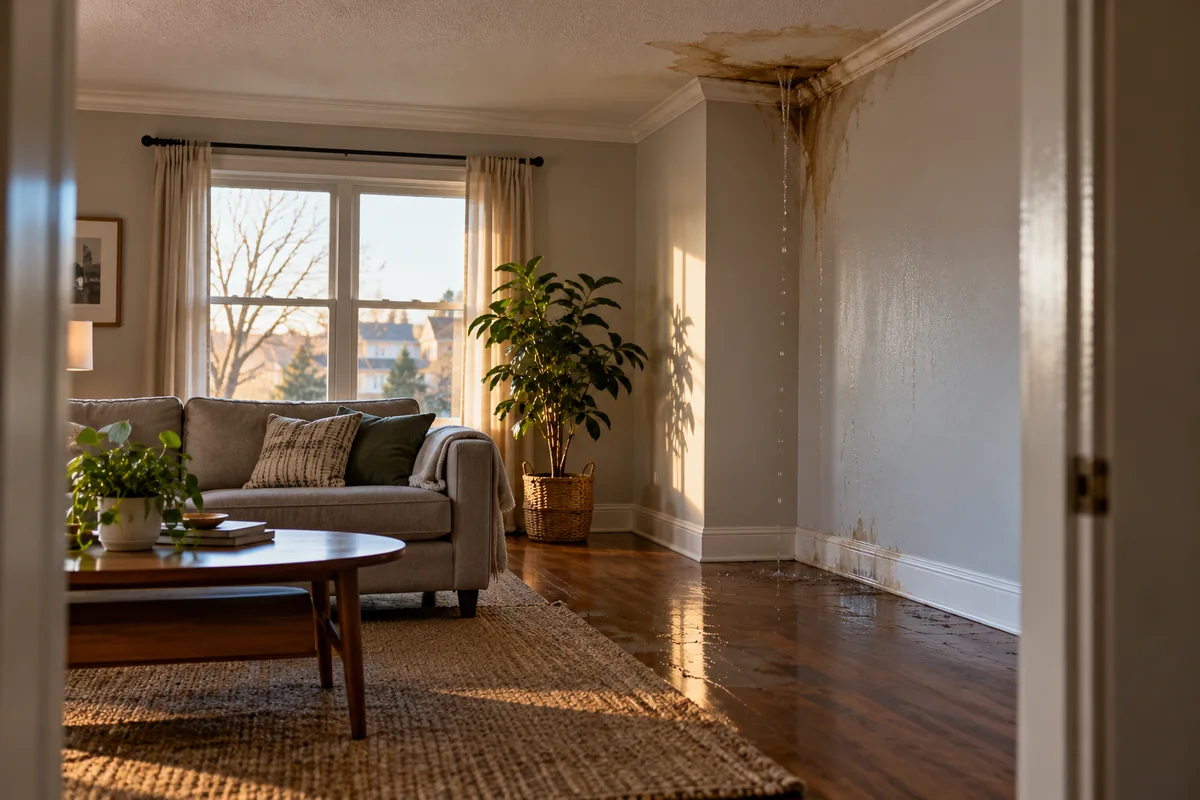
Leave the wet area if safety is uncertain
Do not enter standing water if wiring, outlets, appliances or electrical equipment may be involved. Do not cross the wet area to reach a breaker or unplug something. Ask building management, the utility or an electrician to arrange safe isolation. If there is immediate danger, call emergency services and follow evacuation instructions. A phone photograph is never worth an unsafe entry.
Water coming through a ceiling needs particular care. Stay away from sagging, bulging or visibly damaged areas, and do not puncture a ceiling or climb beneath it to investigate. EPA re-entry guidance treats structural changes and uncertain electrical safety as reasons to avoid entry until the situation is assessed. An upstairs source can affect more than one room or unit.
Keep children and pets away from unknown water. If sewage, outdoor floodwater or another contaminated source is possible, do not begin household cleanup as if it were a small spill of clean tap water. Tell responders what you observed. Use our sewage-backup response guide if water is visibly rising from a drain or toilet.
Report the flood while the source is still being investigated
Call the building’s emergency maintenance number or landlord promptly. Use the emergency route listed in your lease, resident portal or building information. A routine work order may not communicate that water is actively entering. Follow the call with a written message and save the work-order number, time and name of the person who responded.
Give the location, whether flow is continuing, visible hazards and how to reach you. Say “water is dripping from the living-room ceiling” rather than “the upstairs tenant broke a pipe” unless a qualified person has established that cause. If you are not in the building, say so. Ask management to confirm who is attending and whether you should remain outside the affected unit.
If an appliance in your own unit is clearly the source and you can safely stop it using an ordinary, accessible control on dry ground, do so. Do not approach wet electrical equipment or operate unfamiliar building valves. Shared water shutoffs, sprinkler systems and neighboring apartments belong with management and appropriate responders. Never enter another unit without authorization.
When the upstairs apartment is flooding yours
You may be able to alert the upstairs neighbor by phone, intercom or a safe knock. Keep the message practical: water is entering below, emergency maintenance has been notified, and the source needs to be checked. You do not need an argument about fault to get the response started. If you cannot reach the neighbor, tell management rather than waiting at their door while your own exit becomes unsafe.
Ask the attending professional to record the source they actually identify. An overflowing fixture, failed supply connection, roof leak and shared pipe problem can all require different repairs and insurance analysis. The fact that water traveled from above does not, by itself, settle negligence or payment responsibility. Preserve the finding when it becomes available, including who made it and when.
A useful incident note separates three stages: first observed, source reportedly stopped, and affected materials assessed. A stop in visible dripping is only one stage. Ask whether water reached ceiling cavities, wall assemblies or neighboring units and who is coordinating further investigation. Our flooded-house drying guide explains why a dry-looking surface is not the complete recovery record.
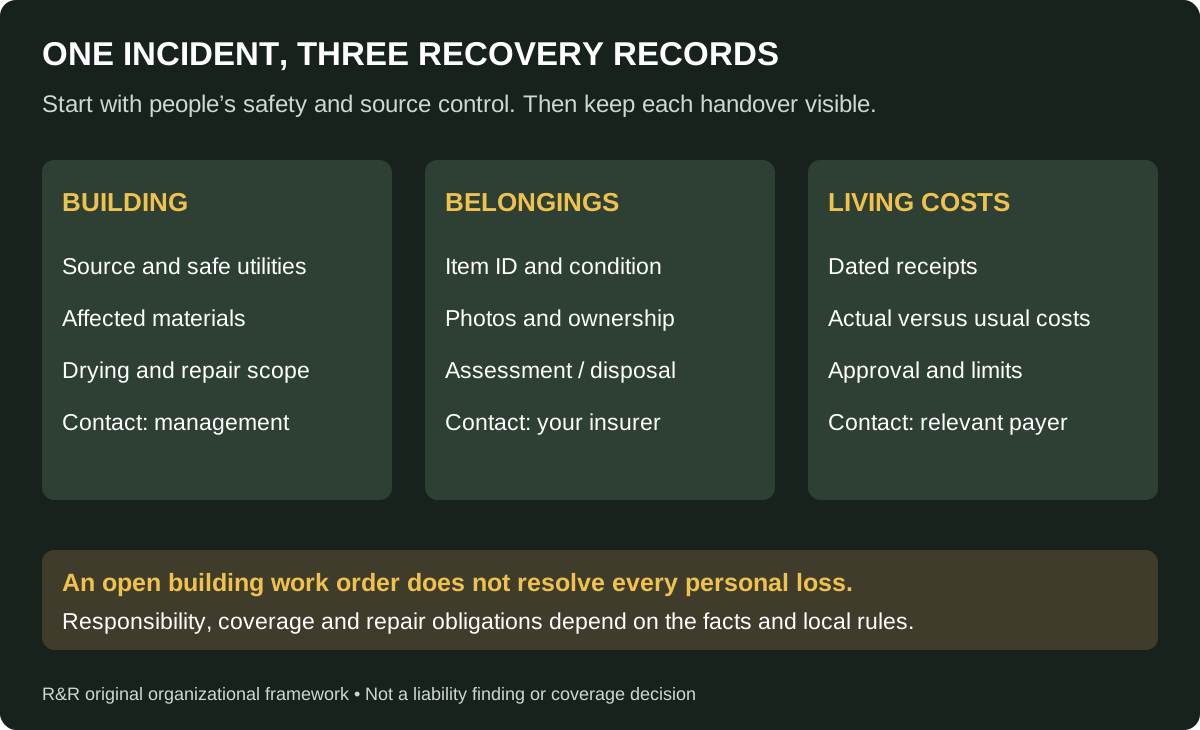
Photograph the damage without turning evidence gathering into a risk
Start only where access is safe. Take a wide view that identifies the room, a closer view of the affected area and identifying views of your damaged belongings when reachable. Record the discovery time separately from any estimated start time. A time stamp tells you when the image was captured; it does not prove when the leak began.
NFIP documentation guidance recommends clear photographs and videos before cleanup, including wide views, details and identifying information such as serial numbers. Keep receipts and follow your insurer’s instructions. Do not retain hazardous items indoors just to preserve evidence; obtain disposal instructions, document what can be documented safely and prioritize health.
Keep original files. Make annotated copies for arrows, room labels and explanations rather than altering the originals. A folder named by date and room is easier to use than dozens of pictures scattered across a messaging app. Back up the files to an account you can access away from the apartment, and share them privately with the relevant people rather than posting addresses, policy numbers or a neighbor’s possessions publicly.
A fictional photo-documentation example
Imagine a renter discovers a living-room ceiling leak at 6:40 p.m. The source and start time are unknown. From the dry doorway, they take a room overview. Later, after safe access is confirmed, they photograph the stain more closely and the wet edge of their own bookcase. These are three connected observations, not three different claims about the cause.
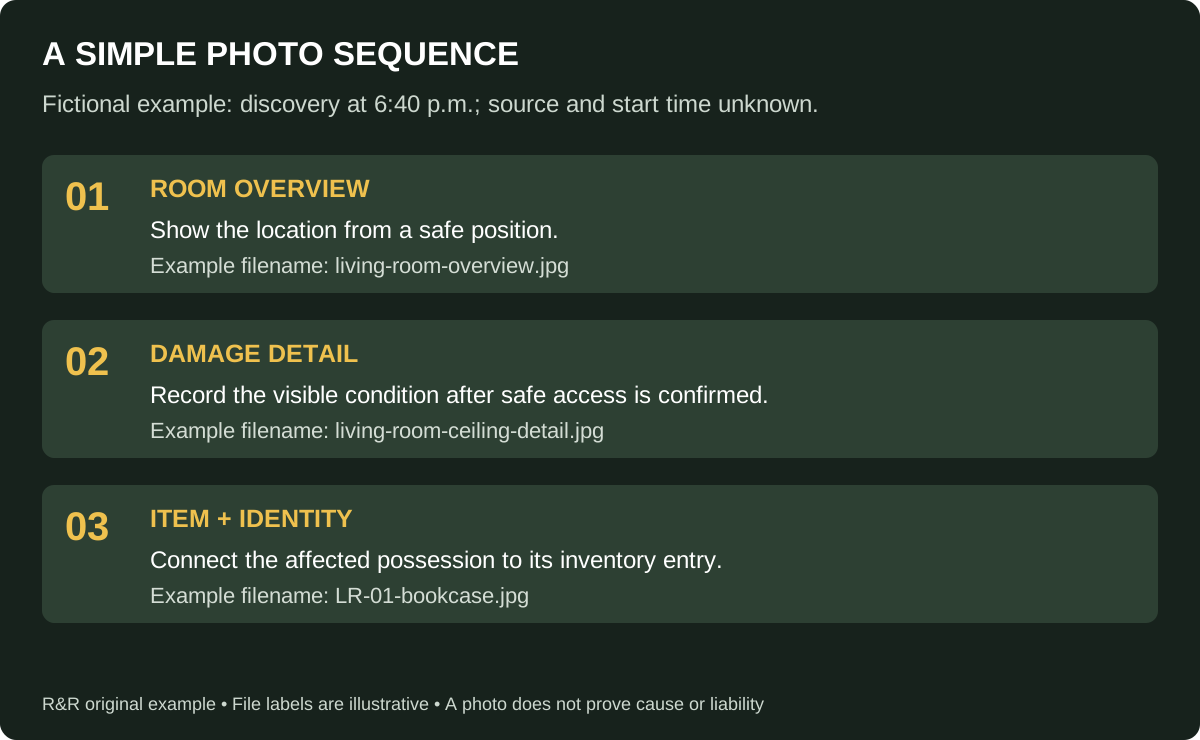
| Example file / time | Observed fact | What it does not establish |
|---|---|---|
| living-room-overview.jpg / 6:40 p.m. | Water visible below ceiling corner from doorway | When the leak began |
| living-room-ceiling-detail.jpg / later, after safe access | Stain and affected surface visible | Concealed moisture or source |
| LR-01-bookcase.jpg / after safe access | Bookcase edge visibly wet; matching item ID | Liability, salvageability or settlement value |
The overview links the damage to a location. The detail records the visible condition. The item view links a particular possession to its inventory entry. If a serial number cannot be reached safely, write “not accessible” and ask what alternative evidence is acceptable. Do not move a wet appliance or stand under damaged plaster to complete a photographic sequence.
Use an item ID across the pictures and inventory: LR-01 for the bookcase, for example. Include its description, approximate age if known, ownership evidence and observed condition. Label an estimated purchase date as estimated. A receipt, order-history screenshot or earlier room photograph may help establish ownership; it does not automatically determine the settlement value.
Download the photo and incident record (CSV)
Send a landlord notice that creates a usable record
A written notice should answer what, where, when, current status and requested response. It should not try to decide every legal issue. Use the reporting method your lease and local requirements specify, and preserve a copy outside the resident portal if possible. The example below is a practical message, not a substitute for a jurisdiction’s formal legal notice.
Example emergency maintenance notice
Subject: Active water entry in [unit] — emergency maintenance requested
I discovered water entering at [location] at [time/date]. It is [still flowing / apparently stopped / unknown]. Visible conditions include [brief factual description]. I have [left the affected room / left the unit / remained in a dry area]. Please confirm receipt, who will attend, the immediate safety instructions and when I should expect an update. Photos taken from safe ground are attached. The source and full damage extent are not yet confirmed. You can reach me at [contact].
Adapt the facts. This example is not a jurisdiction-specific legal notice or a finding of responsibility.
Update the record when conditions change. “Maintenance attended at 8:15 p.m.; dripping stopped at approximately 8:30 p.m.; ceiling assessment pending” is more useful than repeatedly sending “nothing is fixed.” If the source is only reportedly stopped, say who told you. Ask for the next action, responsible contact and expected update time.
Keep emergency notification separate from scheduling routine access. Tell management about access needs, pets and how to contact you if you are temporarily elsewhere. Do not give permission for unrelated work unintentionally, sign an unexplained completion form or confirm that all damage is resolved when you only mean that someone attended. Read the document and ask for a copy.
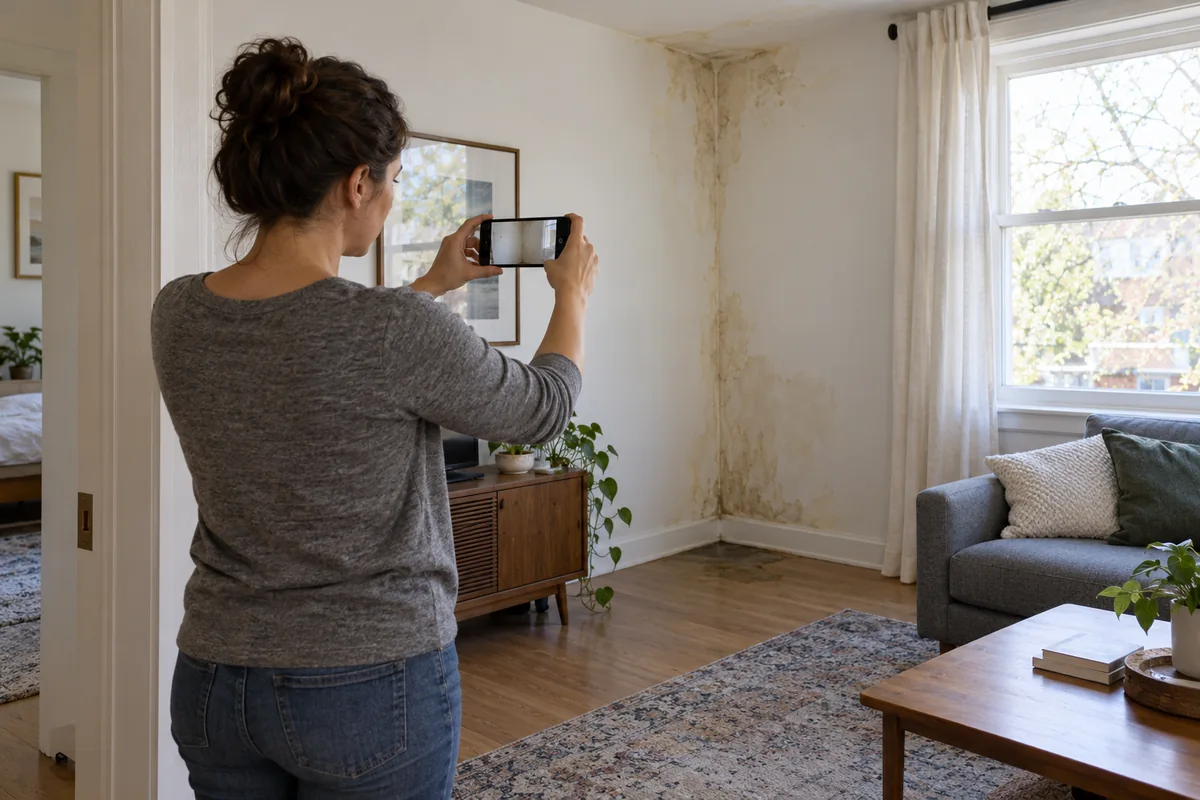
Keep building repairs, belongings and living costs on separate tracks
The building file concerns the source, electrical and structural assessment, damaged finishes, drying and repairs. Your belongings file concerns furniture, clothing, electronics and other possessions you own. Your expense file concerns costs incurred while dealing with the disruption. These files can overlap, but one person saying “a claim is open” does not establish that all three are being handled.
| Track | Ask this question | Keep this evidence |
|---|---|---|
| Building | Who is addressing the source, utilities, materials and repairs? | Work orders, assessment findings, repair scope and updates |
| Belongings | Which policy or responsible party is reviewing my possessions? | Item IDs, original photos, ownership records and instructions |
| Living costs | Which expenses are authorized or potentially covered? | Receipts, usual-cost baseline where required, written responses |
Ask who is authorizing each stage. A restoration contractor working for management may be assessing building materials without assessing your sofa. Your renters insurer may need your personal-property inventory even while the landlord’s insurer handles the structure. A neighbor providing their insurer’s details does not mean that insurer has accepted responsibility for your loss.
Keep the handovers visible. After each visit, record the company, the scope discussed and unresolved questions. If someone says another party is handling an item, ask for the contact and confirmation. This is an organizational safeguard, not a demand that every company share confidential claim records. Your goal is to know what still requires action and who should receive the next document.
What landlord water-damage responsibilities depend on
There is no single U.S. rule that tells every renter exactly when a landlord must finish repairs, pay for a hotel or replace belongings. State and local law, the lease, cause of damage and particular facts matter. USAGov’s tenant-rights page directs renters to their state’s housing or tenant-rights resources and appropriate complaint routes.
Ask management for the building repair plan and the process for assessing whether the unit remains usable. Ask your insurer about your belongings and any relevant living-expense provision. If the response is inadequate, consult local housing or code-enforcement resources and tenant legal aid. Do not assume that a repair deadline, rent deduction or lease-termination rule from another state applies to you.
Before withholding rent, deducting cleanup bills, abandoning the tenancy or signing a release, get advice specific to your jurisdiction. Keep the lease, notices, photographs and response history together for that discussion. USAGov’s legal-aid directory links to programs that handle housing matters; eligibility and available help vary.
For readers outside the United States, retain the practical documentation sequence but use local tenancy rules. GOV.UK’s private-renting repair guidance, for example, describes landlord duties and different routes for complaints and housing standards. It is not a U.S. rule or a universal rule for every Western country. Canadian renters should use their province or territory’s tenancy authority rather than importing another country’s deadlines.
Ask the insurer which kind of water damage is being considered
Report the loss promptly and describe observations accurately. “My apartment flooded” is an everyday description, not a policy classification. Ask which coverage, exclusions, endorsements, deductible and reporting requirements apply to the identified source. If the cause is still under investigation, state that rather than choosing a label you think will secure payment.
The National Association of Insurance Commissioners distinguishes a landlord’s building policy from coverage for a renter’s possessions. Some renters policies include additional living expenses after a covered loss. Settlement may also differ between actual cash value and replacement-cost terms. Your declarations and full policy, not a generic online example, control the claim.
External flooding is a separate coverage question. FloodSmart explains that most standard renters policies exclude flood damage and that renters can obtain contents flood coverage. NFIP coverage does not include temporary housing or additional living expenses. Do not assume that buying a new policy after the event will cover existing damage, or that a neighbor’s insurance automatically fills a gap.
Before disposing of belongings, ask what the adjuster needs and what can be documented remotely. Record any instruction and the person who gave it. Keep safe evidence without delaying necessary health-protective disposal. If coverage is denied or limited, request the written explanation and use the insurer’s review process or state insurance department as appropriate. A claim outcome cannot be predicted from a stain photograph alone.
Track temporary-living expenses without assuming reimbursement
If the unit may be unsafe, ask management or the appropriate authority about occupancy and arrange a safe place to stay. Ask the insurer separately whether additional living expenses apply, what is authorized and what limits or documentation are required. Safety does not wait for a claim decision, but a necessary expense is not automatically a covered expense.
Keep receipts by date and category: accommodation, food, transport, laundry, storage and other actual costs. Record any ordinary cost you would have incurred anyway when the insurer asks for incremental expenses. Do not combine all charges into an unexplained total. The example below shows arithmetic only; it does not establish a coverage rule or a local price benchmark.
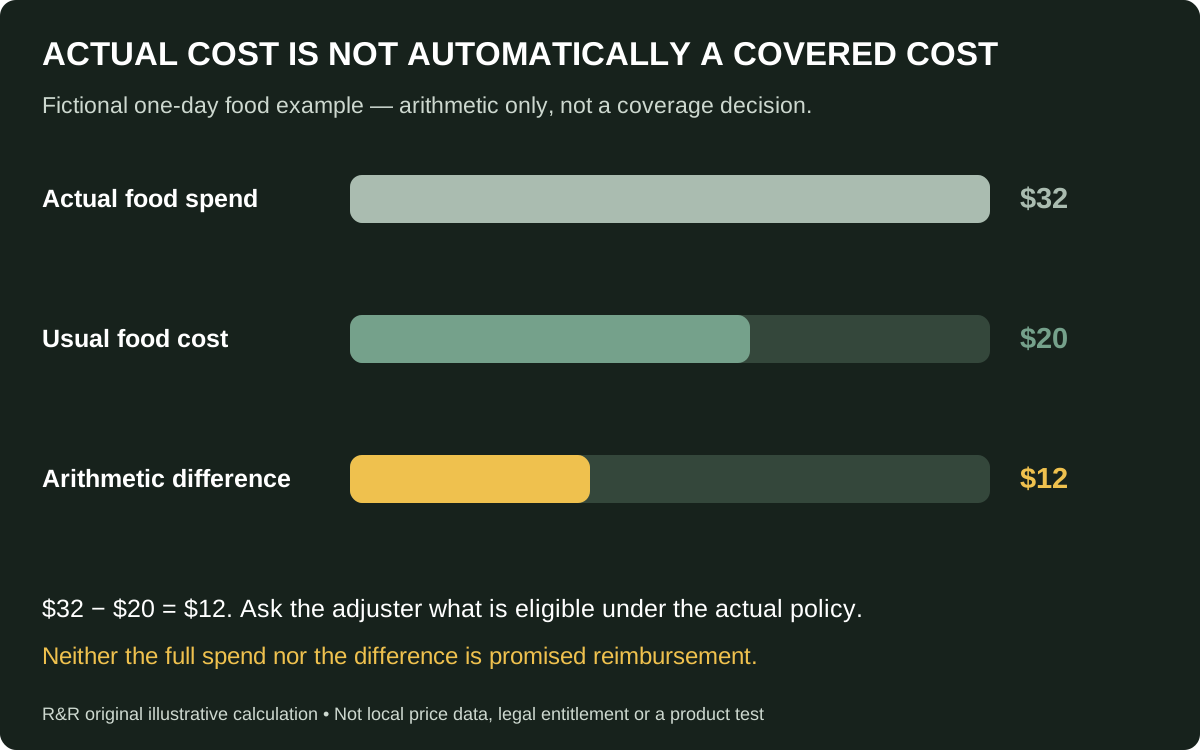
Suppose a fictional household spends $32 on food on one disrupted day and its documented usual food cost for that day is $20. The difference is $12. That calculation can organize a question for an adjuster. It does not prove the $12 is payable, or that the full $32 is payable. Keep the receipt, the baseline explanation and the insurer’s answer together.
Ask before committing to a long hotel stay, storage contract or large cleanup purchase when advance approval is possible. If you must act urgently, record why and keep the evidence. Avoid signing a settlement or accepting a description of costs as “fully resolved” until you understand its effect. Local tenant advice and insurance guidance answer different parts of the same disruption.
Protect belongings only when the room is safe to access
From a safe area, prioritize essential medication, identification, keys, chargers and irreplaceable records you can reach without exposure. Do not carry heavy wet furniture through water, use damaged electronics to see if they still work or open electrical appliances for photographs. Tell management when access to essential items is unsafe and ask how retrieval can be arranged.
Group possessions by location and decision: not affected, wet and awaiting assessment, removed for safety, or sent to a specialist. Avoid mixing damp belongings into clean storage. Document an item’s condition before moving it when safe, then record where it went. The inventory should still work after the room has been rearranged by cleanup crews.
Do not authorize building demolition yourself. Removing flooring, cutting walls or directing drying equipment can affect the landlord’s property, hidden utilities and the recovery plan. Older finishes may also present additional hazards. EPA’s cleanup guidance addresses lead-paint, asbestos-containing flooring and drying considerations. Ask management and qualified responders to define the scope.
Prevent mold by keeping moisture decisions visible
EPA recommends drying water-damaged areas and items within 24–48 hours to help prevent mold growth. Treat that as a prompt-action window, not a guarantee that every material is safe at hour 47 or ruined at hour 49. If you do not know when wetting started, record it as unknown.
Ask what was affected above and behind the visible surfaces, which materials require removal and how retained materials will be assessed. A humidity monitor measures room air, not moisture hidden inside a ceiling. A fan running in the room is evidence that a fan is running, not evidence that the whole assembly is dry. Do not operate HVAC suspected of mold contamination without appropriate assessment.
For contaminated water, extensive damage or unresolved mold concerns, involve qualified professionals rather than treating this as a routine spill. Our mold-after-flood guide covers material decisions, while drying a flooded home explains the handover before rebuilding. If water is coming through a ground-floor slab, use our basement water-source guide to understand the different investigation.
Before you move back into normal use
Ask for a clear update covering source control, safe utilities, affected materials and the remaining repair schedule. Distinguish “the leak stopped” from “the unit has been assessed for occupancy” and “all repairs are complete.” Those statements answer different questions. A fresh coat of paint or the removal of drying equipment cannot explain the entire recovery on its own.
Keep a short unresolved-issues list. Examples might include a ceiling cavity awaiting assessment, a damaged personal item awaiting an adjuster’s instruction or a temporary-living receipt awaiting review. Send each issue to the correct contact. Use dates and references so the next person does not need to reconstruct the incident from an old group message.
Prepare for another interruption without taking responsibility for building systems. Keep emergency contacts and essential records accessible, know the building’s reporting route and store important possessions away from a known unresolved leak. Our apartment power-outage guide and free preparedness resources support that household planning. If a wider storm is involved, our El Niño preparedness checklist adds weather and service-interruption planning.
Common questions after an apartment flood
Who pays if the upstairs apartment floods mine?
The source, cause, policy terms, lease and applicable law matter. Notify management and your insurer, preserve evidence and ask for the professional source finding. Water traveling from above does not by itself establish that the upstairs renter was negligent or that their insurer will pay.
Does my landlord have to pay for a hotel?
That cannot be answered universally. Ask management about applicable relocation arrangements and ask your insurer whether covered additional living expenses apply. Local tenancy rules may affect the position. Keep receipts and get jurisdiction-specific advice rather than relying on another renter’s outcome.
Can I stop paying rent after water damage?
Do not assume you can withhold rent or deduct bills without following local rules. Preserve the notice and repair history and consult a local tenant authority or legal-aid service before changing payments or ending the tenancy.
Should I wait for the adjuster before doing anything?
Report promptly and ask for documentation and mitigation instructions. Photograph what is safe to record, preserve receipts and do not keep hazardous items in the apartment solely for inspection. Immediate safety, source control and necessary health protection should not be postponed to obtain a perfect inventory.
Can I use a dehumidifier and consider the problem fixed?
No. Drying equipment does not establish that the leak is repaired, concealed layers are dry or contaminated materials are safe. Ask for the source-control and material-assessment record. The equipment is one possible part of recovery, not the full answer.
What if the landlord does not respond?
Preserve your emergency call and written notice, update the hazard description and use the appropriate local housing, code-enforcement or tenant-assistance route. Immediate danger belongs with emergency services. USAGov links to state tenant resources; subsidized housing may have additional program-specific complaint channels.
If the flood also disrupts essential services
Follow local drinking-water notices and use our small-apartment emergency water guide for separate clean supplies. If drains cannot be used, our apartment emergency-toilet guide explains planning; do not keep flushing a suspected backup. If electricity is interrupted, check our refrigerator food-safety guide. These are household contingencies, not permission to remain in an unsafe unit.
Research, examples and reusable resources
Prepared by Ready & Resourceful, reviewed October 19, 2026. This source-based renter guide does not inspect a property, decide liability, interpret an individual policy or claim professional legal review. The household photographs are conceptual scenes; the photo filenames, incident entries and expense figures are clearly fictional teaching examples. Product information is manufacturer-based, not hands-on testing.
Key references: EPA renter and re-entry guidance; EPA flooded-home materials and drying; EPA moisture and mold; NFIP damage documentation; NAIC renters coverage; NFIP flood coverage and exclusions; USAGov tenant resources; USAGov legal aid; GOV.UK repairs.
The three original SVG visuals and incident CSV may be reused with attribution to Ready & Resourceful under CC BY 4.0. This permission excludes photographs, manufacturer images and third-party material.