PREPAREDNESS / WINTER WEATHER
Winter Storm Warning Explained and What to Do Before Conditions Worsen
Understand the warning, check the official alert for your location and turn the time available into a practical home, travel and outage plan.
THE SHORT ANSWER
Read the local warning. Resolve the urgent dependency. Reconsider travel.
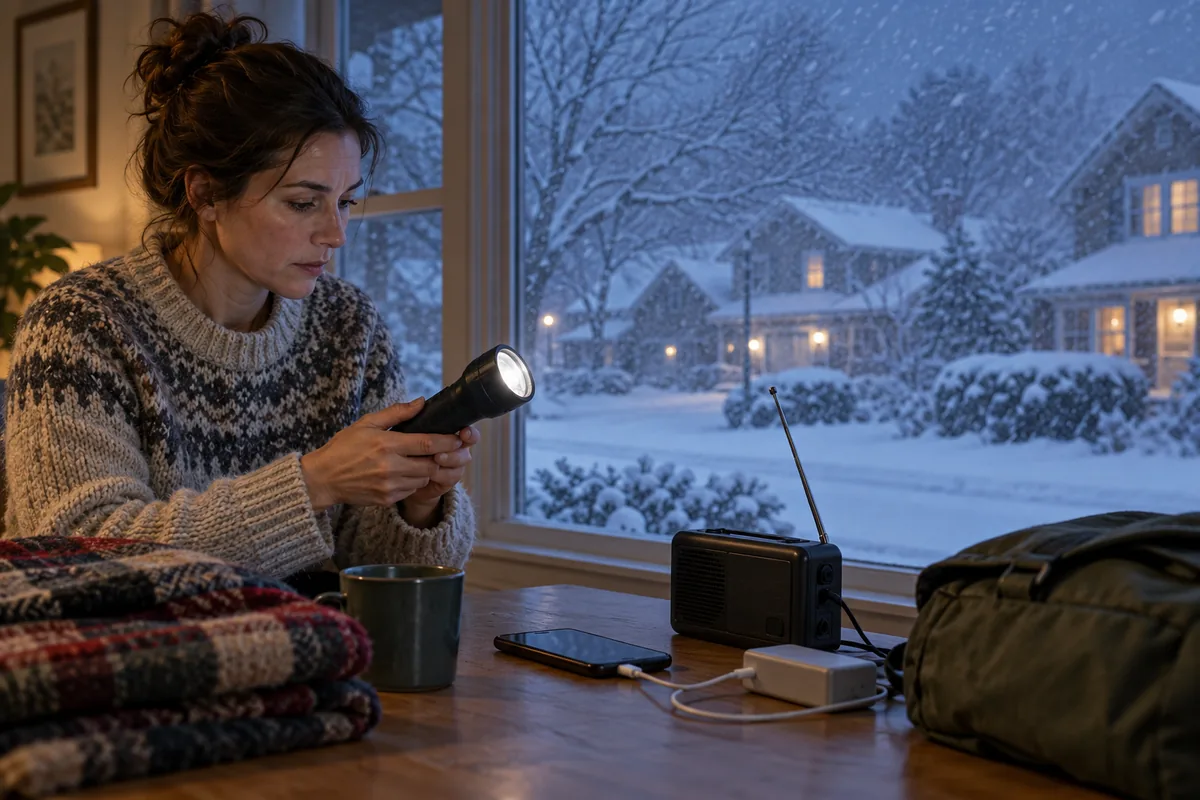
A winter storm warning means significant winter weather is expected or already occurring in the warned area. Read the local alert for the hazards, timing and locations, then finish essential preparations and reconsider travel. It is a signal to act, not a guarantee of a particular snowfall total at every address. National Weather Service warning guidance.
WATCH / AN ORIGINAL R&R EXPLAINER
A warning is your signal to act
Our narrated winter-storm explainer connects the warning to your next household decision. Original animation, an illustrative household scene and synthetic narration—not event footage or a live forecast.
Read the video transcript
A winter storm warning is a signal to act. Significant winter weather is expected or already happening. Your local bulletin explains the hazards and timing.
Check Weather dot gov for your location. Read the affected area, timing and instructions. A screenshot can become outdated, so check for updates.
Before conditions worsen, confirm essential travel, care and medicine arrangements. Charge your devices, gather working lights and agree on a check-in. If heat or essential equipment fails, know your fallback.
Avoid nonessential travel in hazardous conditions. Never run a fuel-burning generator inside a home or garage. Never use an oven or camp stove to heat your home.
Read the complete Ready and Resourceful winter storm guide. Use the five planning checks and official alert links. Prepare for your household, and follow current local instructions.
You do not need to turn a warning into a last-minute shopping expedition. The useful question is what becomes difficult if roads deteriorate or electricity stops working. A household with electric heat has a different weak point from one waiting for a prescription delivery. This guide helps you identify that weak point, assign the next action and use the time that is actually available.
What does a winter storm warning mean?
The warning concerns a significant combination of winter hazards such as snow, ice, sleet or blowing snow. Local National Weather Service offices use local criteria; there is no single national snowfall amount that automatically defines every warning. Read the actual bulletin rather than applying a threshold you remember from another state. A warning can involve difficult or impossible travel. NWS definitions.
For household planning, separate three questions. What is forecast? When could access become difficult? What do we depend on? A snow-depth graphic answers only part of the first. A commute, exposed steps, a caregiver visit and an electrically powered medical device can each change the practical decision.
Do not assume the warning's start time is a safe-until deadline. Your route may include a different forecast area, and preparation itself takes time. Equally, the warning's end does not certify every road or service as restored. This is why the next section starts with reading the alert rather than counting supplies.
Check the official warning for your location
Use Weather.gov to search your city or ZIP code and open the alerts attached to the correct local forecast. You can also use the NWS active alerts page. This article does not display or continuously refresh current warnings. For travel, separately consult your state transportation department's road-condition and closure service.
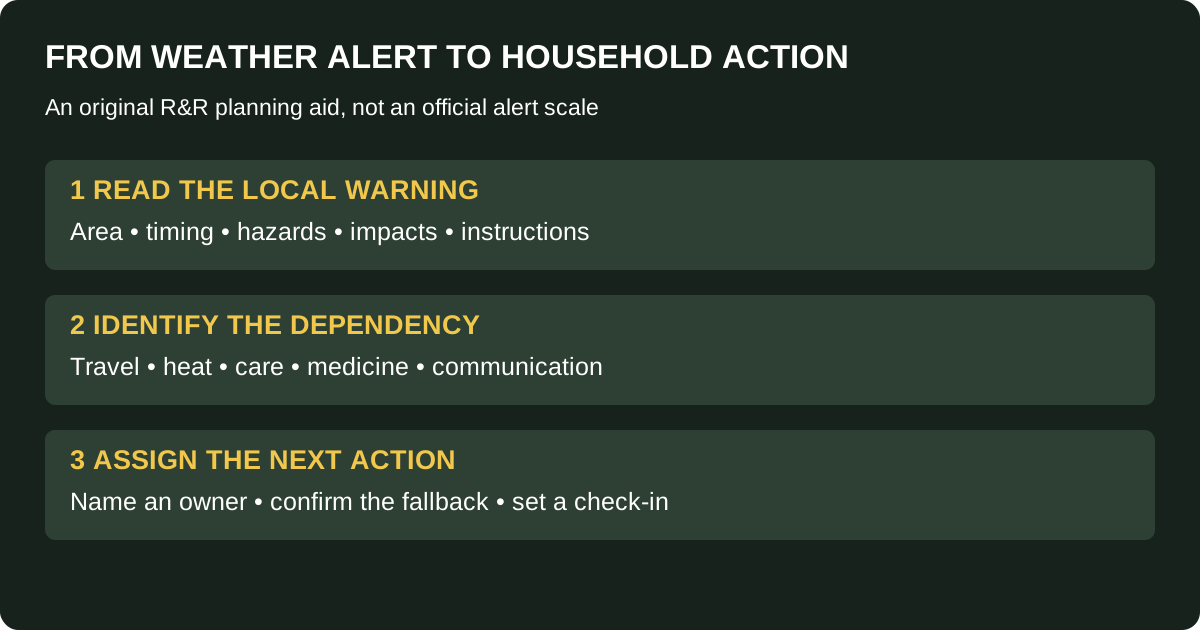
Record five details from the current bulletin: the affected area, expected hazards, start and end times, likely impacts and recommended actions. Look at its issue time before sharing it. If you save a screenshot, retain that timestamp and check for updates later; a saved image is not an updating forecast.
For a trip, check the destination and the route, not just your home. For a caregiver, check where the person receiving care lives. If the forecast location looks wrong, correct it before making plans. A nearby city name is not necessarily a description of conditions on a mountain road or at a different elevation.
Turn an alert into a short household message
Here is a fictional example of the format, not a forecast: “Checked the local warning at 4 p.m. We are cancelling tomorrow's optional drive. Sam will confirm the prescription arrangement, Lee will charge the lights, and we will check the bulletin again before bed.” It identifies a source check, a decision and owners. A forwarded dramatic map alone does none of those jobs.
Winter storm watch vs warning vs advisory
| Alert | What it communicates | Household response |
|---|---|---|
| Winter storm watch | Conditions could develop into a significant winter event | Review plans and dependencies before decisions become urgent |
| Winter storm warning | Significant winter weather is expected or occurring | Act on the local instructions and finish essential arrangements |
| Winter weather advisory | Winter conditions can create difficulties even below warning criteria | Check the actual hazards; do not interpret it as “safe to drive” |
These are not three required stages that every storm must pass through. Follow the alert currently issued for your area. The table summarizes NWS terminology, not local road restrictions or a universal timetable.
A blizzard warning is not simply another name for heavy snowfall. Its criteria involve wind, low visibility and duration. For the household decision, the important distinction is whether blowing snow and visibility make movement dangerous, not which storm has the more impressive snow total.
Prepare according to the time you actually have
The windows below are an R&R planning framework, not NWS warning-issuance rules. Start with the conditions now. If travel is already unsafe, skip errands and focus on shelter, information and help. An official evacuation or emergency instruction takes precedence over completing this sequence.
Resolve dependencies
Confirm care, medicine, essential travel and a backup destination.
Finish and hand off
Charge, gather reachable essentials and assign check-ins.
Manage conditions
Avoid optional travel, monitor updates and seek help for changing needs.
If conditions are still suitable for essential arrangements
Begin with the tasks that depend on somebody else. Confirm a medication question with the pharmacist, an equipment plan with the care team, or an alternate place to stay with the actual host. A phone number written down is not the same as a confirmed arrangement. Ask how the person will be reached if an ordinary call fails.
Next, decide whether any planned journey can be moved or cancelled. Check transport, school and work communications instead of assuming everyone will follow the same schedule. If a necessary movement can be completed safely earlier, make that decision using the route forecast and local instructions, not the desire to squeeze in one more errand.
The NWS pre-storm guide identifies heat, power, communication and supplies as key concerns. Check familiar food that needs no cooking or refrigeration, safe water, lights, batteries and essential medicines. Our no-cook emergency food guide helps turn supplies into usable meals rather than an assortment of packages.
If only a short preparation window remains
Stop expanding the plan. Assign one person to information and contacts, one to reachable supplies, and one to personal needs if enough adults are available. In a one-person household, do these in order rather than trying to complete several unfinished tasks at once.
Charge the devices you already use and pair each with its correct cable. Place a light where you will first need it, not at the bottom of a storage box. Put warm layers, shoes and essential records in an accessible location. Use our bug out bag checklist if you need a portable inventory, but do not delay a necessary departure to finish packing it.
Complete a handoff: who needs a check-in, when will it happen, and what happens if there is no reply? Agree this while communication is straightforward. “We will keep in touch” leaves those details unresolved.
If hazardous conditions have begun
Shift from preparation to managing the situation. Avoid nonessential travel, monitor official updates and keep the household's essential items accessible. A missing optional gadget is not a good reason to go out. Use the NWS during-storm guidance for the circumstances you face.
Review the plan when something meaningful changes: heat fails, a person's condition changes, an authority gives new instructions, or the expected help is no longer available. A new condition may require assistance rather than another round of equipment adjustments.
Match each forecast hazard to a household decision
| Forecast concern | Question to answer | Practical planning action |
|---|---|---|
| Snow and difficult access | Who depends on a delivery, pickup or visit? | Confirm alternatives and record the person responsible |
| Ice and possible outages | Which essential tasks require electricity? | List the critical device, its actual backup arrangement and a fallback destination |
| Wind and blowing snow | Could the route become unusable? | Reassess optional travel; check official road and weather updates |
| Cold with loss of heat | Who needs earlier assistance or a warmer setting? | Confirm a suitable destination and safe transport before it becomes urgent |
This is a dependency table, not a forecast of what will fail. Fill in the household-specific answer rather than assuming every warning will cut power or close every road. For example, a charged phone does not solve a building-access problem, and a full pantry does not resolve a medical-device power requirement.
A worked example without a shopping list
Consider a fictional apartment household with electric heat, one adult returning from work and a parent who normally receives a morning check-in. The first unresolved task is not buying a radio. It is confirming the adult's travel decision and the parent's support arrangement. The next is identifying what happens if heat is lost.
Write three lines: “travel decision and owner,” “parent contact and backup,” and “warmer destination and transport.” Only then inspect supplies against those arrangements. If the host cannot accommodate the household, or transport is unavailable, the gap remains open even if the flashlight batteries are new. The example illustrates a planning method; it does not prescribe a safe departure time for an actual warning.
Plan for a power outage without creating an indoor hazard
An outage plan should separate warmth, lighting, food and medical equipment. A single large battery is not automatically a solution for all four. Check actual equipment requirements and manufacturer instructions. For essential medical devices, agree a plan with the provider or care team before relying on a consumer backup product.
The CDC's winter safety guidance warns against using a cooking stove for heat and calls for careful heater use. Keep combustible materials at least three feet from space heaters and follow the equipment instructions. Use our staying warm during a power outage guide for a household warmth plan rather than improvising indoor combustion.
Never operate a fuel-burning generator inside a home or garage, even with doors open. CDC directs users to operate generators outdoors, more than 20 feet from windows, doors and vents, with battery-powered or battery-backup carbon monoxide detection inside. Charcoal grills and portable gas camp stoves do not belong indoors. CDC carbon monoxide guidance.
If a CO alarm sounds, get everyone outside to fresh air and call 911. Do not remain indoors to find the cause. Headache, dizziness, weakness or confusion can also signal a serious problem. Do not treat a warning article or a product purchase as a substitute for emergency help.
For food, keep a record of when power was lost and follow the fridge and freezer food-safety guide. For communication, our emergency radio comparison explains the difference between listening to broadcasts and receiving automatic alerts. Test the arrangement before relying on it.
Should you drive during a winter storm warning?
Postpone nonessential journeys when hazardous winter conditions threaten the route. A warning is not a uniform legal driving ban, but an open road is not proof that the journey is sensible. Check current transportation restrictions and the local bulletin. NHTSA advises considering a different departure time to avoid the worst conditions. NHTSA winter driving guidance.
Make the decision about the entire trip: departure, destination and return. Ask whether the destination will be open, whether parking and access are usable, and whether the return would occur after conditions worsen. A short outward drive can become a much longer problem if the return plan is ignored.
If essential travel remains necessary, follow local instructions, check the vehicle and tell a contact your route and expected arrival. Keep the phone charged and carry appropriate emergency supplies. Our winter emergency car kit guide supports that preparation; equipment does not make a closed road or poor visibility safe.
If you become stranded, contact emergency assistance and provide your location as accurately as you can. NWS recommends staying with the vehicle and waiting for help rather than wandering into a storm. Follow responder instructions. A roadside situation needs current location-specific decisions, not a generic promise that a particular vehicle or tire can get through.
Renters, caregivers and pets need explicit arrangements
For an apartment, ask management how heating, entry systems and common-area communication work during an outage. Keep the emergency maintenance number offline. Do not put equipment in shared corridors or block exits. Our apartment power outage checklist covers building-dependent tasks separately from the items inside your unit.
For someone receiving care, record who will check in and what support is actually agreed. A neighbour's proximity is not consent or an availability guarantee. Confirm backup arrangements with the people involved. Where medicines need special storage or powered equipment is essential, get condition-specific guidance rather than substituting household food or battery advice.
For pets, confirm that a backup destination accepts them and that transport is workable. Put food, medicines, restraints or carriers where they can be retrieved together. Keep these tasks connected to the departure plan rather than treating pet supplies as a separate shopping category.
CDC identifies confusion, slurred speech, fumbling and drowsiness among possible hypothermia signs. Seek immediate medical attention if hypothermia is suspected. Do not assume being indoors rules it out. CDC hypothermia guidance.
After the warning ends, check what is actually restored
The bulletin ending is not an all-clear for every task. NWS notes that ice, blocked roads, downed lines and snowmelt flooding can remain after a storm. Keep checking transportation and utility updates, and stay away from damaged infrastructure. NWS after-storm guidance.
For your own record, separate “forecast improved,” “route confirmed,” “power restored” and “household needs checked.” Do not replace all four with one message saying the storm is over. A caregiver may still be unable to arrive; food may still need assessment; a building fault may remain unresolved.
Finish with a small review. Which contact was missing? Which item could not be found? Which backup depended on somebody who was unavailable? Fix one named failure while it is easy to remember. That creates a more useful plan than buying another box of supplies without changing the underlying arrangement.
MAKE THE PLAN USABLE
Five checks before conditions worsen
Use this as a handoff, not a readiness score. A checked box records your review; it does not certify safety. Checkmarks stay only on this open page.
0 of 5 planning checks reviewed.
Local alert checked at ____________________
Next check-in ____________________
Contact / fallback ____________________
Questions people ask about winter storm warnings
Does a winter storm warning mean school is cancelled?
Not by itself. Check the school district's own notification channel and transport arrangements. Weather alerts and closure decisions are different information products. Save the relevant contact before the household needs it.
How much snow triggers a winter storm warning?
There is no universal national snowfall threshold. Local criteria and combinations of hazards matter. Read your local warning's expected conditions rather than relying on a number from a different region.
What should I do first when a winter storm warning is issued?
Confirm the affected area and timing, then identify the household's most time-sensitive dependency. That might be travel, care, medicine or a place to stay if heat is lost. Assign the action and a fallback before optional supply shopping.
Is an advisory safe to ignore?
No. Conditions below warning criteria can still disrupt travel and daily tasks. Read the hazards and local instructions; an alert label is not a personal safety guarantee.
Can I use this page to find a winter storm warning near me?
Use the official Weather.gov location search or active-alert links at the top. This is an evergreen preparation guide, not a live warning map or an automated notification service.
Sources and how this guide was prepared
Research method and primary references
Ready & Resourceful checked the linked NWS, CDC, NHTSA and American Red Cross guidance on October 26, 2026. The time windows, household handoff example and dependency tables are original editorial planning aids, not official alert criteria or results of a field trial. No meteorologist, medical professional or emergency manager has reviewed this article on our behalf. Current local instructions take precedence.
- NWS winter watches, warnings and advisories
- NWS active alerts
- NWS preparation before a winter storm
- NWS actions during a winter storm
- NWS hazards after a winter storm
- CDC winter-storm safety
- CDC carbon monoxide prevention
- CDC hypothermia guidance
- NHTSA winter driving
- American Red Cross winter-storm preparation
Choosing whether to postpone? Compare winter storm watches, warnings and advisories with household and travel examples.