
PREPAREDNESS / COMMUNITY RESILIENCE
How to Build a Neighborhood Emergency Plan Without Making It Complicated
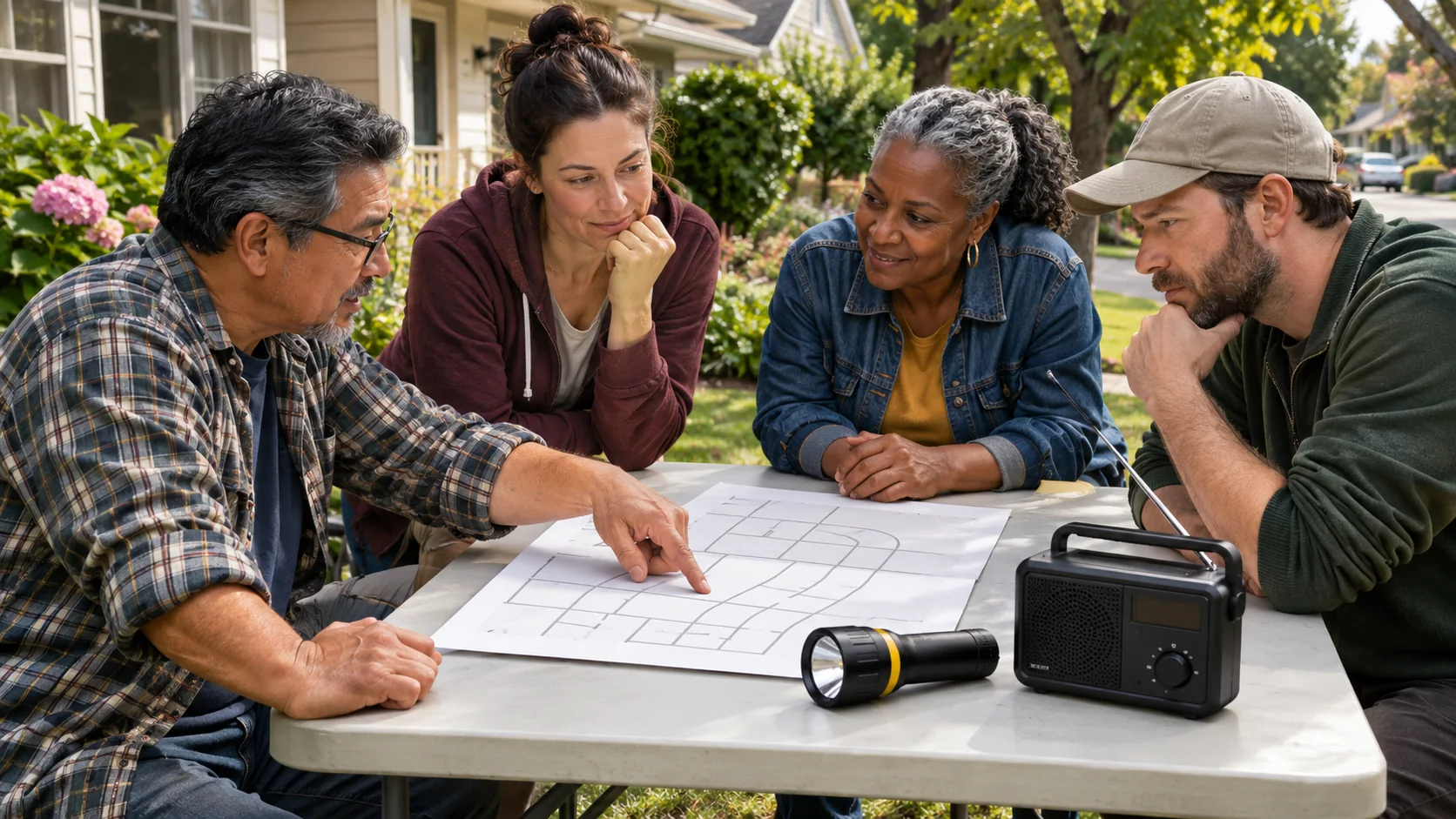
Start with the people you can actually reach
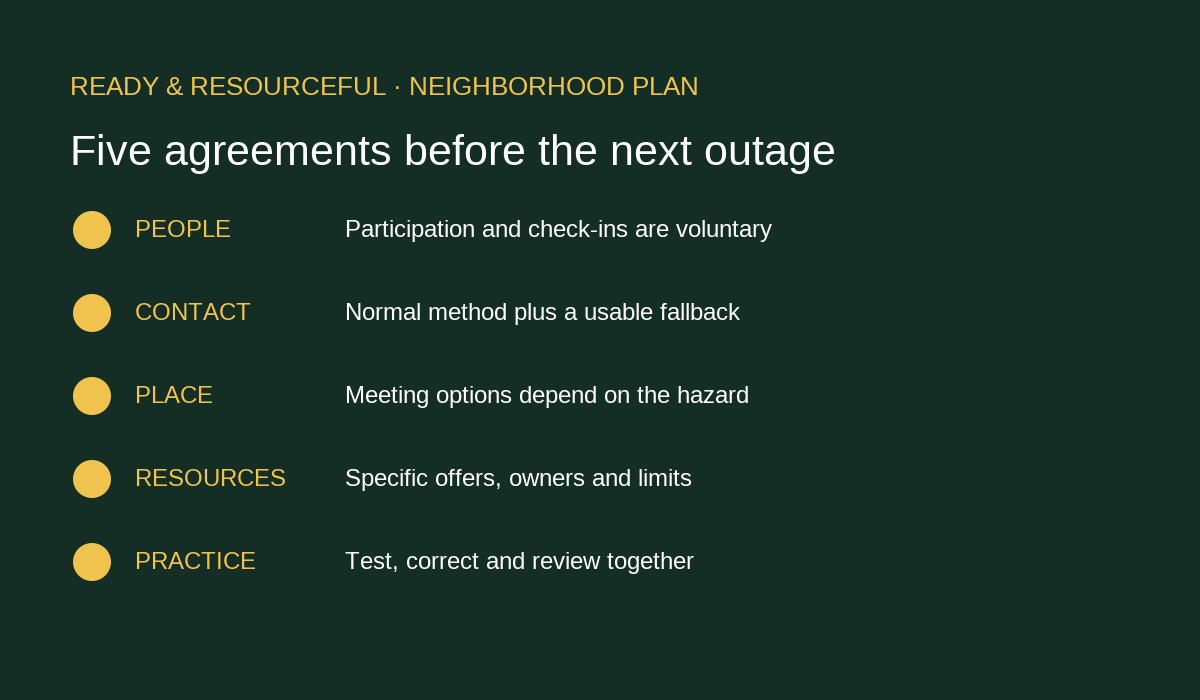
A neighborhood emergency plan needs five things: willing households, a way to check in, a backup when phones fail, safe meeting options, and a short list of responsibilities. Start with a manageable cluster of homes or one apartment floor. Write down who agreed to do what. Then practice the plan before relying on it.
The prepper advantage is less dramatic than a garage full of equipment: you know which problems you can handle at home, who might welcome a check-in, and when it is time to leave. Supplies buy time. Clear arrangements stop that time being wasted.
Picture the first evening of a long blackout. One household has a charged phone but no signal. Another can receive updates but has not written down a neighbor’s number. Someone offers a generator, but nobody has checked whether it can be operated safely at the intended location. Those are coordination problems. Buying another gadget does not automatically solve them.
This guide is a source-linked planning resource, not an account of an R&R emergency deployment. The block example below is hypothetical. The original worksheets and decision framework are designed to help you organize a real conversation without inventing medical needs, assigning duties to unwilling neighbors or treating volunteers as professional responders.
1. Pick a group small enough to know
Do not begin by promising to organize an entire subdivision. Begin where introductions and follow-up are realistic: a short street, several nearby homes, an apartment floor or an existing residents’ group. Geography matters more than a tidy household count. A busy road, locked access gate or flight of stairs can make two apparently neighboring homes difficult to reach during disruption.
Invite people to a short conversation about an ordinary shared problem: power cuts, storm preparation or keeping in touch. Let each household choose whether to join. A group that respects a polite refusal will be easier to trust than one asking immediately for an inventory of everyone’s supplies.
Explain the benefit plainly: “Could we agree how to check in after an outage, and what to do if phones are unavailable?” That is a smaller and more useful commitment than asking someone to join a survival organization. You can build the arrangement gradually.
Keep household readiness underneath the group plan
A neighbor’s reserve is not your household’s guaranteed reserve. Keep your own drinking water, food, lighting, medication arrangements and essential contacts. Community help is an additional layer. It is especially valuable for information, agreed assistance and noticing a problem early, but its availability can change when volunteers are away or dealing with their own emergency.
Use our 72-hour preparedness explainer for context and the free supply checklist to review your household. Three days is a planning starting point, not a promise that services will return on schedule. Follow local guidance and account for your own needs.
Open the printable neighborhood plan worksheet
2. Give the first meeting a concrete finish line
A preparedness meeting can disappear into stories, gear recommendations and arguments about which disaster is most likely. Give it one deliverable: a first version of the check-in plan. Leave with named volunteers, a backup communication method and a review date. Unresolved questions should be recorded rather than settled by the loudest guess.
| Time | Task | Write down |
|---|---|---|
| First 10 minutes | Introduce households and identify relevant local hazards | Group boundary and official information sources |
| Next 10 minutes | Agree voluntary check-ins | Preferred method, coordinator and backup |
| Next 10 minutes | Discuss communications failure and meeting options | Backup method and conditions that make a location unsuitable |
| Next 10 minutes | Identify offered skills and practical gaps | Specific offers, permission and limitations |
| Final 5 minutes | Schedule a small practice | Date, owner and unresolved actions |
The timing is our suggested format, not an official requirement. Shorten it if that makes participation possible. Offer a paper summary for neighbors who cannot attend or do not use messaging apps.
Ask about support, not diagnoses
Ask “Would a check-in help, and how would you like us to contact you?” rather than “What medical conditions do you have?” Someone may want a large-print update, help understanding an alert, or a prearranged call to a trusted contact. Let them describe the arrangement. Do not assume needs from age, appearance or disability.
Keep private household details private. Your shared list normally needs only the information participants agreed was necessary. Avoid collecting passwords, financial information, medication lists or detailed medical records. Agree who can see the list, how it will be stored, and how someone can remove their information. Do not publish it in an open social group.
3. Build a communication plan with more than one path
Choose a normal method that people already use, such as a text tree or small consent-based group chat. Name a backup coordinator so the plan does not depend on one person being available. Put essential agreed contacts on paper. A useful contact list remains usable when a phone battery dies.
Then ask what happens if that method fails. An app, a cellular call and a message sent through the same mobile network may share important dependencies. Three apps on one dead phone are not three independent backups. A radio needs power, compatible equipment and people who know when to listen. A meeting point only helps if it is safe and reachable.
| Method | Useful role | Failure to plan around |
|---|---|---|
| Text tree or group chat | Quick voluntary status updates | Battery, network access, missing members and rumor forwarding |
| Printed contact sheet | Accessible numbers and agreed instructions | Outdated copies or uncontrolled sharing |
| Compatible two-way radios | Local coordination under an agreed procedure | Coverage, licensing, charged batteries and missed listening periods |
| Safe meeting option | Fallback when remote contact fails | Hazard exposure, access barriers or an evacuation order |
For a deeper household plan, read how to communicate when cell towers are down. Before buying group radios, check the rules for your country and the exact equipment. Do not assume U.S. radio services or permissions apply in Canada, the U.K. or Europe.
Write a radio procedure before buying more handsets
If the group chooses lawful compatible radios, write down the service and exact equipment, agreed channel settings, who holds each radio, and how to identify the speaker without disclosing private details. Agree listening expectations and the fallback when no reply arrives. A radio left switched off until someone happens to think of it is not a check-in system.
Practice from the actual intended locations with the people who will use them. Record where communication worked and where it failed; do not extrapolate a packaging range claim across different buildings or terrain. Keep a paper quick-start instruction with the equipment and establish who recharges or replaces batteries. A successful practice is evidence about that practice, not a promise that the same path will always be available. Radios coordinate the group; they do not replace official alerts or automatically connect to emergency services.
Use messages that tell someone what to do
“Everything is crazy” is hard to act on. “We are safe at home; no assistance requested; next check-in at the agreed time” closes a loop. If you need assistance, say what is needed, where and how urgent it is. Do not put sensitive details into a channel with a wider audience than necessary.
For a claimed alert, preserve the issuing organization, location, time and instruction. Link to the original when possible. A forwarded screenshot without its date can make yesterday’s closure look current. The group should amplify official directions, not vote on whether to obey an evacuation order.
4. Choose meeting options around hazards
Choose a primary and alternate location, but do not call either one universally safe. The useful location depends on the emergency. A park that works after a neighborhood power cut may be unsuitable in wildfire smoke, extreme heat, flooding or near downed lines. Write down what would rule it out.
Consider access, lighting, toilets, children, service animals and anyone using mobility equipment. Check permission to use the space. A private driveway is not automatically a public assembly point, and a locked community center is not an operational shelter just because it appears on a map.
Meeting is optional when travel is unsafe. A plan should explicitly say that people follow official instructions and do not delay evacuation to report to the neighborhood coordinator. If you are told to leave, take your household plan and go. The group must be able to function with incomplete information.
5. Share capabilities without creating a single point of failure
List specific voluntary offers rather than vague labels. “Can translate an official message by phone when available” is more useful than “good with languages.” “Has first-aid training and will identify its limits” is more useful than assigning someone the role of neighborhood medic. Training, willingness and availability are different questions.
Keep personal essentials distributed. Shared equipment may make sense when ownership, access and maintenance are clear: a meeting clipboard, a covered information board, or spare charging leads. A group purchase is not useful if it is locked in the home of someone who is usually away.
| Keep in each household | Potential shared layer | Agreement needed |
|---|---|---|
| Water, usable food, lighting and personal care needs | Voluntary additional supplies | No guaranteed allocation without explicit arrangements |
| Essential contacts and household instructions | Limited-access check-in list | Consent, access and disposal of old copies |
| Personal charging capability | Agreed charging support when available | Compatibility, safe operation and priority limits |
| Individual evacuation arrangements | Voluntary transport assistance | Capacity, access, pets and a fallback if the driver is absent |
Start with the gap rather than the shopping category. Our power-bank guide can help with personal charging decisions. Router backup compatibility matters if a household intends to keep network equipment running, but powered equipment does not guarantee the internet provider is operating.
Do not turn a generator into an informal indoor power station
Generator sharing requires a separate safety and compatibility plan. Never improvise a connection to a building’s wiring or operate fuel-burning equipment indoors or in a garage, even with doors and windows open. Follow manufacturer instructions and current local safety guidance; use qualified help for installation work. If no safe arrangement exists, record that limitation instead of promising electricity to the block.
The same rule applies to food and water. Shared meals need safe storage and handling. Water that looks clear is not established as drinkable. Decide whose official instructions the group follows, and avoid distributing treatments or medical advice beyond anyone’s training.
6. Work through a realistic outage before it happens
Here is a hypothetical six-household exercise. It is not a report from a real neighborhood, and its timings are exercise choices rather than recommended response deadlines.
At the beginning of the exercise, the power is unavailable, cellular data is intermittent and one volunteer is away. Four households reply to the agreed text check-in. One has already said it will be away for the weekend. The sixth does not reply. That missing response is a question to resolve under the agreed procedure, not evidence that someone is injured.
The backup coordinator checks the plan. The sixth household requested a phone call first and a doorstep check only if the approach is safe. In the scenario, a fallen branch makes that approach unsafe. The volunteer records that contact remains unconfirmed and follows the prearranged escalation route. Nobody enters a damaged building or takes an avoidable risk to complete the exercise scorecard.
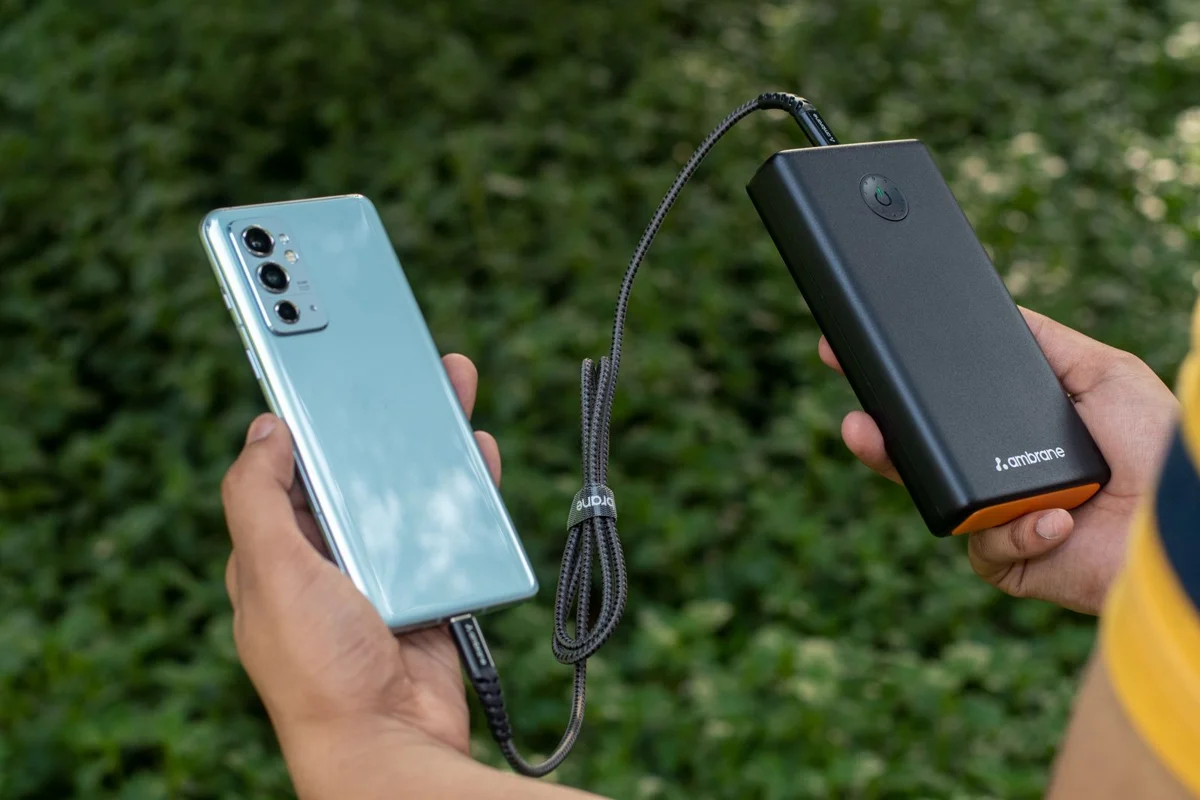
Meanwhile, one household asks to charge a phone. Another can offer a compatible power bank, but only after keeping enough reserve for its own necessary communications. The arrangement works because the offer and its limit were discussed beforehand. It does not depend on an assumption that one prepared household must supply everyone indefinitely.
What the example reveals
Count the actual gaps: an absent coordinator, an unsafe route, a missing reply and a limited charging reserve. Each calls for a different decision. A larger supply pile would not fix the unsafe approach. A better group chat would not remove the need for a backup volunteer. The point of the exercise is to find these dependencies while the consequences are small.
7. Know where voluntary help stops
Discuss limits before an incident. People can decline a task, leave to protect their own household, or say that they do not have the training. Avoid plans that require force, confrontation, unauthorized entry or handling damaged utilities. Useful mutual aid depends on trust and competence, not a claim of authority.
If neighbors want structured response training, investigate your local CERT pathway in the United States or relevant local equivalent elsewhere. Introductory online learning is not the same as completing hands-on training.
8. Run a small drill and fix the weakest link
Announce a short exercise in advance. Test the check-in method and one fallback. Keep the drill modest: no surprise emergencies, alarm imitation or unannounced visits. Ask participants what they could actually do, including anyone who could not attend.
Review three questions: Did the message reach the intended people? Did everyone understand the next action? Could the plan work without its usual coordinator? Record a few assigned corrections rather than producing a long report nobody opens. A corrected phone number is a meaningful result.
Choose a review date and revisit the plan when residents, contact preferences, access arrangements or local hazards change. At least an annual review is a reasonable starting point drawn from municipal guidance. Seasonal check-ins may be useful where storms, wildfire or extreme temperatures change the practical situation.
Your first-week action list
- Invite nearby households to a voluntary planning conversation.
- Identify official local alerts and emergency-management information.
- Agree check-in permission, method, coordinator and backup.
- Choose conditional meeting options and a communications fallback.
- Write down specific offers and limits without exposing private inventories.
- Keep the printed plan securely and arrange a small announced practice.
Adapt the plan to apartments, suburbs or rural roads
The same contact sheet will not solve every neighborhood’s problems. Start with how people enter and leave, which services they share, and what would prevent a willing neighbor from reaching them. A plan drawn for detached homes can miss the most important dependencies in an apartment building.
Apartment buildings: access and building systems come first
In an apartment, the first useful conversation may be with management about the existing emergency procedures. Ask how residents receive notices, what happens when access control loses power, and where official building instructions are available. Do not assume your voluntary group can operate lifts, unlock service areas or override a building evacuation procedure.
Work out whether the agreed check-in method reaches people on different floors. A person may receive a message but be unable to use the normal route downstairs. Anyone who needs an evacuation arrangement should discuss it with the appropriate building and emergency-planning professionals before an incident; a neighbor’s promise to carry someone is not an adequate substitute.
Keep corridors, stairs, fire doors and exits clear. A shared supply shelf that obstructs an escape route is a new problem, not preparedness. Store household reserves inside suitable private space and ask permission before placing anything in a common area. For household-specific preparation, use our apartment power-outage checklist.
Suburban blocks: distance can be deceptive
A street may look compact while its safe walking route is much longer. Think about fences, busy intersections, drainage channels, dogs, gates and poor lighting. A meeting point across a flooded road is unavailable even if it is only a few houses away. Walk the ordinary routes in daylight before deciding they are practical.
Make the group boundary obvious. Use street names or a simple sketch that participants understand. Avoid an elaborate map containing every resident’s personal details. If several small groups coordinate, identify the contact between them without creating a public directory of everybody on the block.
Ask what happens when the usual volunteer is commuting, traveling or collecting children. A workable plan covers ordinary absence. It should not quietly assume every resident will be home when the power fails.
Rural areas: water, transport and longer travel matter
On rural roads, a “quick check” may involve driving several miles, passing a bridge or opening livestock gates. Agree which checks can happen remotely and which journeys should be avoided when conditions deteriorate. A volunteer should never become the missing person because the plan encouraged travel through an unsafe area.
Identify dependencies rather than prescribing one solution. A private well may depend on electricity. A road closure may separate a household from its usual fuel station or pharmacy. An electric gate may change access. Ask owners what their actual systems require, who can service them and what alternative arrangements are realistic.
Do not treat a nearby stream as a ready drinking-water supply or assume a generator can run a well pump. Water quality, pump startup demand, wiring and safe installation require their own checks. Our flooded-well safety guide covers a different situation from an ordinary power interruption; keep those problems distinct.
Put numbers against the supplies your households actually need
“We have plenty” is not a useful inventory entry. A plan becomes clearer when you can name the people, planning period and usable supply. Keep detailed inventories private if households prefer; the group can record an unresolved need without publishing everything someone owns.
Water: count people first, then account for extra needs
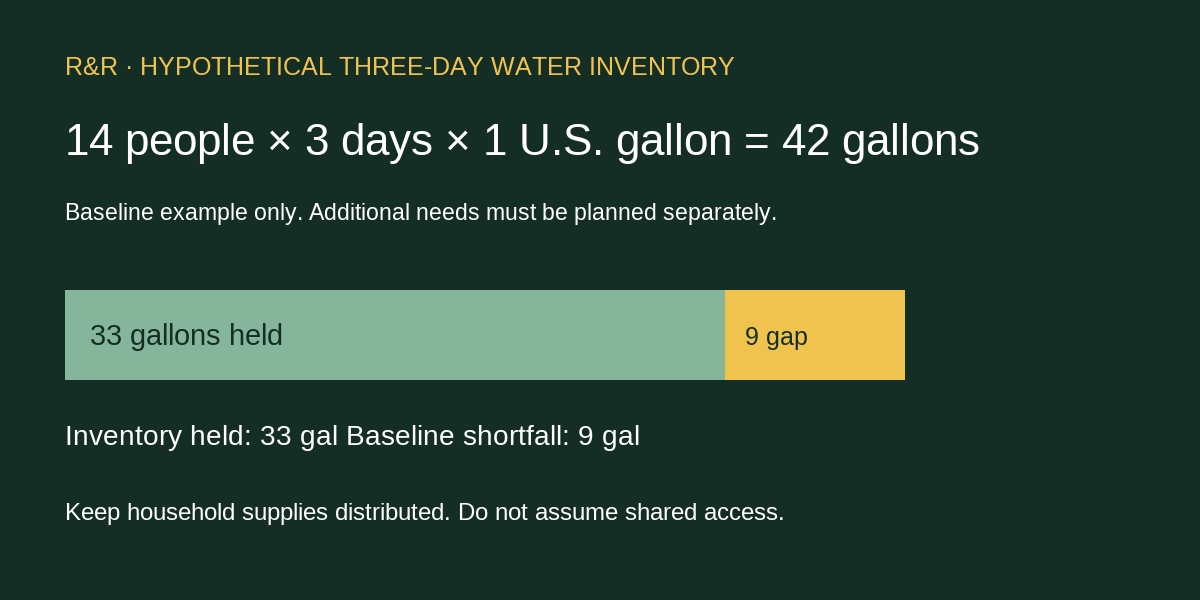
CDC’s emergency-water guidance recommends storing at least one U.S. gallon per person per day for three days, and considering additional needs. Use that as a U.S. household starting point rather than a universal ceiling. Climate, health, pregnancy, pets and other circumstances can change requirements. Local instructions may differ.
Consider a hypothetical group of six households with 14 people in total. The baseline calculation is 14 × 3 × 1 = 42 U.S. gallons, approximately 159 liters. That figure excludes any extra allowance you identify. It also does not mean all the water belongs in one house.
| Household | People | Baseline gallons | Usable gallons already held | Baseline gap |
|---|---|---|---|---|
| A | 2 | 6 | 6 | 0 |
| B | 4 | 12 | 8 | 4 |
| C | 1 | 3 | 3 | 0 |
| D | 3 | 9 | 6 | 3 |
| E | 2 | 6 | 6 | 0 |
| F | 2 | 6 | 4 | 2 |
| Total | 14 | 42 | 33 | 9 |
Food: plan usable meals, not an impressive can count
For the same fictional 14-person group, three meals per person per day for three days means 126 meal occasions. This is a scheduling calculation, not a calorie prescription. Children, adults, dietary needs and portion sizes differ. A can is not automatically a complete meal, and a food that requires water or cooking has dependencies that must be counted.
Build menus at household level. Record whether each meal needs opening, heating, refrigeration after opening, utensils or extra drinking water. A useful meal is one the intended person can and will eat. Food allergies and special dietary arrangements should stay with the appropriate household rather than being guessed by a group coordinator.
For a worked shopping exercise, suppose one household prices 18 suitable meal portions at an illustrative average of $2.50 per portion. That gives $45 before snacks, drinks, equipment or delivery. These are invented planning prices, not current supermarket quotations. Replace them with actual local prices and the portions your household needs. Our no-cook emergency-food guide helps turn the inventory into meals.
Do not solve a blackout by inviting everyone to eat warming refrigerated food. FoodSafety.gov explains the time and temperature limits and warns against tasting food to decide whether it is safe. Keep doors closed and use its item-specific guidance. A shared meal is only useful when its food-handling plan is sound.

Charging: calculate energy before promising a shared service
Write down the device and the energy needed, not just the number of charging sockets. For an illustration, four phones each needing 15 watt-hours of replenishment require 60 Wh delivered. If you assume 80% of a battery pack’s stored energy becomes usable charging energy, you would calculate 60 ÷ 0.8 = 75 Wh of stored capacity.
Decide what charging support is actually being offered. One phone top-up for an urgent check-in is a different commitment from keeping six households’ devices charged for three days. Avoid assigning a shared battery to medical equipment unless its suitability and the individual’s backup arrangements have been established with appropriate professional guidance.
Sanitation: separate drinking-water reserves from toilet planning
Do not quietly spend the drinking-water inventory on flushing. First establish whether the sewer, septic system and building plumbing are usable and what the responsible authority permits. Running water, electricity and wastewater disposal can fail independently. “The lights are back” does not answer all three questions.
Each household should identify a workable hygiene arrangement and a way to follow local waste instructions. Shared toilets, improvised disposal and overflowing containers can create additional hazards. Use our apartment emergency-toilet guide and power-outage flushing explainer to identify the questions, rather than assuming every building works the same way.
A 72-hour neighborhood exercise: what changes each day?
Use this fictional scenario at a meeting. A storm interrupts electricity and some communications. There is no evacuation order at the start. The group has six households, a coordinator and a backup. Participants respond to the exercise from a safe setting; nobody actually disconnects essential equipment, withholds medication or attempts hazardous travel.
- Hours 0–6
Establish the facts
Check household safety, official updates and agreed contacts.
- Hours 6–24
Use the fallback
Practice communication without the usual app or coordinator.
- Hours 24–48
Resolve specific gaps
Check what help is available and whether access is safe.
- Hours 48–72
Verify recovery
Confirm each service separately and close outstanding actions.
Hours 0–6: establish facts and limits
Start with personal safety and official information. The coordinator records what the utility has actually said: estimate, confirmed restoration or no estimate. Ask participants to distinguish a direct statement from a neighbor’s assumption. Each household follows applicable instructions before reporting its status to the voluntary group.
Now introduce one complication: the primary coordinator is away. Can the backup find the current contact sheet without asking for a password that nobody else knows? If the answer is no, write down the access problem. The exercise has already produced a useful improvement without buying anything.
Hours 6–24: test the communication fallback
Tell the group that its normal messaging service is unavailable. Ask each household to describe the agreed next action. Do not accept “we would figure it out” as a completed arrangement. The answer should identify a method, a listening or check-in expectation where applicable, and a safe alternative when contact still fails.
Introduce a missed response. The participant representing that household can explain what support and privacy permissions were agreed in advance. The rest of the group should identify the next permitted step without inventing authority to enter the home. A safety limit remains in force even when the contact sheet has an empty box.
Hours 24–48: make a specific assistance decision
Give the group a concrete request: one household needs two gallons of additional safe water, but the usual walking route is blocked. Ask who has voluntarily offered supplies, whether those supplies are available, and whether there is a safe lawful way to transfer them. No answer should assume crossing floodwater, downed lines or an official closure.
If safe assistance cannot be arranged, the correct result is an unresolved need with an appropriate escalation or relocation decision. The purpose is not to win the exercise by making every fictional delivery succeed. It is to expose the point where the neighborhood’s informal capacity ends.
Hours 48–72: avoid declaring recovery too early
Restore electricity to three homes in the scenario. Leave water instructions unchanged and one access route closed. Ask what the group can now mark resolved. The answer is the specific service or household issue supported by confirmation, not “the emergency is over.”
Finish with a recovery list: replenish used supplies, update contact arrangements, return borrowed equipment, document any agreed expenses and correct the failures found in the exercise. Keep personal information out of a public debrief. The useful result is a shorter list of known weaknesses and a named owner for each correction.
Make assistance arrangements with people, not about them
A buddy arrangement should answer what assistance is requested, who has agreed to offer it, and what happens when that person is unavailable. “Check on older residents” sounds helpful but is too vague to run. Someone may prefer a text, a call to a family member, or no group participation at all.
For children, keep responsibility with parents, guardians and the relevant school or care arrangements. A neighborhood chat does not authorize an unfamiliar adult to collect a child. Make reunification and trusted-contact arrangements within the appropriate household and institutional procedures before a disruption.
For disabled neighbors, ask about the practical access or communication arrangement they want to share. Do not turn a private diagnosis into a group label. Confirm who can provide the agreed support and identify the backup when access, transport or a volunteer’s availability changes.
For pets, identify safe handling, carriers, food, water and transport at household level. A neighbor who can offer a ride may have room for people but not a large crate. Do not assume a meeting site or shelter accepts every animal under the same rules. Check the relevant provider’s instructions and plan before leaving.
Build a departure decision into every assistance arrangement. Who can say that staying is no longer workable? Which official instruction takes priority? Where will the household go if its essential needs cannot be met? Answering those questions early is more useful than promising that the group will improvise whatever becomes necessary.
A completed first-version plan you can adapt
This fictional entry shows how little information a first version can contain while still being usable. It is an example of structure, not a recommendation to use its times or locations.
- Group boundary
- Six participating homes on the same side of one short street. Participation confirmed individually.
- Coordinator and backup
- Two volunteers hold current agreed contact details securely. Either can start the check-in.
- Normal communication
- Opt-in text tree. Messages state status, requested action and time. No private health details in the group channel.
- Fallback
- If an agreed text check-in is missed, try a voice call. With prior household permission, a second volunteer may make a doorstep check only if access is safe. Otherwise record contact as unconfirmed and use the household’s agreed trusted-contact route. Immediate danger goes to emergency services, not an informal group discussion.
- Meeting options
- Two pre-agreed outdoor locations, each subject to current hazards, accessibility and official directions. No meeting takes priority over evacuation.
- Shared capability
- One voluntary phone-charging offer with a stated household reserve. No guaranteed power service.
- Open action
- Confirm whether the alternate meeting option remains accessible when the usual gate is locked. Named volunteer to check before the practice date.
- Review
- After the announced exercise, when participants change, and on the agreed routine review date.
Notice what is absent: no public stockpile map, no medical register, no invented command authority and no promise that every household can be supplied indefinitely. The plan is deliberately modest. Its strength comes from arrangements people understand and can maintain.
Frequently asked questions
How many neighbors should join?
There is no universal number. Start with a group you can contact, follow up with and understand geographically. Expand after the first arrangement works.
Should we tell neighbors about our supplies?
Share only what you voluntarily agree is useful. A public stockpile inventory is unnecessary. A specific offer with an availability limit is often enough.
Do we need to buy radios immediately?
No. Establish the communication problem and the people who will use the equipment first. Then assess lawful, compatible options and practice from actual locations.
Can the plan work in apartments?
Yes, but shared access, stairs, building procedures and management responsibilities matter. Use the building’s instructions and avoid appointing volunteers to tasks requiring professional access or training.
What if nobody else wants to participate?
Keep your own household ready, maintain friendly ordinary contact and offer one small practical invitation later. Preparedness participation should remain voluntary.
Sources and reporting method
Prepared November 23, 2026. This is an original planning guide based on municipal preparedness resources, with an R&R meeting agenda, resource calculations, comparison tables and explicitly hypothetical exercises. It does not claim field testing, interviews or emergency-response credentials.
- Menlo Park: neighborhood check-ins, voluntary participation and privacy
- Fairfax County: neighborhood planning templates and surveys
- Ready Houston: neighborhood meeting resources
Local contacts, training and emergency instructions vary. Follow the issuing authority for your location. The related R&R equipment guides may contain disclosed affiliate links.