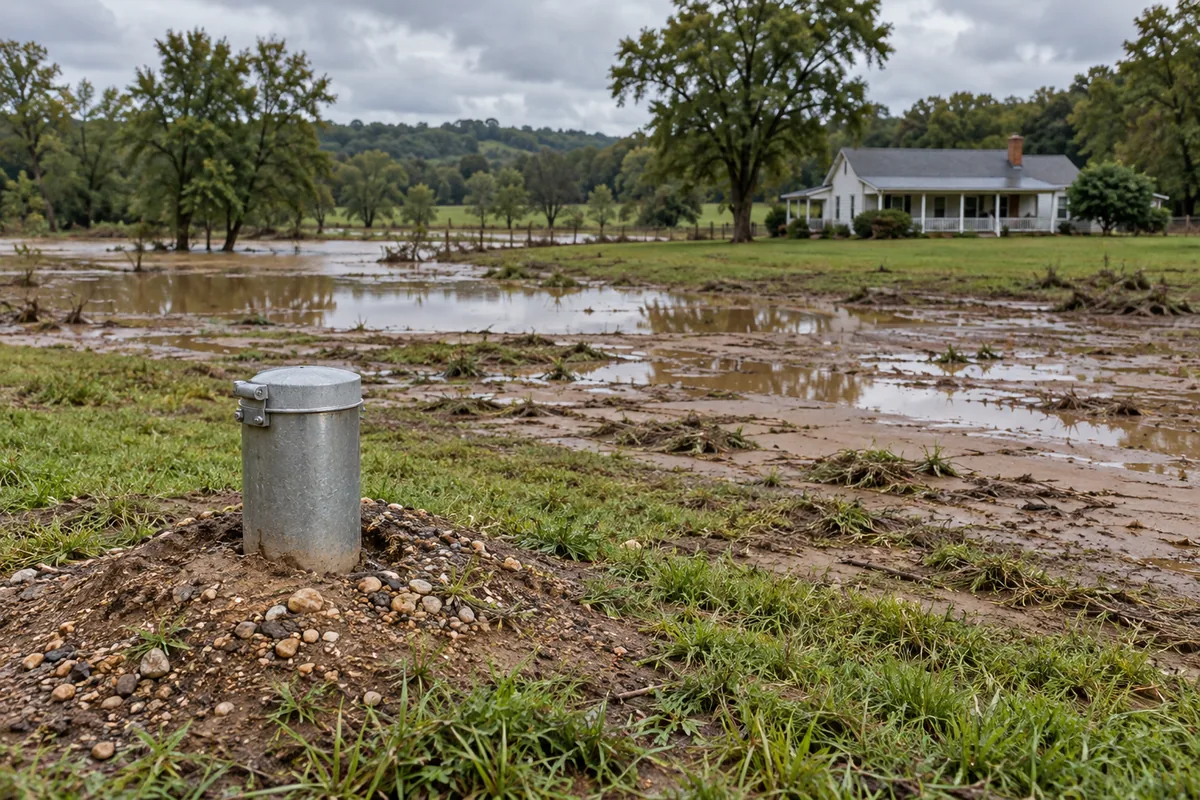
Is well water safe after flooding?
Do not assume it is safe. Use bottled water or another confirmed safe source while the well is assessed and appropriately tested. Boiling cannot make water contaminated with fuel or toxic chemicals safe. A running pump and clear water are not clearance.
The lights come back, the pump starts, and water runs from the kitchen tap. After a flood, that can feel like the moment the house is usable again. For a private well, it answers only the power question. It does not establish what is in the water or whether the well and household plumbing have been restored.
I would organize the recovery around three separate decisions: **what the household can use today, what a qualified contractor needs to inspect, and what the laboratory must test before drinking resumes.** Keeping those decisions separate prevents a working pump, a chlorine smell or one reassuring-looking glass from becoming an accidental all-clear.
This guide focuses on U.S. private domestic wells. Contact your county or state health department for the instructions that apply to your property. Outside the U.S., use the corresponding environmental-health authority and drinking-water laboratory accreditation system. A neighboring public utility's notice does not establish the condition of your own well.
What to do first with well water after flooding
If the well was flooded or may have been affected, stop using its water for drinking and food-related tasks. Arrange a safe alternative while the well is assessed. NGWA's WellOwner flood guidance advises treating a flood-affected well as unsafe for drinking until evaluation and testing establish otherwise.
Start with these practical actions:
- Use unopened commercially bottled water or another source confirmed safe for drinking, cooking, washing food, making ice and brushing teeth.
- Tell everyone who uses the property, including visitors and anyone caring for animals, that the private supply is under investigation.
- Keep away from flooded pumps, electrical controls and damaged wiring. Do not enter a well pit.
- Call the health department about contamination concerns and laboratory testing, and a qualified well or pump contractor about the physical system.
- Record what happened from a safe position. A photograph of the flood line and a date can be more useful than an uncertain description days later.
Put a temporary note beside the kitchen tap and refrigerator dispenser. Keep it brief: alternative water source, person coordinating the work, and next update. That small communication step is our organizational suggestion; it helps the whole household follow the same plan.
The wider flooded-house drying guide covers building recovery. Dry floors and safe drinking water are separate milestones. Neither should be used as a shortcut for the other.
How flooding can affect a private well
Floodwater can reach a damaged cap, an inadequately sealed opening or other vulnerable parts of a well system. Moving debris and sediment can also damage equipment. The EPA's private-well flood guide treats well inspection, disinfection and testing as linked parts of recovery.
Groundwater contamination is another concern. The wellhead does not have to look dramatic for an investigation to be justified. Report nearby wastewater releases, flooded agricultural areas, displaced fuel tanks or chemical storage, and changes to the surrounding ground. Describe observations rather than deciding which contaminant must be present.
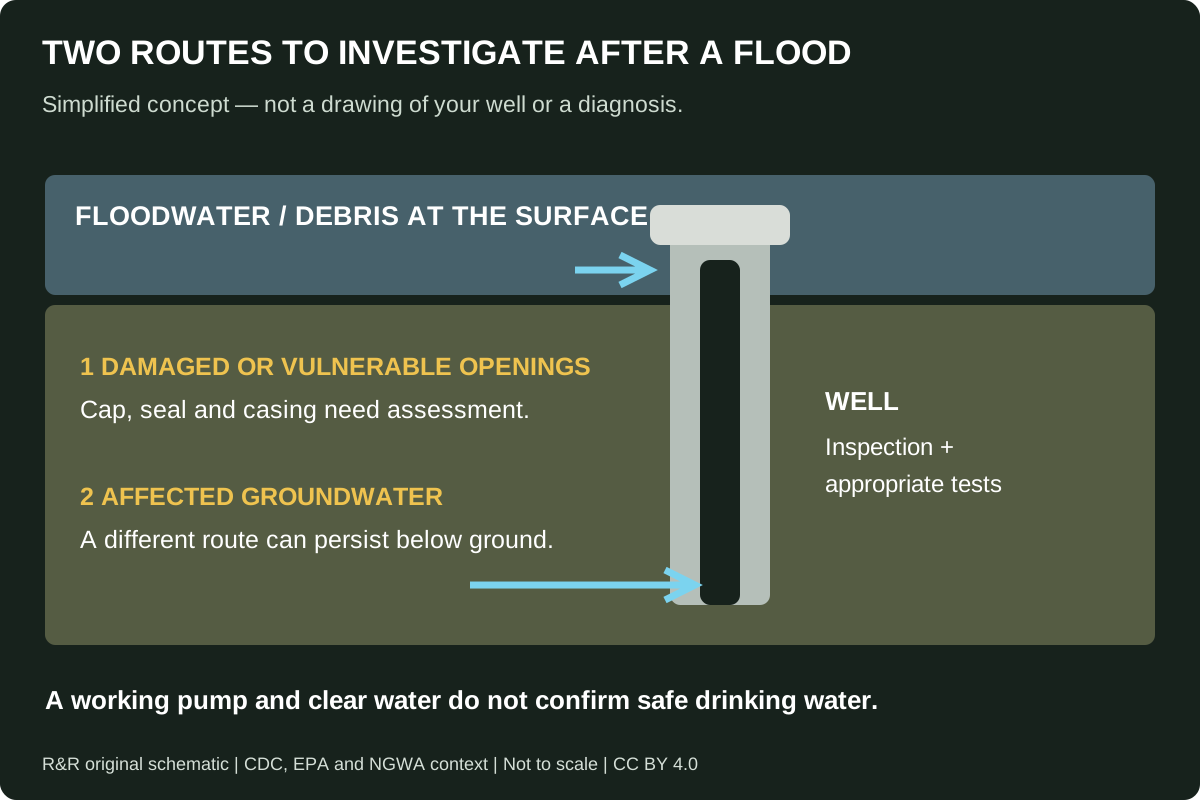
Clear water is not a safety test. A new smell, discoloration or sediment is useful information to report, but the absence of those signs does not replace appropriate sampling. Avoid tasting the water to investigate it.
If you were away during the flood, write “extent unknown.” Do not change that to “not flooded” because the yard is dry now. Ask a neighbor about observed water levels, save any relevant photographs, and give the contractor the distinction between something you saw and something you were told.
For the surrounding property, our storm surge versus flooding explainer separates coastal water, rainfall runoff and river flooding. The mechanism helps describe the incident, but it cannot tell you which laboratory tests your well requires.
Can you boil flooded well water to make it safe
**Boiling can kill germs. It does not make water contaminated with fuel or toxic chemicals safe.** When contamination is uncertain after a flood, bottled water is the clearest temporary option while your health department determines the appropriate precautions.
The CDC's emergency water guidance specifies a rolling boil for one minute, or three minutes above 6,500 feet, when boiling is an appropriate microbial treatment. That instruction is not permission to use a chemically contaminated source. It also does not inspect the well, repair the cap or demonstrate that contamination has stopped entering the system.
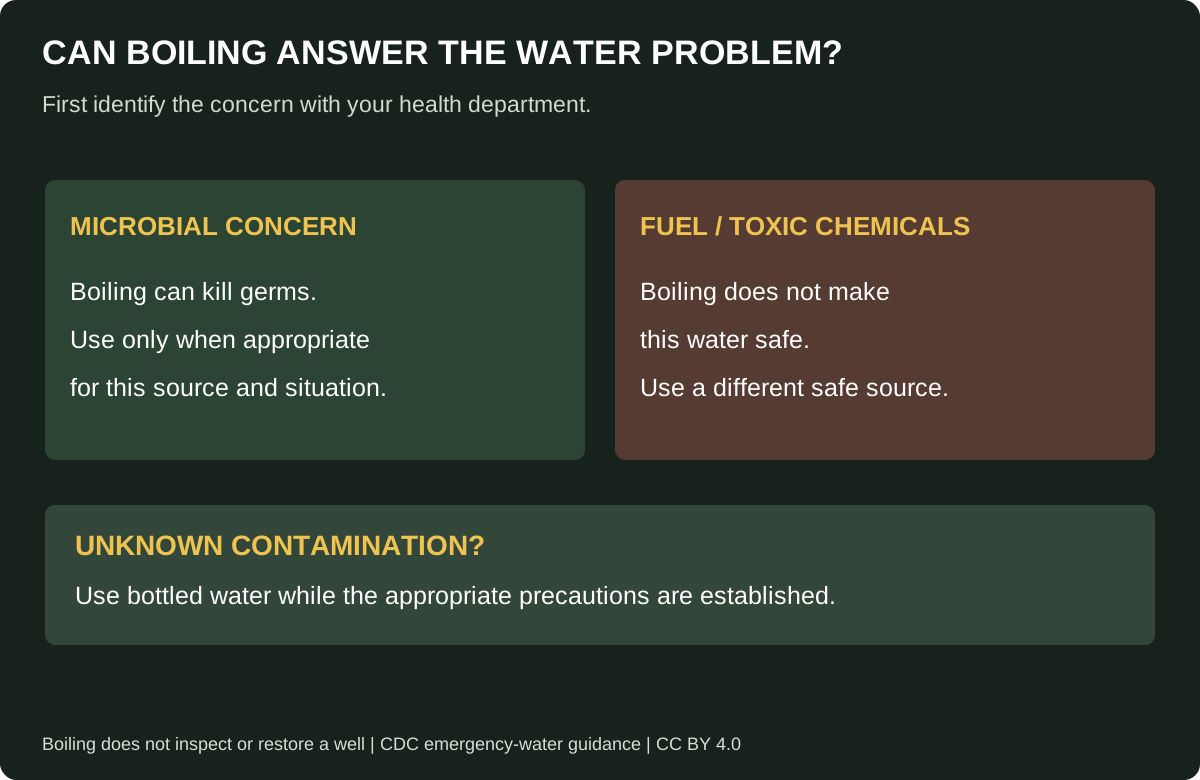
There are therefore two different questions to ask on the phone: “Is boiling appropriate for this water while we wait?” and “What must happen before we resume untreated tap-water use?” Write down both answers. A temporary microbial precaution and completion of a well-restoration process are different decisions.
A pitcher filter, camping filter or ordinary sediment cartridge also cannot be assumed to solve an unknown flood-contamination problem. Treatment has to match the contaminant. The CDC's well-water treatment guidance recommends checking that a treatment system addresses the specific germ or chemical of concern and verifying the result.
My buying priority here would be a dependable alternative water supply and the right professional assessment. Purchasing an unverified “purifier” can leave the central question unanswered while giving the household false confidence.
Is bathing or washing with flooded well water safe
Do not treat non-drinking use as automatically acceptable. NGWA advises avoiding washing with flood-affected well water, and EPA's flood-well guidance also warns about that exposure. Ask your health department specifically about bathing, handwashing, laundry, dishes and cleanup; the answer depends on the contamination and the stage of restoration.
Make a use-by-use plan instead of a single “water on” decision. In our suggested household record, give drinking and cooking one line, personal washing another, and sanitation a third. Record the authority's instruction beside each. Leave the line unresolved until there is an answer.
For toilets, first establish whether your wastewater system can accept water. A flooded or malfunctioning septic system creates a separate problem, even if you have clean water available for flushing. See whether toilets work during a power outage and the no-running-water flushing guide for the distinctions. Neither guide overrides a no-use instruction for the sewer or septic system.
Who to call and what information to have ready
Start with the county environmental-health or state private-well program. Ask for the current flood-specific instructions and a laboratory that handles private drinking-water samples. A well contractor addresses the physical installation; a laboratory analyzes the submitted sample; the health department helps interpret the required precautions. Arrange those roles rather than expecting one retail test kit to cover them all.
| Contact | Useful question | Record to request |
|---|---|---|
| County / state health department | Which uses and tests fit this flood? | Current precautions and result interpretation |
| Well / pump contractor | What damage and restoration work need assessment? | Inspection, repairs and disinfection record |
| State-certified laboratory | Which bottles, sample point and delivery method? | Test panel, collection instructions and written report |
Prepare one page containing the property location, well identification or construction record if available, the approximate flood dates, and the highest water level you can document. Add the last known normal operation, equipment that was submerged, repairs already performed, and any treatment equipment connected to the supply.
Write down unknowns rather than delaying the call to find every document. A missing well depth is useful for the contractor to know. Guessing a depth and presenting it as a record can send the investigation in the wrong direction.
Ask these questions:
- Which household uses should stop now, and which alternative water sources are appropriate?
- Does this property need a physical or electrical inspection before the pump operates?
- Which bacterial and chemical tests fit the flood history and nearby sources?
- Who supplies the bottles, collects the sample and transports it?
- What treatment and sampling sequence should we follow, and who will interpret the results?
- What follow-up is required if the first sample passes or fails?
These are suggested handover questions, not a substitute inspection checklist. Use the answers to assign the next call, appointment or sample delivery to a named person.
Testing well water after a flood
A useful test begins with a defined question. “Test everything” is not a practical specification; “test only what this strip measures” is not a contamination assessment. Describe the flood and let the health department and certified laboratory identify the appropriate panel.
| Question | Discuss with the laboratory / health department | What it does not settle |
|---|---|---|
| Could fecal contamination have entered? | Total coliform and appropriate fecal-indicator testing | Untested fuel, pesticide or other chemicals |
| Could local runoff or a spill affect the well? | Nitrate and specific chemical analyses based on the incident | A generic strip does not answer every chemical question |
| Did the restoration achieve the intended result? | Sampling after the agreed treatment and flushing sequence | A sample collected at the wrong stage may be unsuitable |
| Can we resume use? | Interpret the complete report and remaining restrictions | One result is not a promise against later contamination |
CDC recommends a state-certified laboratory and additional testing when flooding, repairs or other problems could affect a well. Its routine annual baseline includes total coliform bacteria, nitrate, total dissolved solids and pH. Flood-specific testing and local chemical concerns may require more.
Total coliform results are indicators of water-system contamination; fecal indicators such as E. coli prompt a different concern from an aesthetic change alone. A bacterial result does not answer every possible chemical question. Ask the laboratory to identify exactly what was analyzed and the meaning of each result.
For U.S. households, EPA's laboratory certification directory links to state programs. Confirm that the laboratory performs the particular drinking-water analyses you need. EPA does not test individual residential water samples on request.
Keep the written report, not just a phone message saying it “passed.” Record the sample point, collection date, tests requested, laboratory and any treatment operating at the time. Those details make a later result comparable and give the contractor something concrete to work with.
When should a flooded well be sampled
There is no universal number of days after a flood that makes every well safe. Physical damage, continuing contamination, disinfection, chlorine removal and laboratory requirements all affect the sequence.
The CDC's emergency well-disinfection guidance describes waiting at least seven to ten days after disinfection before testing and ensuring chlorine has been flushed. It also describes follow-up testing two to four weeks later and again at three to four months. Use your local program's instructions for the actual schedule; these intervals are not an automatic clearance date.
Before a sampling visit, confirm the specific collection point, required bottles, handling and delivery deadline with the laboratory. Do not substitute a washed drink bottle for a supplied sample container. Do not open sterile containers early, rinse them or change their contents unless the laboratory directs you to do so.
New York's restoration and testing guidance emphasizes following the sampling instructions and using alternative water until results establish safe drinking water. If a sample is rejected or collected incorrectly, record that as an incomplete step. A rejected sample is not a negative result.
Why shock chlorination is not the whole repair
Well disinfection addresses a microbial problem within a broader restoration process. It does not straighten damaged casing, repair submerged wiring or remove every chemical contaminant. If the entry route remains open, a successful treatment can be followed by renewed contamination.
Use a qualified well or pump contractor for the inspection and disinfection plan. There is no single bleach dose appropriate for every installation: well type, dimensions, water volume, connected plumbing and treatment equipment matter. A generic gallon-of-bleach recipe is not the level of precision a damaged household water system deserves.
Ask the contractor to explain the sequence in ordinary terms: what was inspected, what needed repair, what was disinfected, how the system was flushed, and when it becomes ready for the agreed sample. Request instructions for filters, softeners and other connected equipment. Do not improvise bypasses or mix cleaning chemicals.
Minnesota's flooded-well guidance includes the plumbing system in restoration and directs owners to consult their treatment-equipment dealer where appropriate. A fresh cartridge by itself does not document that the rest of the installation was addressed.
A safe-water plan while the well is out of service
Count the people using the house and the days until the next realistic supply delivery. Add visitors or caregivers who are actually there. Then separately list pets, medical needs and any other use that changes your requirements. A theoretical reserve in a shopping cart is not water available in the kitchen.
CDC recommends at least one gallon per person per day for three days and, where possible, a two-week supply. That is a planning baseline, not a full allowance for normal baths, laundry and a rural property's animals. The emergency water storage guide helps organize containers and rotation even when space is limited.
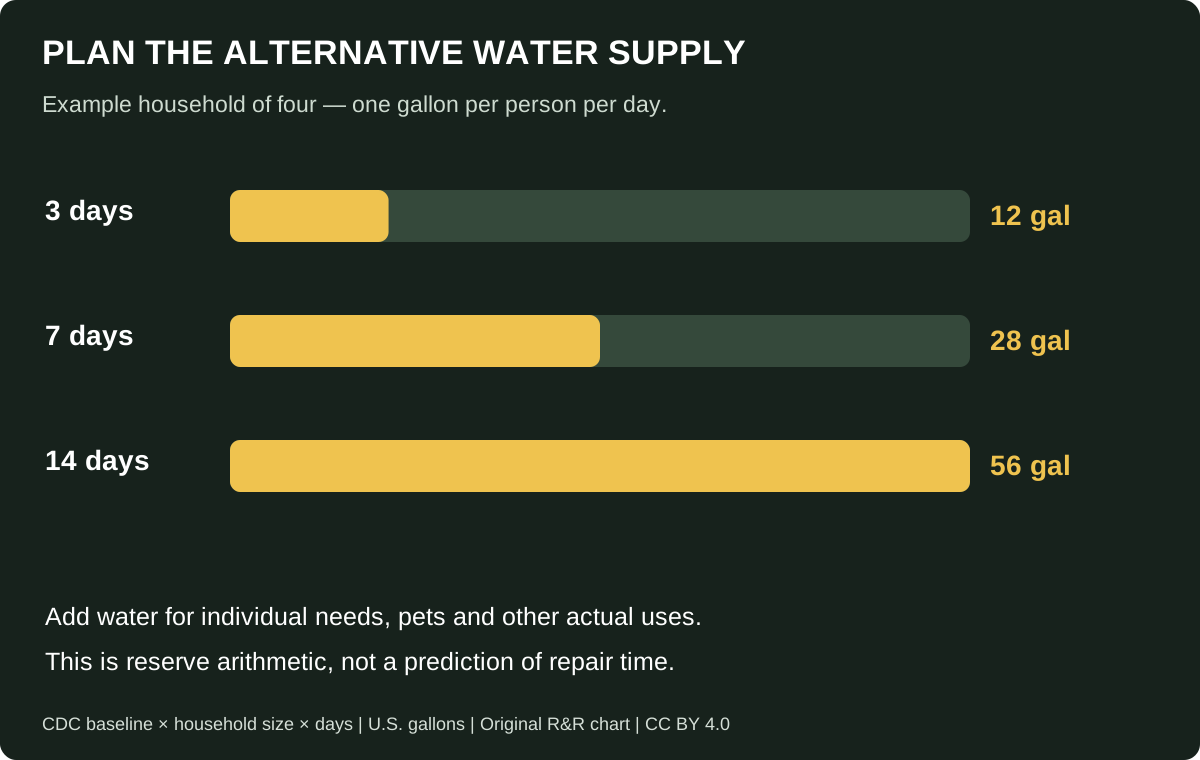
For four people, the baseline arithmetic is 4 × 1 × 3 = **12 gallons for three days**, or **56 gallons for fourteen days**. The graph uses that published baseline; it does not predict well repair time or water consumption at your property.
Choose containers intended for drinking-water storage, fill them only from a safe source and keep clean water separate from cleanup supplies. Do not reuse a container that held pesticides, fuel or other toxic substances. The CDC's emergency water-supply guidance explains container selection and storage.
What to do if the well fails its next test
Keep the alternative water arrangement in place and ask what the specific result changes. A second disinfection may be part of the response to bacterial contamination, but recurring failure also warrants investigation of the underlying route. Chemical findings require their own assessment and treatment decisions.
Do not alternate between “unsafe” and “safe” based on whether the water looks clear that morning. Keep a dated status note and give the household an update after each actual decision. If there is no new decision, say the previous precautions still apply.
Save each report in sequence. In our suggested recovery record, use a separate row for every sample rather than overwriting the last result. A contractor should be able to see which repair happened before which test and whether the sample was taken before or after treatment.
EPA's flood guidance warns that contamination can persist or recur after an initial reassuring result. That is why a follow-up plan belongs in the handover, along with the laboratory report. It is also why no article can promise a fixed recovery date from the flood date alone.
Reopening the household water system
Before resuming normal use, get the applicable result interpretation and return-to-use instructions. Establish which tests were satisfactory, whether any restrictions remain, and how connected appliances should be handled. Keep the contractor's work record with the laboratory reports.
Our after a boil-water advisory is lifted guide discusses faucets, refrigerator filters and ice makers. A private well needs its own clearance and equipment instructions before those household tasks begin. A public utility announcing restored service does not clear a separate private supply.
Food also needs its own review. Use the power-outage food-safety guide if refrigeration was interrupted, and do not assume food exposed to floodwater becomes safe when the well does. If there was wastewater in the building, the sewage-backup guide addresses that separate recovery path.
Build a better well record before the next storm
Make the next handover easier while the information is fresh. Keep the well construction record, equipment models, service contact, laboratory reports and repair dates together. Add a simple map showing the wellhead and water-system components without putting sensitive household details in a public document.
Ask the contractor whether drainage, cap condition, casing height or another site-specific improvement should be assessed. Let the professional apply local construction rules. Do not raise, seal or modify the installation from a generic online diagram.
For the wider property, use El Niño home preparedness, regional flooding context and the basement-water source guide to organize separate questions. A sump installation manages a specific drainage route; it does not certify the well. If backup power is also a concern, the sump-pump outage guide explains why equipment and power dependencies deserve their own check.
Common questions about flooded well water
My well was not underwater but the surrounding land flooded. Should I test it
Describe the flood extent to your local health department and ask about testing. A well does not need obvious visible damage to justify concern. Do not treat a universal distance from floodwater as a guarantee of safety.
The pump runs and the water is clear. Can we drink it
Pump operation and appearance do not establish drinking-water quality. Continue the agreed alternative supply until the assessment, appropriate testing and interpretation support return to use.
Will a home test strip prove the water is safe
Only the parameters actually measured are answered by a test. A strip or dissolved-solids meter does not provide a complete bacterial and chemical assessment. Arrange the laboratory tests selected for your circumstances.
Can I boil water that smells like gasoline
No. Use a different safe source and contact your health department. Boiling does not make fuel-contaminated water safe, and smell is not a reliable way to rule out other contaminants.
Does a negative bacteria test mean there are no chemicals
No. Read the test panel: a bacterial analysis does not establish the absence of chemicals that were not analyzed. Ask how the flood history affects any additional testing.
How long will we need bottled water
Plan around the inspection, repair, treatment and laboratory schedule. Keep enough supply for delays and repeat testing. No fixed number of days after flooding establishes safety for every private well.
Where should we start today
Secure safe drinking water, communicate the temporary restrictions, and make the health-department and well-contractor calls. Use the 72-hour household guide and water shut-off planning guide to keep daily household needs organized while the well's condition is resolved.
Research and original visual resources
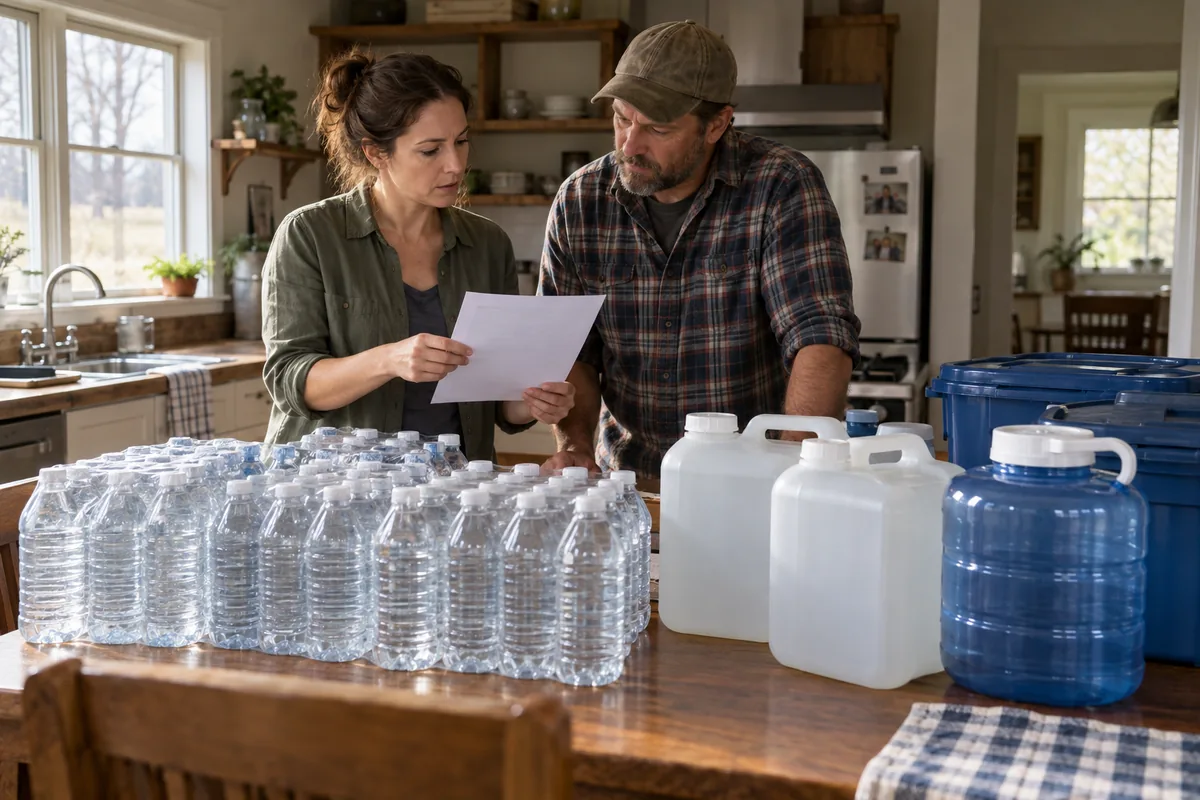
Prepared by Ready & Resourceful on October 21, 2026 from CDC, EPA, state health-department and National Ground Water Association guidance linked throughout. This household explanation does not claim an inspection, professional water-quality review, interviews or product tests. State instructions and the laboratory plan determine the work at a particular well. The two photos are fictional household scenes, not records of an actual flood.
The three original SVG diagrams may be reused with attribution to Ready & Resourceful under CC BY 4.0; photographs and product images are excluded. Keep the cautions with each diagram. Editorial standards and corrections.